
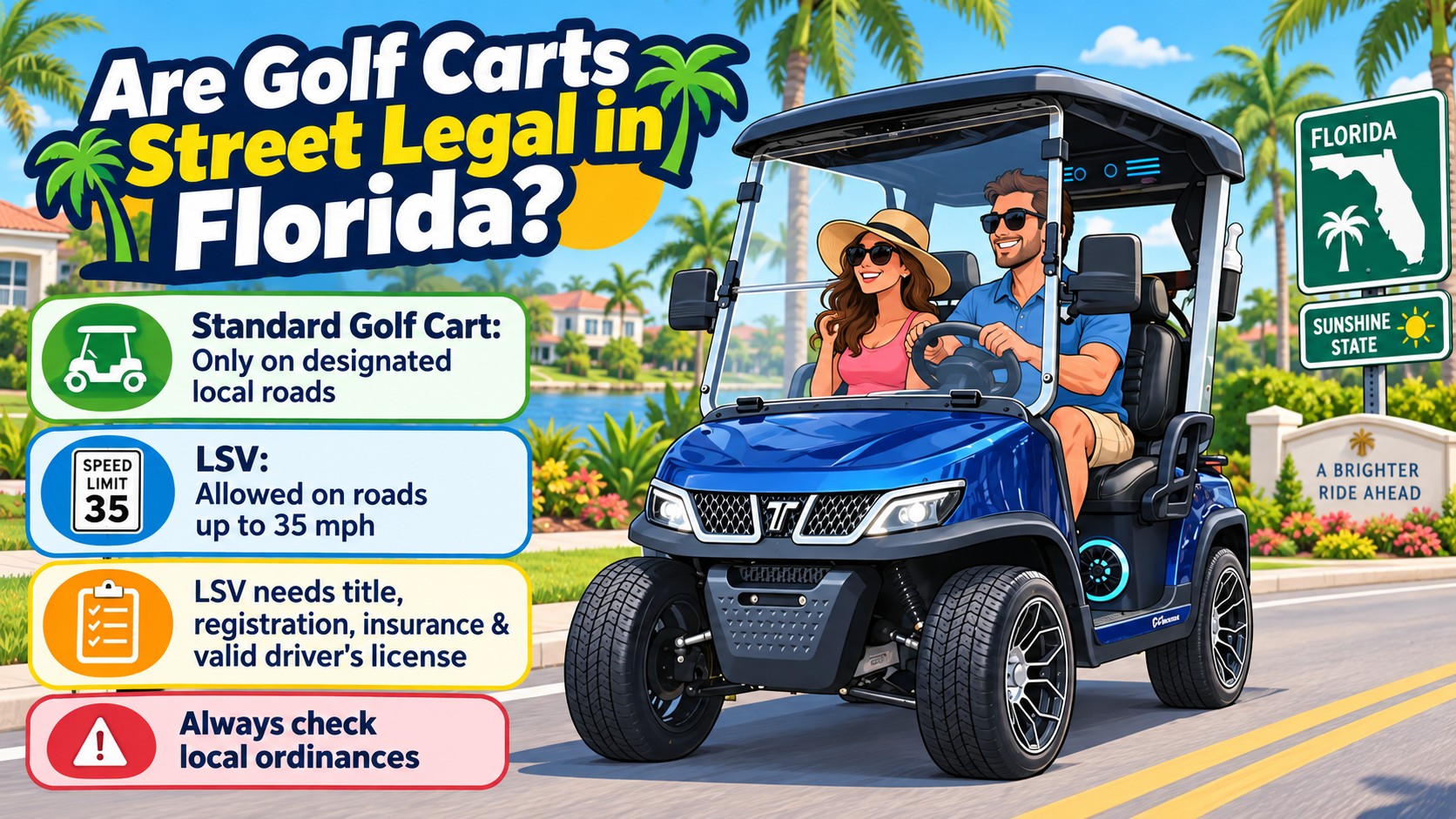
Standard golf carts may operate on public roads specifically designated for golf cart use by the appropriate county, municipality, or water control district. A qualifying low-speed vehicle can generally operate on streets with posted speed limits of 35 mph or less, but it must meet additional equipment, registration, title, insurance, and driver-license requirements.
Florida is one of the most golf-cart-friendly states in the country, but that does not mean every golf cart can legally travel on every neighborhood street. Florida law distinguishes between a standard golf cart and a low-speed vehicle, or LSV. Understanding that difference is important before taking Tara golf carts or other electric vehicles onto public roads.
Can You Drive a Golf Cart on Public Roads in Florida?
Yes, but standard golf carts have more limited road access than registered motor vehicles.
Under Florida Statute 316.212, a standard golf cart may generally be operated on a county road, municipal street, certain two-lane county roads within a municipality, or roads maintained by a water control district only when the responsible governmental authority has designated that roadway for golf cart use.
Therefore, the common statement that golf carts are automatically allowed on every road with a speed limit of 30 mph or less is not accurate. Local designation and local ordinances matter.
Cities and counties may also adopt rules that are more restrictive than statewide requirements, so owners should always check local regulations before driving.
Florida Rules for Standard Golf Carts
| Requirement | Standard Golf Cart Rule |
|---|---|
| Vehicle Speed | A Florida golf cart is generally defined as a golf-course vehicle that is not capable of exceeding 20 mph. |
| Road Access | Normally limited to roads specifically designated for golf cart operation by the responsible local authority. |
| Driver Under 18 | Must possess a valid learner’s driver license or valid driver license. |
| Driver 18 or Older | Must possess valid government-issued photographic identification. |
| Operating Hours | Generally sunrise to sunset unless nighttime operation is authorized locally and the cart has the required lighting and windshield. |
| Registration | Standard golf carts operated under Florida golf cart rules are generally exempt from state motor-vehicle registration requirements. |
| Title | A standard golf cart operating as a golf cart is generally not titled like an LSV. |
| Insurance | State motor-vehicle insurance requirements that apply to registered LSVs do not automatically apply to a standard golf cart, although coverage is strongly worth considering. |
What Equipment Does a Florida Golf Cart Need?
Florida requires a standard golf cart used on authorized public roads to have basic safety equipment. This includes:
- Efficient brakes
- Reliable steering equipment
- Safe tires
- A rearview mirror
- Red reflectorized warning devices on the front and rear
For authorized operation between sunset and sunrise, additional equipment is required. The vehicle generally needs headlights, brake lights, turn signals, and a windshield.
Never assume a residential street allows golf carts simply because its speed limit is low. Look for local signs and check city or county ordinances before entering a public roadway.
What Is the Difference Between a Golf Cart and an LSV in Florida?
The distinction is especially important when people use the phrase “street legal golf cart.”
Florida defines a standard golf cart as a vehicle designed and manufactured for golf-course sporting or recreational use that cannot exceed 20 mph. A low-speed vehicle is generally a four-wheeled vehicle with a top speed greater than 20 mph but no more than 25 mph and must comply with additional federal and Florida safety requirements.
| Feature | Standard Golf Cart | Low-Speed Vehicle |
|---|---|---|
| Top Speed Classification | 20 mph or less | Greater than 20 mph and up to 25 mph |
| Road Access | Designated golf cart roads | Generally roads posted at 35 mph or less |
| Title Required | Generally no | Yes |
| Registration Required | Generally no | Yes |
| Insurance Required | Generally not under LSV registration rules | Yes |
| Valid Driver License | Rules depend on operator age | Yes |
Do You Need Insurance for a Street-Legal Golf Cart in Florida?
It depends on how the vehicle is legally classified.
A standard golf cart operated under Florida’s golf cart rules is generally exempt from the motor-vehicle registration requirements that apply to regular automobiles. Florida does not impose the same statewide LSV insurance requirement on these standard golf carts, although owners may still want liability or golf cart insurance for financial protection.
The situation changes when the vehicle qualifies and is registered as a low-speed vehicle.
Florida requires LSVs to be titled, registered, and insured. According to the Florida Department of Highway Safety and Motor Vehicles, an LSV must maintain at least $10,000 in Personal Injury Protection and $10,000 in Property Damage Liability coverage.
If your vehicle is titled and registered in Florida as an LSV, insurance is required. A standard golf cart and a registered LSV may look similar, but their legal requirements are different.
Where Can an LSV Be Driven in Florida?
A properly registered and equipped LSV may generally be operated on streets where the posted speed limit is 35 mph or less.
Florida law also permits an LSV to cross a roadway with a speed limit above 35 mph at an intersection. However, local governments and the Florida Department of Transportation can restrict LSV operation on certain roads when necessary for safety.
Required LSV equipment includes headlamps, stop lamps, turn signals, taillamps, reflectors, a parking brake, rearview mirrors, windshield, seat belts, and a vehicle identification number.
Are Tara Golf Carts Street Legal in Florida?
Whether a Tara vehicle can legally operate on Florida public roads depends on the exact model, configuration, certification, documentation, and how the vehicle is registered.
Tara offers personal transportation models such as the Roadster 2, Roadster 2+2, and Explorer 2+2. These models include many features useful for neighborhood transportation, including LED lighting, turn signals, braking systems, lithium batteries, and passenger-oriented designs.
However, equipment alone does not automatically make a particular vehicle legal for unrestricted public-road use in Florida.
A Tara vehicle intended to be registered as an LSV must meet the applicable Florida and federal requirements, have the appropriate manufacturer documentation and VIN, and successfully complete Florida title, registration, and insurance requirements.
Tara’s published specifications may also vary by configuration and market. Buyers who intend to use a vehicle on Florida public roads should confirm the exact vehicle specification and certification with the dealer before purchasing.
What Should You Check Before Buying a Tara Vehicle for Florida Road Use?
- Confirm whether the exact vehicle is sold as a standard golf cart or qualifying LSV configuration.
- Ask whether the vehicle has the required VIN and manufacturer documentation.
- Verify its certified maximum speed classification.
- Check that all required road-safety equipment is installed.
- Confirm Florida title and registration eligibility.
- Arrange the required insurance if registering it as an LSV.
- Check local city and county road restrictions.
- Confirm which nearby streets permit the vehicle before regular use.
Can You Drive a Golf Cart at Night in Florida?
A standard golf cart is normally limited to operation between sunrise and sunset. However, a local governmental authority can authorize nighttime operation.
When nighttime operation is permitted, the golf cart must have headlights, brake lights, turn signals, and a windshield. Local governments can establish additional requirements, so the rules may vary considerably between Florida communities.
Do You Need a Driver’s License to Drive a Golf Cart in Florida?
For a standard golf cart on a public road, Florida law requires an operator under 18 to possess a valid learner’s driver license or driver’s license. A person age 18 or older must possess valid government-issued photographic identification.
An LSV has stricter requirements. Anyone operating an LSV on Florida public roads must possess a valid driver’s license.
Conclusion
So, are golf carts street legal in Florida? They can legally use certain public roads, but the answer depends on vehicle classification and local regulations.
Standard golf carts are generally limited to roads specifically designated for golf cart use and are normally restricted to daytime operation unless local authorities permit otherwise. Properly equipped and registered LSVs can generally operate on roads with posted speed limits of 35 mph or less, but they require a title, registration, insurance, and a licensed driver.
If you are considering Tara golf carts such as the Roadster 2, Roadster 2+2, or Explorer 2+2 for neighborhood transportation in Florida, confirm the exact vehicle configuration, certification, registration eligibility, insurance requirements, and local road rules before driving on public streets.
