
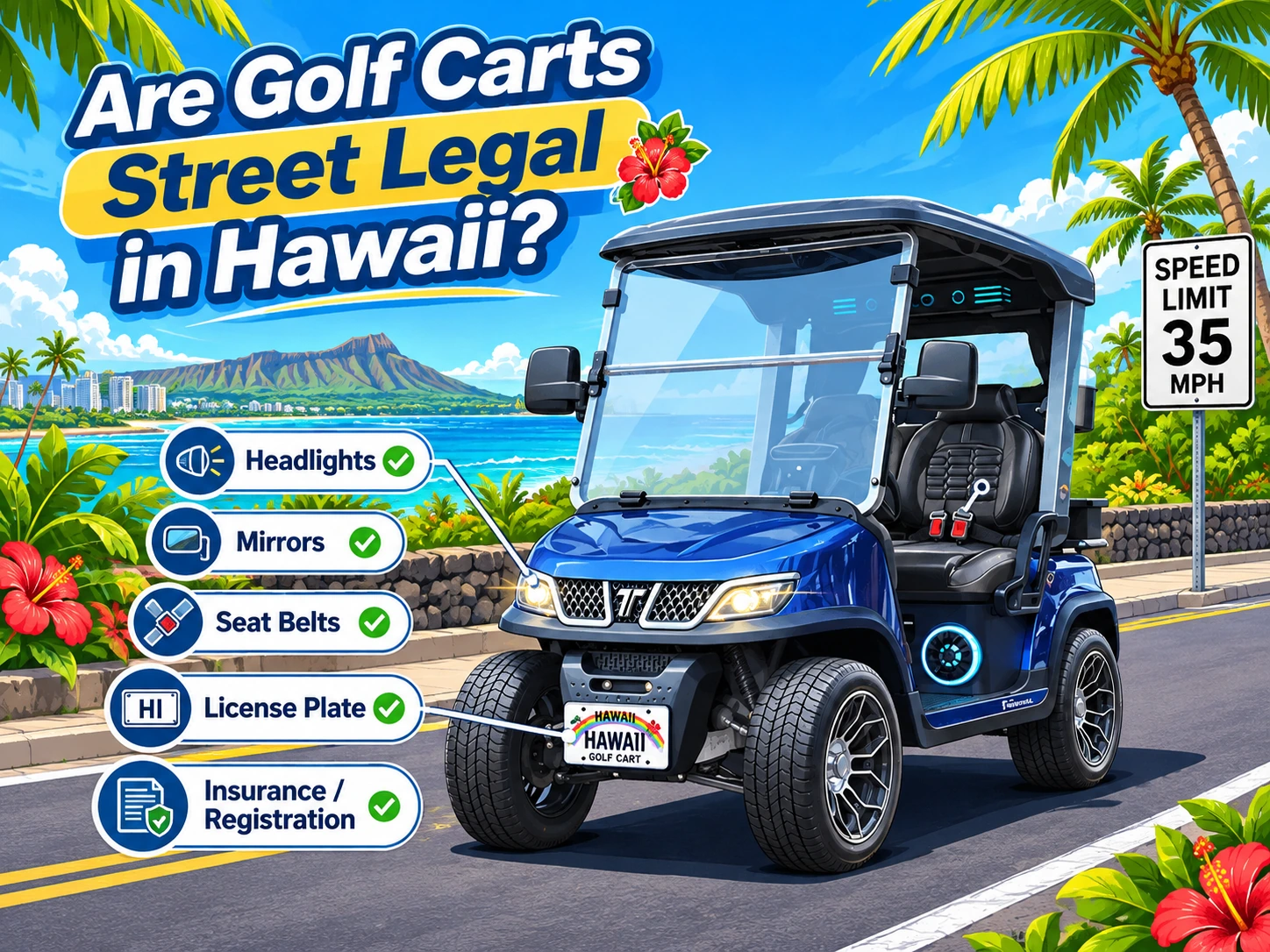
The answer depends on the type of vehicle. A standard golf cart designed primarily for golf-course or private-property use should not be treated as a street-legal motor vehicle simply because it is electric or equipped with headlights.
Hawaii recognizes a separate category called a Neighborhood Electric Vehicle, or NEV. This category is closely related to the federal Low-Speed Vehicle, or LSV, classification.
A qualifying NEV can operate on certain public roads when it meets Hawaii’s vehicle requirements and federal safety standards.
This distinction is important for owners of Tara golf carts and other electric carts because street legality depends on the certification of the actual vehicle, not merely its appearance or available accessories.
| Feature | Standard Golf Cart | LSV / Neighborhood Electric Vehicle |
|---|---|---|
| Public-Road Use | Generally intended for courses and private property | Can operate on qualifying public roads |
| Maximum Vehicle Speed | Typically below 20 mph | Designed and operated at 25 mph or less |
| Road Speed Limit | Not automatically authorized for public roads | Generally limited to roads posted at 35 mph or less |
| Federal Safety Standard | Not necessarily FMVSS 500 compliant | Must meet applicable FMVSS No. 500 requirements |
| VIN / Identification | May not have road-vehicle certification | Must have appropriate vehicle identification and certification |
| Registration | Not normally registered as a street vehicle | Registration is required for public-road use |
| Insurance | Not sufficient for normal street operation | Appropriate motor vehicle insurance is required |
| Driver | Private-property rules may vary | Must meet applicable Hawaii driver-license requirements |
Hawaii law defines a Neighborhood Electric Vehicle as an emission-free, four-wheeled electric motor vehicle designed and operated at speeds of 25 mph or less, with a gross vehicle weight rating below 3,000 pounds.
Most importantly, the vehicle must comply with the minimum safety-equipment requirements of Federal Motor Vehicle Safety Standard No. 500.
A federally compliant LSV generally includes equipment such as:
Hawaii places clear speed restrictions on Neighborhood Electric Vehicles.
An NEV cannot be operated faster than 25 mph. It also cannot normally be driven on a highway with a posted speed limit greater than 35 mph.
This makes LSVs best suited to residential streets, resort communities, planned developments, local commercial districts, and other lower-speed areas.
Yes. Hawaii law allows a Neighborhood Electric Vehicle to cross a roadway with a speed limit greater than 35 mph at an intersection.
That exception does not mean the NEV can continue traveling along the higher-speed roadway.
Standard golf carts should not be driven on Hawaii’s major public highways simply because they can physically reach the road.
Even a properly registered Neighborhood Electric Vehicle is restricted from roads with posted speed limits above 35 mph, except for permitted crossings.
As a result, interstate-style highways and other high-speed arterial routes are not appropriate for LSV operation.
A qualifying NEV used on public roads is treated as a motor vehicle for registration purposes.
Hawaii motor vehicles are registered through the county in which they are operated. Registration and title procedures may therefore be administered through the relevant county agency.
The vehicle may also need to pass Hawaii’s periodic motor vehicle safety inspection process.
For initial registration of a Neighborhood Electric Vehicle, Hawaii law also requires certification that the operational-restriction notice required by law is permanently displayed where the driver can see it.
Yes. A street-operated NEV should have the insurance documentation required for motor vehicles in Hawaii.
Hawaii’s safety-inspection process requires applicable proof of motor vehicle insurance before an inspection certificate can be issued.
Owners should confirm coverage with an insurer before attempting to register or operate an LSV on public streets.
Unlike some states that impose a blanket daylight-only rule on golf carts, Hawaii’s NEV rules focus on whether the vehicle qualifies as a motor vehicle and has the required equipment.
A properly registered NEV with compliant lighting can therefore be treated differently from a basic golf cart with no road certification.
Drivers should still follow all applicable lighting, visibility, traffic, and local county requirements when operating after dark.
Yes. Operating an unregistered or otherwise noncompliant vehicle on public roads can lead to traffic enforcement.
The exact citation or enforcement action depends on the violation and local circumstances, but owners should not assume that a neighborhood or resort setting makes an unregistered golf cart exempt from Hawaii motor vehicle laws.
Tara offers several road-oriented electric models that may be relevant for buyers looking for an LSV-style vehicle in Hawaii.
However, the street legality of any specific Tara vehicle depends on whether that exact unit has the required federal certification, vehicle identification, documentation, registration, inspection, and insurance.
The Roadster 2 is a two-passenger lithium-powered electric vehicle designed for use beyond traditional golf-course environments. Tara lists road-oriented equipment and versions capable of approximately 25 mph.
For Hawaii public-road use, buyers should confirm that the exact vehicle is certified as an LSV or NEV rather than assuming that its maximum speed and equipment alone establish legality.
The Roadster 2+2 provides four-passenger seating and road-oriented features such as lighting, turn signals, mirrors, braking systems, and lithium power.
Tara documentation has listed 25-mph configurations, although product specifications can vary by version and market. Confirm the current model’s certification documents before registration in Hawaii.
The Explorer 2+2 is a four-passenger electric model with lithium power, LED lighting, mirrors, turn signals, and a road-oriented design.
Its current public specifications include versions with maximum speeds around 25 mph, placing it within the performance range commonly associated with LSVs.
The terms “golf cart” and “street-legal golf cart” are often used interchangeably in advertising and everyday conversation, but legally they can describe very different vehicles.
A traditional golf cart is primarily designed for golf courses, private communities, resorts, campuses, and similar controlled environments.
An LSV or NEV is designed to meet road-vehicle safety standards and operate within a specific low-speed road environment.
Understanding this distinction helps owners avoid buying a vehicle that looks street-ready but cannot be legally registered.
Standard golf carts are generally not street legal on Hawaii public roads. Electric carts that qualify as federally compliant Low-Speed Vehicles or Hawaii Neighborhood Electric Vehicles can be operated on qualifying roads after meeting registration, inspection, insurance, and safety requirements. Hawaii limits NEVs to a maximum operating speed of 25 mph and generally restricts them to roads posted at 35 mph or less. Road-oriented Tara golf carts, including Roadster 2, Roadster 2+2, and Explorer 2+2, may be suitable for this type of use, but owners should verify the exact vehicle’s federal certification and Hawaii registration eligibility before driving on public streets.
