
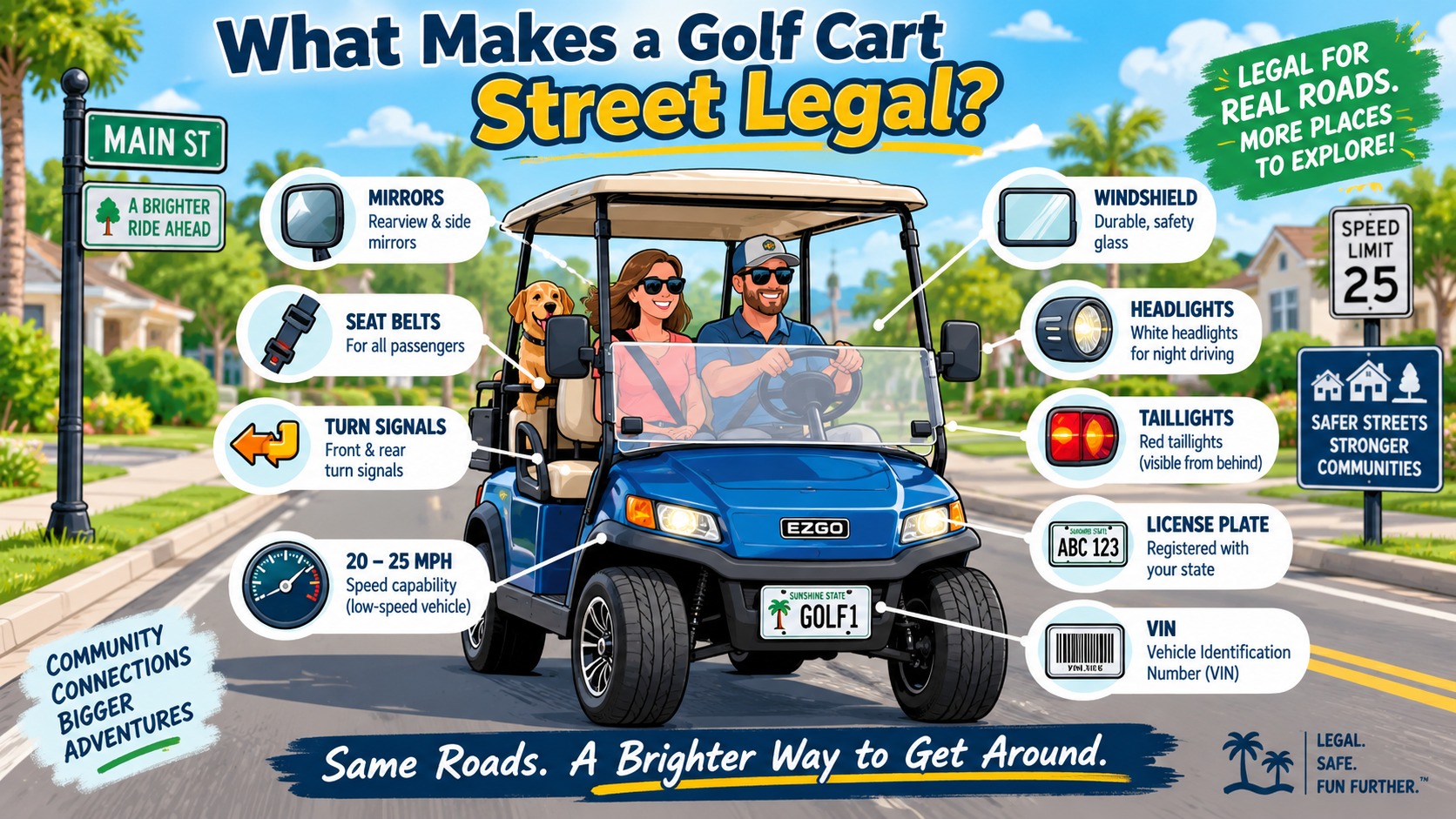
A road-going golf-cart-style vehicle generally needs to qualify as an LSV: four wheels, a maximum attainable speed above 20 mph but no more than 25 mph, a GVWR below 3,000 lb, required FMVSS No. 500 safety equipment, a VIN, and appropriate state title, registration, insurance, and licensing where required.
A regular golf cart is primarily intended for golf courses, resorts, and private property. For broader public-road use, the vehicle generally needs to qualify as a Low-Speed Vehicle, or LSV, under federal standards and satisfy state registration requirements. This involves more than simply adding headlights. Speed capability, vehicle weight, safety equipment, VIN identification, insurance, and local road rules all matter. Tara Electric Vehicles offers purpose-built LSV models for buyers who want factory-designed low-speed transportation for permitted public-road environments.
What Is the Difference Between a Golf Cart and an LSV?
The terms are often used interchangeably in casual conversation, but legally they describe different types of vehicles.
A traditional golf cart is designed mainly for golf-course and private-property transportation. An LSV is a motor vehicle that meets a federal definition and applicable federal safety requirements.
| Feature | Standard Golf Cart | LSV |
|---|---|---|
| Primary Use | Golf courses and private property | Permitted public-road and community transportation |
| Typical Speed | Often around 13–15 mph | More than 20 mph and no more than 25 mph |
| VIN | May use only a manufacturer serial number | Motor-vehicle VIN required |
| Federal Safety Equipment | May vary | Must meet applicable LSV requirements |
| Registration | Usually unnecessary for golf-course use | Generally required for road operation |
Speed and Weight Limits
Federal regulations define an LSV as a four-wheeled motor vehicle that can attain a speed of more than 20 mph but no more than 25 mph on a paved, level surface. Current federal guidance also places the GVWR below 3,000 pounds.
These limits distinguish LSVs from both conventional golf carts and full-speed passenger vehicles.
| Federal LSV Characteristic | Requirement |
|---|---|
| Number of Wheels | Four |
| Minimum Speed Threshold | More than 20 mph |
| Maximum Speed | 25 mph |
| GVWR | Less than 3,000 lb |
Required Safety Equipment
Speed alone does not make a golf cart suitable for public-road registration. FMVSS No. 500 establishes specific equipment requirements for LSVs.
A properly equipped LSV generally includes:
- Headlamps
- Front and rear turn signals
- Taillamps
- Brake lights
- Red reflex reflectors
- Driver-side exterior mirror
- Additional passenger-side exterior or interior mirror
- Parking brake
- Compliant windshield glazing
- Seat belts at designated seating positions
- Vehicle Identification Number
Many modern LSVs also include a horn and additional convenience or visibility features.
Adding headlights, mirrors, and seat belts to an ordinary golf cart does not automatically change its legal classification. The complete vehicle must meet applicable certification, identification, and state registration requirements.
Why a VIN Matters
A motor-vehicle VIN links the vehicle to its manufacturer, ownership documents, insurance, title, and registration records.
A standard golf cart may only have a manufacturer serial number used for parts and production identification. That serial number should not automatically be treated as the same thing as a road-vehicle VIN.
When buying a vehicle for public-road use, check that the VIN appears consistently on:
- The vehicle identification label
- Manufacturer documentation
- Title paperwork
- Registration documents
- Insurance records
Do You Need a Title and License Plate?
Generally, yes for an LSV used on public roads.
State motor-vehicle agencies typically require the owner to complete a title and registration process before the vehicle can be legally operated on permitted streets.
The process may include:
- Providing the manufacturer’s ownership documentation.
- Submitting the VIN.
- Applying for a title.
- Obtaining liability insurance.
- Paying registration and title fees.
- Receiving a license plate.
Requirements vary by state, so buyers should confirm the exact process before purchasing.
Do You Need Insurance?
LSVs used on public roads commonly require liability insurance, much like other registered motor vehicles.
Minimum coverage amounts vary by state. Some insurers may list LSVs separately from conventional automobiles, so owners should clearly identify the vehicle type when requesting a policy.
Do You Need a Driver’s License?
A valid driver’s license is generally required for operating an LSV on public roads.
The driver is also expected to follow normal traffic laws, including:
- Stop signs
- Traffic lights
- Lane markings
- Right-of-way rules
- Speed limits
- Passenger-restraint rules
Can an Ordinary Golf Cart Be Converted?
Some golf carts can be modified, but converting one into a registrable LSV involves more than adding accessories.
Potential changes may include:
- Upgraded lighting
- Turn signals
- Mirrors
- Seat belts
- Windshield
- Parking brake
- Speed-related drivetrain changes
However, federal motor-vehicle certification and VIN requirements still apply. For buyers whose goal is regular public-road use, purchasing a purpose-built factory LSV is usually simpler than attempting to convert a recreational golf cart.
If road use is the primary goal, start with a factory-built LSV. This avoids many of the documentation and certification complications associated with converting a conventional golf cart.
What Roads Can an LSV Use?
Public-road access is determined primarily by state and local law.
Many jurisdictions allow LSVs on roads posted at 35 mph or less, but that is not a universal nationwide rule. States, cities, counties, and communities can establish different restrictions.
Some jurisdictions may also control:
- Which streets are permitted
- Crossing higher-speed roads
- Operating hours
- Minimum driver age
- Insurance requirements
- Local equipment requirements
What States Allow Street-Legal Golf Carts?
Many states provide a legal pathway for LSV operation, while some also create separate rules for conventional golf carts in designated communities.
States with significant LSV or golf-cart use include places such as Florida, California, Arizona, Texas, South Carolina, Georgia, and others. However, the rules are not identical from one state to another.
For example, a vehicle may be permitted on a neighborhood road in one city but prohibited from a similar-looking road in another municipality.
The most reliable approach is to check:
- Your state DMV or motor-vehicle agency.
- Your city or county traffic regulations.
- The posted speed limit on the intended road.
- Any private community or HOA rules.
There is no single nationwide list of roads that every LSV may use. Federal rules define the vehicle; state and local laws determine where it may operate.
Which Tara Electric Vehicles Meet LSV Standards?
Tara Electric Vehicles currently offers three personal transportation models in its LSV category: the Roadster 2, Roadster 2+2, and Explorer 2+2.
| Tara Model | Category | Seating | Top Speed |
|---|---|---|---|
| Roadster 2 | LSV | 2 passengers | Up to 25 mph |
| Roadster 2+2 | LSV | 4 passengers | Up to 25 mph |
| Explorer 2+2 | LSV | 4 passengers | Up to 25 mph |
Tara Roadster 2
The Roadster 2 is a two-passenger LSV designed for compact personal transportation.
Its smaller passenger layout makes it useful for couples, individuals, communities, resorts, and short local trips where permitted.
Tara Roadster 2+2
The Roadster 2+2 expands capacity to four passengers while retaining a compact personal-transportation format.
This makes it particularly useful for families and community or resort transportation.
Tara Explorer 2+2
The Explorer 2+2 also provides four-passenger seating but with a more rugged recreational design.
It is suited to drivers who want an LSV for communities, parks, resorts, large properties, and recreational transportation.
Roadster 2, Roadster 2+2, and Explorer 2+2 are Tara Electric Vehicles’ current LSV personal-transportation models, combining lithium electric power with road-oriented safety equipment and passenger-focused design.
Checklist Before Driving on Public Roads
- Confirm that the vehicle is an LSV rather than a basic golf cart.
- Verify the VIN and manufacturer documentation.
- Confirm required safety equipment is installed and operational.
- Complete state title and registration requirements.
- Obtain insurance.
- Display the required license plate.
- Make sure the driver holds the required license.
- Check local road and speed-limit restrictions.
Conclusion
A golf-cart-style vehicle becomes suitable for public-road use when it qualifies and is documented as an LSV, carries the required safety equipment, and satisfies state and local registration rules. Federal LSV requirements cover four wheels, a speed above 20 mph but no more than 25 mph, a GVWR below 3,000 lb, and specific safety equipment. Tara Electric Vehicles’ Roadster 2, Roadster 2+2, and Explorer 2+2 provide factory-designed LSV options for buyers seeking compliant low-speed personal transportation.
