
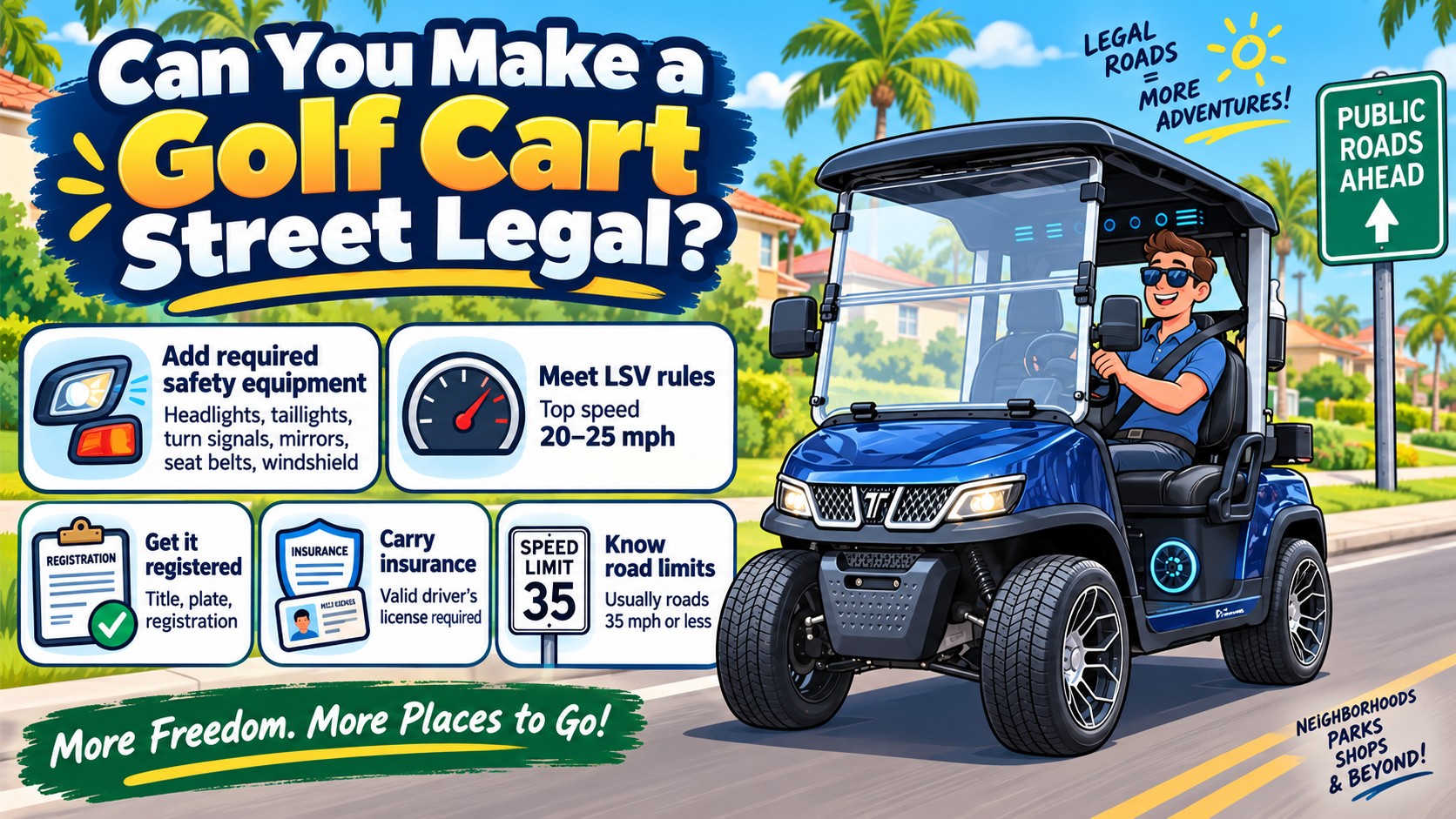
You may be able to convert an eligible golf cart into an LSV by adding the required safety equipment and completing your state’s inspection, title, registration, and insurance process. Federal LSV rules generally cover four-wheeled vehicles capable of more than 20 mph but no more than 25 mph, with a gross vehicle weight rating below 3,000 pounds. State requirements can add additional equipment and restrictions.
A basic golf cart is usually designed for golf courses, resorts, private communities, and recreational transportation rather than general public-road use. In the United States, one common route is converting an eligible cart so that it meets the requirements for a Low-Speed Vehicle, or LSV. However, installing lights and seat belts alone does not automatically complete the process. Vehicle speed, weight, safety equipment, identification, inspection, registration, insurance, and local traffic laws can all matter.
What Does a Golf Cart Need for Public-Road Use?
The exact equipment depends on where the vehicle will be registered. At the federal level, LSVs are subject to Federal Motor Vehicle Safety Standard No. 500, which establishes basic safety requirements for low-speed vehicles.
A road-oriented vehicle will typically need the following equipment:
- Headlights
- Taillights
- Brake lights
- Front and rear turn signals
- Red rear and side reflectors
- Seat belts for designated seating positions
- A driver’s-side exterior mirror
- A passenger-side exterior mirror or interior rearview mirror
- A parking brake
- A compliant windshield
- A Vehicle Identification Number
Some states also require equipment beyond the federal minimum. These additions can include a horn, windshield wiper, illuminated license plate bracket, speedometer, or other items.
Do not assume that installing an aftermarket light kit automatically changes the legal classification of your golf cart. Registration authorities may require documentation, inspection, receipts for conversion parts, proof of vehicle weight, and proof that the completed vehicle meets applicable standards.
What Speed Does a Converted Golf Cart Need?
Speed is one of the biggest differences between a traditional golf cart and an LSV.
Under the federal LSV definition, a qualifying vehicle must be capable of reaching more than 20 mph but not more than 25 mph on a paved level surface. Traditional golf carts often operate below this range.
Simply increasing motor speed is not enough. Increasing vehicle speed also changes braking, stability, tire, steering, and occupant-protection demands. Any conversion should therefore be performed with the entire vehicle system in mind rather than by changing only a controller or speed setting.
Golf Cart vs. LSV: What Is the Difference?
| Feature | Standard Golf Cart | Low-Speed Vehicle |
|---|---|---|
| Primary Use | Golf courses, private property and recreational transportation | Low-speed transportation on approved public roads |
| Typical Speed | Usually 20 mph or below | More than 20 mph and no more than 25 mph under the federal definition |
| Safety Equipment | Basic equipment varies by model | Must meet applicable LSV safety requirements |
| VIN | May not have the same road-vehicle documentation | Vehicle identification is required for registration |
| Title and Registration | Often not required when used only as a golf cart | Normally required for public-road operation |
| Insurance | Depends on local use and state law | Typically required when registered for public-road use |
| Driver License | Requirements vary by jurisdiction | A valid driver’s license is commonly required |
Does an LSV Have a Weight Limit?
Yes. Under the federal definition, an LSV has a gross vehicle weight rating of less than 3,000 pounds.
Gross vehicle weight rating, or GVWR, is different from the vehicle’s empty or curb weight. GVWR represents the manufacturer’s rated maximum operating weight, which can include the vehicle, passengers, cargo, batteries, and other permitted loads.
This distinction is important when checking whether a particular vehicle can qualify under LSV regulations.
Does a Converted Golf Cart Need a VIN?
A vehicle registered for public-road use needs appropriate vehicle identification documentation. However, it is not always accurate to say that every converted cart must already have a factory-issued 17-digit VIN.
The procedure varies by state. A purpose-built LSV may arrive from the manufacturer with the necessary identification and certification documentation. A converted golf cart may instead have to go through a state inspection or reconstructed-vehicle process before identification and title documents can be issued.
For that reason, owners should contact their state DMV or motor-vehicle agency before spending money on a conversion.
How Do You Convert a Golf Cart for Road Use?
- Check local regulations. Determine whether converted golf carts can be registered in your state and what roads they may use.
- Confirm vehicle eligibility. Check speed capability, GVWR, vehicle condition, manufacturer information, and available documentation.
- Install required safety equipment. Add compliant lights, turn signals, mirrors, seat belts, windshield, parking brake, reflectors, and any additional equipment required locally.
- Verify speed safely. The vehicle must fit the applicable speed classification without compromising braking, steering, suspension, or stability.
- Complete the required inspection. Some jurisdictions inspect converted vehicles before allowing them to be titled or registered.
- Obtain title and registration. Submit the required forms, proof of ownership, inspection records, and supporting documents.
- Purchase required insurance. Insurance requirements vary by state but commonly apply once a vehicle is registered for public-road operation.
- Install the license plate. Once approved and registered, display the plate according to local requirements.
Can You Drive an LSV on Any Road?
No. LSV registration does not provide unrestricted road access.
States and local governments determine where these vehicles may operate. Many jurisdictions restrict LSVs to lower-speed streets, often roads with posted speed limits of 35 mph or less. Other states may use different limits or impose additional restrictions.
Major highways, interstates, high-speed arterials, bridges, and other designated roads may prohibit LSV operation entirely.
Always check your state DMV, city or county traffic rules, posted road signs, and community regulations. Federal standards determine what an LSV is, while state and local laws largely determine where it can be driven.
Is Converting a Golf Cart Better Than Buying an LSV?
Conversion can make sense if you already own a suitable golf cart, but the cost and paperwork can add up quickly.
A purpose-built LSV may be easier because its road-oriented equipment, speed configuration, VIN, and documentation are incorporated into the vehicle from the beginning. This can reduce uncertainty when applying for registration.
Buyers looking for modern electric personal transportation can explore Tara EV, which offers both golf-focused vehicles and personal transportation models.
Which Tara EV Vehicles Are LSV Models?
Tara EV currently identifies three personal transportation models in its LSV category: the two-passenger Roadster 2, four-passenger Roadster 2+2, and four-passenger Explorer 2+2.
| Tara EV Model | Seating | Vehicle Category | Published LSV Speed |
|---|---|---|---|
| Roadster 2 | 2 passengers | LSV personal transportation | Up to approximately 25 mph in LSV configuration |
| Roadster 2+2 | 4 passengers | LSV personal transportation | Up to approximately 25 mph in LSV configuration |
| Explorer 2+2 | 4 passengers | LSV personal transportation | Up to approximately 25 mph in LSV configuration |
Specifications and regulatory configurations can vary by market and model version, so buyers should verify the exact vehicle specification, certification documents, VIN information, and local registration eligibility with the dealer before purchase.
What Paperwork Is Usually Required?
The paperwork depends on the state, but a conversion may require proof of ownership, bills of sale for installed parts, a certified weight record, vehicle inspection documents, title application, insurance documentation, identification, and payment of registration and plate fees.
Purpose-built LSVs may have a simpler process because the manufacturer can provide vehicle documentation appropriate to that configuration.
Conclusion
So, can you make a golf cart street legal? In many locations, an eligible golf cart can be converted and registered as an LSV, but the process involves much more than installing headlights and seat belts.
The vehicle must meet applicable speed, weight, safety-equipment, identification, inspection, registration, insurance, and driver requirements. Because state and local laws differ, checking with the appropriate motor-vehicle agency before beginning a conversion is essential.
For buyers who would rather start with a purpose-built road-oriented electric vehicle, Tara EV offers the Roadster 2, Roadster 2+2, and Explorer 2+2 in its current LSV lineup, providing options for two- and four-passenger personal transportation.
