
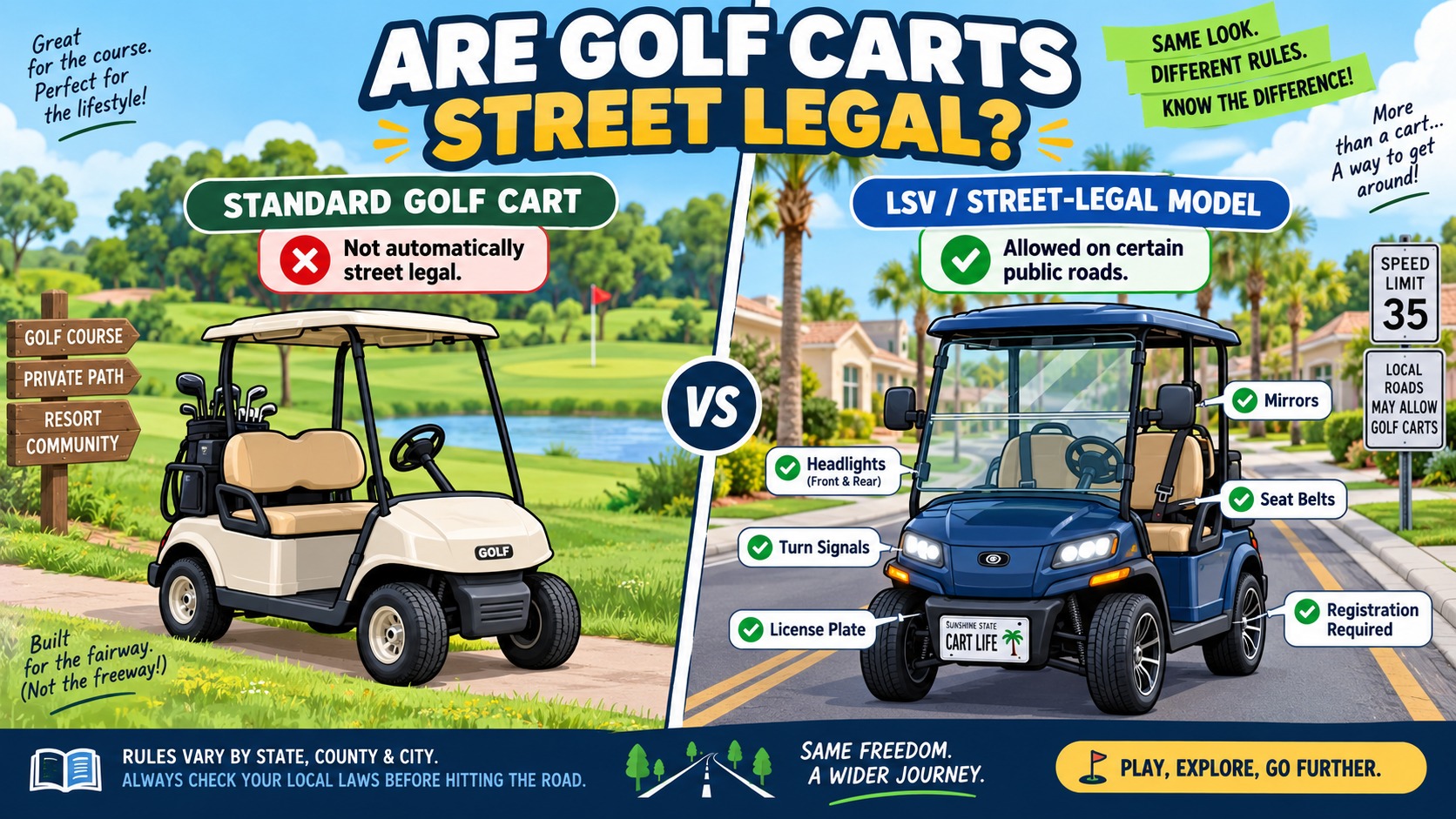
Traditional golf carts are generally not street legal by default. Public-road use usually requires either an LSV that meets applicable federal and state requirements or a golf cart specifically allowed under local or state ordinances. Rules vary by location, so always check local DMV and municipal regulations.
Whether a golf cart can legally travel on a public street depends on the vehicle type and the rules in your state and municipality. Traditional golf carts are mainly designed for golf courses, resorts, and private property, while Low-Speed Vehicles are equipped and documented for approved road use. Tara EV offers both standard golf-course models and LSV models, giving buyers different options depending on where and how the vehicle will be driven.
Golf Carts vs. Low-Speed Vehicles
The most important distinction is between a traditional golf cart and an LSV, or Low-Speed Vehicle.
| Feature | Standard Golf Cart | LSV |
|---|---|---|
| Primary Use | Golf courses, resorts, private property | Short-distance transportation on permitted public roads |
| Typical Speed | About 15–20 mph | More than 20 mph and up to 25 mph |
| VIN | May use a manufacturer serial number rather than a road-vehicle VIN | Has a VIN suitable for vehicle registration |
| Turn Signals | May be optional | Required equipment |
| Seat Belts | May vary | Required |
| Registration | Usually not required for private use | Generally required for public-road operation |
| Insurance | Depends on use and local rules | Commonly required |
Are Standard Golf Carts Street Legal?
Not automatically. A standard golf cart is generally intended for recreational transportation on golf courses and other controlled properties.
Many standard carts do not come from the factory with all of the equipment, identification, and documentation required for registration as a motor vehicle.
However, some states and local governments allow ordinary golf carts on designated roads under specific rules. These local programs may establish:
- Maximum road speed limits
- Operating hours
- Required lighting
- Driver age requirements
- Insurance requirements
- Specific permitted streets or zones
Do not assume that adding lights and mirrors automatically makes a standard golf cart legal for public streets. Vehicle classification and local registration rules still apply.
What Is an LSV?
An LSV is a federally recognized motor-vehicle category designed for lower-speed transportation.
Under the federal definition, an LSV is generally a four-wheeled vehicle capable of traveling more than 20 mph but no more than 25 mph on a paved, level surface.
Because it is treated as a motor vehicle, an LSV is built with additional safety equipment and identification that go beyond what is normally found on a basic golf cart.
Requirements for Street-Legal Operation
An LSV intended for public-road operation generally needs appropriate safety equipment and state documentation.
| Requirement | Purpose |
|---|---|
| Headlights | Provide forward visibility |
| Taillights | Make the vehicle visible from behind |
| Brake Lights | Warn following traffic during braking |
| Turn Signals | Communicate turning intentions |
| Rearview and Side Mirrors | Improve driver visibility |
| Windshield | Provides weather and occupant protection |
| Seat Belts | Provide passenger restraint |
| Parking Brake | Helps secure the vehicle when parked |
| VIN | Provides official vehicle identification |
| License Plate and Registration | Required by the state for approved road use |
Do You Need a Driver’s License?
In most jurisdictions, a valid driver’s license is required when operating an LSV on public roads.
The driver must also follow normal traffic laws, including:
- Stop signs
- Traffic lights
- Right-of-way rules
- Speed restrictions
- Passenger safety requirements
Does an LSV Need Insurance?
Liability insurance is commonly required because an LSV is registered as a motor vehicle for road use.
Minimum coverage levels vary by state, so owners should confirm requirements with their insurance provider before registering the vehicle.
Where Can an LSV Be Driven?
Many states and communities allow LSVs on roads with posted speed limits of approximately 35 mph or lower.
However, the 35 mph figure should not be treated as a universal nationwide rule. States and municipalities can adopt different restrictions, and some roads may prohibit LSV traffic even when nearby streets permit it.
Always verify local rules before driving on public streets. A vehicle may be properly registered as an LSV while still being prohibited from certain roads because of speed limits or local traffic regulations.
Can You Convert a Golf Cart for Road Use?
Some golf carts can be upgraded with additional equipment, but installing accessories does not by itself guarantee that the vehicle can be registered as an LSV.
Possible upgrades may include:
- Headlights and taillights
- Brake lights
- Turn signals
- Mirrors
- Seat belts
- Windshield
- Horn
- Parking brake
The vehicle must still satisfy applicable identification, certification, registration, and state requirements.
For buyers who specifically need public-road transportation, purchasing a factory-built LSV is usually more straightforward than attempting to convert a basic golf cart.
Is Tara EV Street Legal?
Tara EV offers two main categories of electric vehicles: standard golf carts designed primarily for golf-course applications and LSV models designed for road-oriented personal transportation.
Tara EV Standard Golf Carts
The Spirit Air is a golf-course-focused model designed around comfort, modern styling, and efficient electric transportation.
The Spirit Plus is another standard golf cart option intended primarily for course and recreational applications.
These models should not automatically be treated as public-road vehicles simply because they have modern lighting or other convenience features.
Tara EV LSV Models
Tara EV’s current LSV personal transportation lineup includes the Roadster 2, Roadster 2+2, and Explorer 2+2.
| Tara EV Model | Category | Seating | Typical Use |
|---|---|---|---|
| Spirit Air | Standard Golf Cart | Golf configuration | Golf courses and recreational transportation |
| Spirit Plus | Standard Golf Cart | Golf configuration | Golf courses and private-property use |
| Roadster 2 | LSV | 2 passengers | Short-distance personal transportation |
| Roadster 2+2 | LSV | 4 passengers | Family, resort and community transportation |
| Explorer 2+2 | LSV | 4 passengers | Community and recreational transportation |
Tara Roadster 2
The Roadster 2 is a two-passenger LSV designed for compact personal mobility.
Its size makes it practical for individuals or couples who need an electric vehicle for short trips around communities, resorts, and other permitted low-speed environments.
Tara Roadster 2+2
The Roadster 2+2 increases seating capacity to four passengers.
This makes it a good choice for families, guests, and community transportation where carrying additional passengers is important.
Tara Explorer 2+2
The Explorer 2+2 also offers four-passenger seating, but with a more adventurous and versatile design.
It can suit buyers who want electric transportation for neighborhoods, recreational settings, and larger properties while maintaining the features expected from an LSV.
Standard Golf Cart or LSV: Which Should You Choose?
The right choice depends mainly on where the vehicle will be used.
| Your Main Use | Better Choice |
|---|---|
| Playing golf | Standard golf cart |
| Private resort transportation | Standard golf cart or LSV depending on property needs |
| Neighborhood transportation | LSV |
| Permitted public-road trips | LSV |
| Four-passenger local transportation | Roadster 2+2 or Explorer 2+2 |
Choose Spirit Air or Spirit Plus primarily for golf-course transportation. Choose Roadster 2, Roadster 2+2, or Explorer 2+2 when you need a Tara EV model designed for LSV applications and permitted public-road transportation.
What Should You Check Before Driving on Public Roads?
- Confirm that the vehicle is classified appropriately for road use.
- Check the VIN and ownership documentation.
- Complete state registration requirements.
- Obtain the required license plate.
- Purchase appropriate insurance.
- Verify that all required safety equipment works correctly.
- Confirm the driver’s licensing requirements.
- Check the road speed limit and local LSV rules.
Conclusion
Traditional golf carts are generally not street legal by default, although some communities allow them on designated roads under local rules. For regular public-road use, an LSV is the more appropriate option because it includes required safety equipment, a VIN, and registration capability. Tara EV separates its lineup accordingly: Spirit Air and Spirit Plus serve golf-course applications, while Roadster 2, Roadster 2+2, and Explorer 2+2 are LSV models designed for broader personal transportation.
