
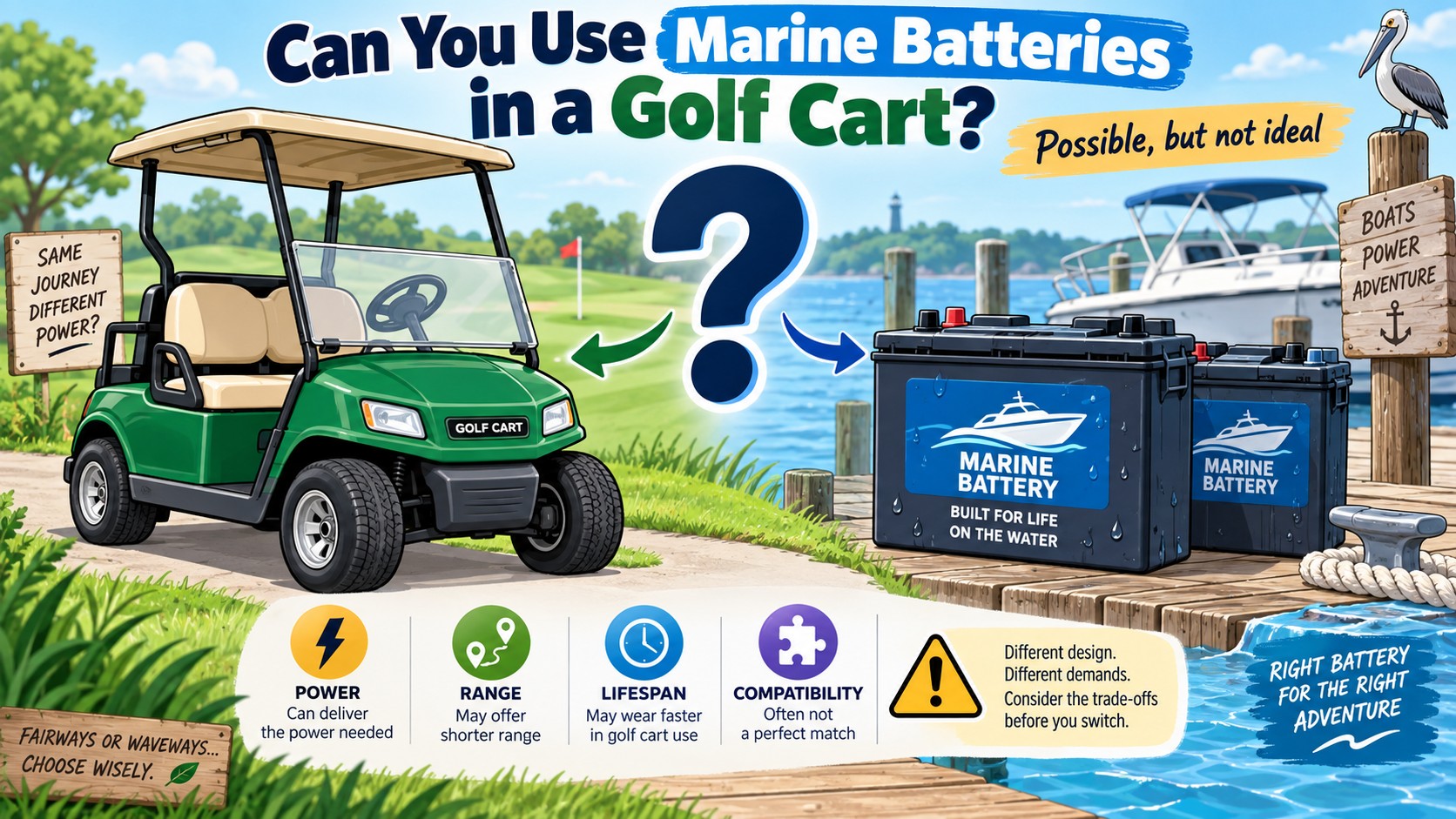
Marine deep-cycle batteries can sometimes power a golf cart if the total system voltage and physical fit are correct, but marine dual-purpose or starting batteries are not ideal. Golf carts need batteries designed for repeated deep cycling and sustained traction loads. For reliable long-term use, choose genuine golf cart deep-cycle batteries or a compatible lithium golf cart battery system.
Marine batteries and golf cart batteries may look similar, especially when both use lead-acid technology, but they are designed for different jobs. A marine battery may work temporarily if its voltage, dimensions, capacity, terminal layout, and wiring match the cart, yet a true golf cart traction battery is usually better suited to repeated deep discharge and sustained motor demand. Modern Tara electric vehicles avoid this issue by using purpose-designed 48V lithium battery systems.
Marine Battery vs. Golf Cart Battery
The main difference is the type of electrical demand each battery is designed to handle.
| Feature | Marine Battery | Golf Cart Battery |
|---|---|---|
| Primary Use | Boat starting, accessories, trolling motors, or dual-purpose use | Electric vehicle propulsion and repeated deep cycling |
| Power Demand | Varies by starting or deep-cycle design | Sustained high current over long periods |
| Deep Discharge | Deep-cycle marine versions tolerate it reasonably well | Designed specifically for repeated deep discharge |
| Plate Design | Often a compromise between starting and deep-cycle needs | Typically optimized for traction and cycle durability |
| Expected Golf Cart Life | May be shorter in traction service | Usually better suited for daily cart use |
Power Demand: Why Golf Carts Are Different
A golf cart motor can demand substantial current during acceleration, hill climbing, and when carrying passengers or cargo.
A true traction battery is designed to deliver this power repeatedly over many discharge and recharge cycles.
Some marine batteries are intended mainly for engine starting. These batteries can produce a large burst of current for a short time but are not designed to be repeatedly discharged deeply.
Deep-cycle marine batteries are closer to golf cart batteries, but they still may not have the same plate thickness, cycle rating, or traction-oriented design as batteries made specifically for golf carts.
Lifespan: Which Battery Lasts Longer?
When used in the application for which they were designed, golf cart batteries generally provide better cycle life than marine batteries used as a substitute.
A marine battery installed in a cart may work initially but can wear out faster if it is repeatedly discharged to low states of charge.
The exact life depends on:
- Battery chemistry
- Depth of discharge
- Daily mileage
- Charging habits
- Temperature
- Vehicle weight
- Terrain
- Battery quality
Do not judge a battery only by amp-hour rating. Two batteries with the same Ah capacity may have very different cycle-life ratings and internal construction.
Discharge Performance
Golf cart batteries are designed to be discharged substantially and then recharged repeatedly.
Marine starting batteries are not intended for this type of use. Deep-cycle marine batteries handle discharge better, but their usable life may still be reduced if the golf cart places heavier traction demands on them than the manufacturer intended.
A cart that is used only occasionally may tolerate a marine deep-cycle battery better than a cart that runs every day on hilly terrain.
Build and Internal Construction
Traditional lead-acid golf cart batteries often use thick plates designed to withstand frequent cycling.
Many marine batteries are designed as dual-purpose units. That means they attempt to provide both starting current and some deep-cycle capability.
This compromise can make them less ideal for a vehicle that requires traction power every time it moves.
What Are the Risks of Using Marine Batteries?
Reduced Driving Range
Marine batteries may provide less usable energy under golf cart loads, which can reduce range.
A cart that normally travels 25 or 30 miles on the correct battery pack may travel significantly less if the substitute batteries have lower usable capacity or higher voltage drop under load.
Shorter Battery Life
Repeated deep discharge can shorten the life of a battery that was not designed for traction service.
Voltage Mismatch
Golf carts are commonly built around 36V, 48V, or other specific system voltages.
The individual batteries must be connected so the total pack voltage matches the cart exactly.
A 48V cart could theoretically use four compatible 12V batteries wired in series, but voltage alone does not make the setup ideal. Capacity, current capability, charger compatibility, dimensions, weight, and battery type must also match the application.
Physical Fit
Marine batteries may use different case sizes, terminal positions, and hold-down designs from golf cart batteries.
Loose or poorly mounted batteries are dangerous because they can shift during turns or bumps and damage cables or terminals.
Charging Problems
The charger must match the battery chemistry and pack voltage.
A charger designed for flooded golf cart batteries may not be appropriate for AGM, gel, or lithium batteries.
Never assume that because the battery physically fits, the existing charger is compatible.
Can You Mix Marine and Golf Cart Batteries?
No. Mixing different battery types, capacities, ages, or brands in the same series pack is not recommended.
The weakest battery can limit the entire pack, and uneven charging can cause some batteries to become overcharged while others remain undercharged.
If replacing a multi-battery pack, use batteries with the same:
- Voltage
- Capacity
- Chemistry
- Brand and model when possible
- Age
- State of health
What Are the Best Batteries to Put in a Golf Cart?
The best choice depends on your budget, usage, and maintenance preferences.
| Battery Type | Best For | Main Advantage |
|---|---|---|
| Flooded Deep-Cycle Golf Cart Battery | Budget-conscious owners | Lower initial cost and widely available |
| AGM Golf Cart Battery | Owners wanting sealed lead-acid | No routine watering |
| LiFePO4 Golf Cart Battery | Frequent users and long-term ownership | Long life, low weight, fast charging |
For most owners, a battery designed specifically for golf cart or traction use is preferable to a general-purpose marine battery.
Why Lithium Is Becoming Popular
Lithium iron phosphate batteries offer several advantages over traditional lead-acid packs:
- Lower weight
- Faster charging
- Longer cycle life
- No water filling
- Consistent voltage under load
- Integrated Battery Management System
- Reduced routine maintenance
These advantages are one reason many newer electric carts now use lithium as standard equipment.
What Type of Battery Do Tara Electric Vehicles Use?
Tara electric vehicles use 48V lithium battery systems across their current lineup.
The golf-course-focused Spirit Air and Spirit Plus currently use 48V 105Ah lithium batteries. Both are designed for golf-course operation and provide an estimated driving range of at least 40 miles under appropriate conditions.
For personal transportation, the Roadster 2 also uses a 48V 105Ah lithium battery.
The larger four-passenger Roadster 2+2 and Explorer 2+2 use 48V 160Ah lithium battery systems for increased energy capacity.
| Tara Model | Category | Battery | Seating |
|---|---|---|---|
| Spirit Air | Golf Course | 48V 105Ah Lithium | 2 |
| Spirit Plus | Golf Course | 48V 105Ah Lithium | 2 |
| Roadster 2 | Personal / LSV Category | 48V 105Ah Lithium | 2 |
| Roadster 2+2 | Personal / LSV Category | 48V 160Ah Lithium | 4 |
| Explorer 2+2 | Personal / LSV Category | 48V 160Ah Lithium | 4 |
Tara’s current lineup uses purpose-designed 48V lithium systems rather than marine batteries. The Spirit Air, Spirit Plus, and Roadster 2 use 105Ah packs, while the Roadster 2+2 and Explorer 2+2 use larger 160Ah packs.
When Might a Marine Battery Be Acceptable?
A deep-cycle marine battery might be acceptable as a temporary or emergency solution if:
- The total pack voltage is correct
- All batteries are identical
- The charger is compatible
- The batteries fit securely
- The required current output is sufficient
- The cart is used lightly
Even in this situation, it should be considered a compromise rather than the ideal long-term setup.
What Should You Check Before Changing Batteries?
- Confirm the cart’s required system voltage.
- Check battery compartment dimensions.
- Verify terminal orientation.
- Compare amp-hour capacity.
- Check maximum current capability.
- Confirm charger compatibility.
- Use batteries of the same chemistry and age.
- Secure every battery with proper hold-down hardware.
- Confirm cable gauge and terminal condition.
- Follow the vehicle manufacturer’s battery recommendations.
Conclusion
So, can you use marine batteries in a golf cart? Technically, yes, especially if you use compatible deep-cycle marine batteries and build a pack with the correct voltage. However, they are generally not the best long-term option.
Golf cart batteries are specifically designed for sustained traction loads and repeated deep cycling. Marine dual-purpose batteries may offer less range, shorter service life, and poorer performance under heavy cart use.
For the best long-term results, use deep-cycle batteries designed for golf carts or a purpose-built lithium system. Modern Tara electric vehicles use 48V lithium batteries across both their golf-course and personal transportation models, providing a lighter, lower-maintenance alternative to traditional lead-acid or marine battery setups.
