
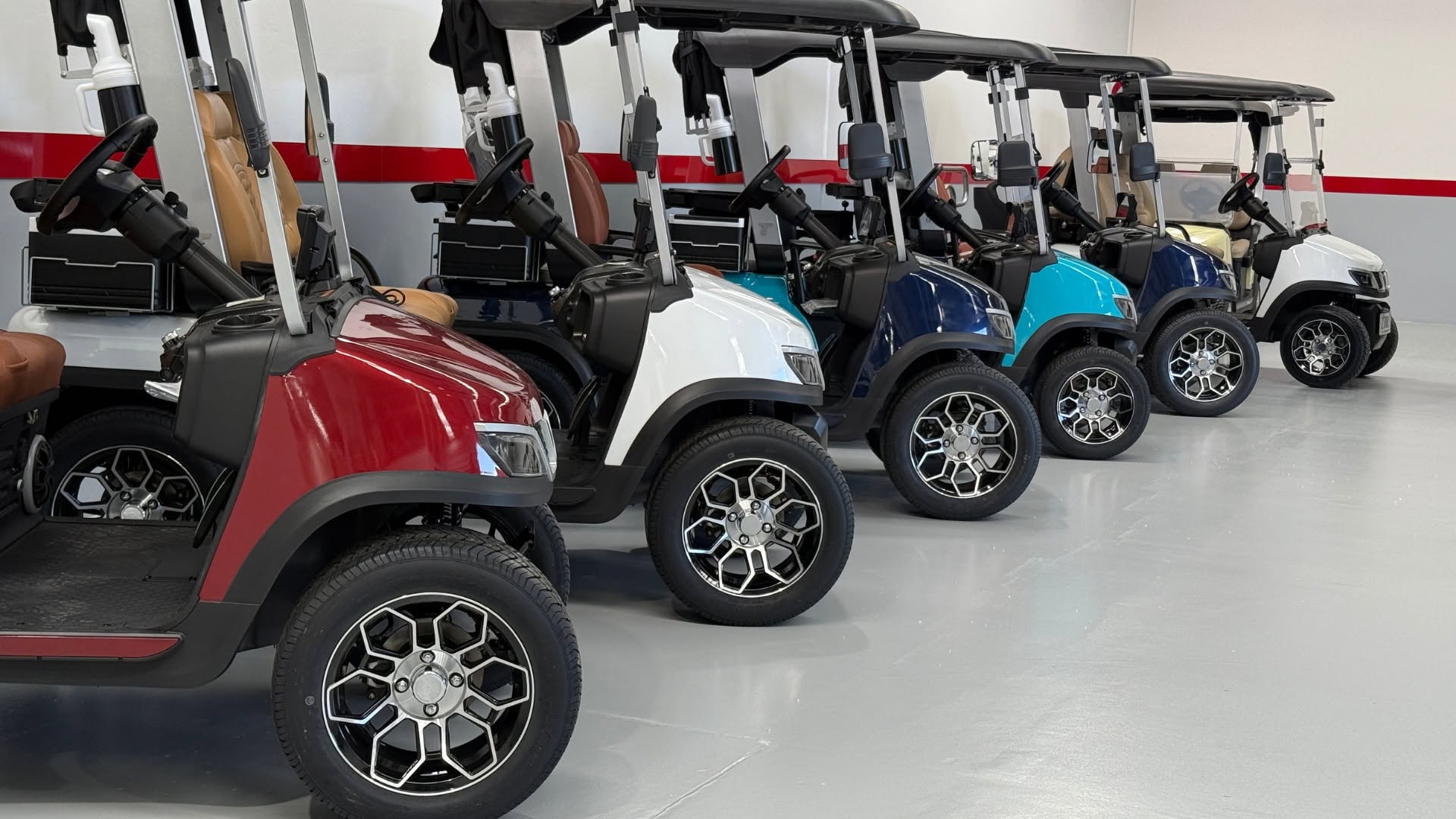
LSV stands for Low-Speed Vehicle. Under the federal definition, an LSV is a four-wheeled motor vehicle capable of more than 20 mph but no more than 25 mph on a paved, level surface. Unlike a standard golf cart, an LSV is manufactured with required motor-vehicle safety equipment and can be registered for public-road use where state and local laws permit.
When you see “LSV” used with a golf cart, it means the vehicle is more than a conventional course cart. An LSV is designed to meet specific motor-vehicle requirements involving speed, safety equipment, identification, and registration. These compact electric vehicles are commonly used in residential communities, resorts, campuses, recreational areas, and for short local trips. Tara EV offers LSV models that combine electric propulsion with practical passenger transportation and road-oriented safety equipment.
What Does LSV Stand For?
LSV is short for Low-Speed Vehicle. Although these vehicles often resemble golf carts, the designation represents a legal motor-vehicle category rather than simply a style of vehicle.
A conventional golf cart is primarily designed for golf courses and private-property transportation. An LSV is built for broader transportation applications and includes equipment intended for operation on approved public roads.
That distinction is important when buying a vehicle for a residential community, resort, neighborhood, or other area where public-road travel may be required.
What Is the Top Speed of an LSV?
The federally defined LSV speed range is more than 20 mph and no more than 25 mph on a paved, level surface.
Therefore, the maximum speed for an LSV under the federal classification is 25 mph, or approximately 40 km/h.
| Speed Detail | LSV Requirement |
|---|---|
| Minimum Federal Speed Threshold | More than 20 mph |
| Maximum Federal Speed | 25 mph |
| Equivalent Maximum Speed | Approximately 40 km/h |
| Typical Road Environment | Lower-speed local roads where permitted by state and local law |
Federal Limit
The 25 mph maximum helps distinguish an LSV from conventional automobiles designed for higher-speed transportation.
Road Restrictions
Many states and municipalities permit LSVs on roads posted at 35 mph or less. However, road-access rules are established at the state and local levels, so the exact limit can differ by location.
Comparison With a Traditional Golf Cart
Traditional golf carts often operate at approximately 15 mph, although specifications vary. Their lower speed and different certification requirements mean they should not automatically be treated as LSVs.
A golf cart does not become an LSV simply because it can travel faster. The vehicle must also have the appropriate certification, identification, and required safety equipment.
What Safety Features Does an LSV Need?
An LSV includes substantially more safety equipment than a basic golf course cart. Typical required equipment includes lighting, occupant restraints, mirrors, and other motor-vehicle components.
| Equipment | Purpose |
|---|---|
| Headlights | Provide visibility during lower-light conditions |
| Taillights | Improve visibility from behind |
| Brake Lights | Alert following traffic when braking |
| Turn Signals | Communicate intended turns |
| Rearview Mirrors | Improve visibility around the vehicle |
| Seat Belts | Restrain occupants in designated seating positions |
| Parking Brake | Helps secure the vehicle when parked |
| Windshield | Provides occupant protection and visibility |
| VIN | Provides official vehicle identification |
LSV vs. Standard Golf Cart
One of the easiest ways to understand what LSV means on a golf cart is to compare it directly with a conventional golf cart.
| Feature | Standard Golf Cart | LSV |
|---|---|---|
| Typical Purpose | Golf course and private-property use | Short-distance transportation and permitted road use |
| Typical Speed | Often around 15 mph | More than 20 mph and up to 25 mph |
| Turn Signals | May be optional | Required |
| Seat Belts | May vary | Required |
| VIN | May not have a road-vehicle VIN | Required |
| Registration | Usually not registered as an LSV | Generally required for public-road operation |
| Insurance | Depends on use | Commonly required for road use |
Is an LSV Allowed on Public Roads?
Yes. One of the main reasons buyers choose an LSV is that it is designed for operation on permitted public roads after satisfying applicable registration and insurance requirements.
Many jurisdictions allow LSVs on roads with posted speed limits of 35 mph or less. However, this should not be treated as a universal rule for every city or state.
Local authorities can impose additional restrictions concerning:
- Road speed limits
- Specific streets
- Driver licensing
- Vehicle registration
- Insurance
- Age restrictions
- Crossing higher-speed roads
Does an LSV Need a VIN?
Yes. An LSV manufactured as a motor vehicle needs a Vehicle Identification Number for identification and registration purposes.
For vehicles subject to standard U.S. VIN requirements, this is generally a 17-character VIN.
The VIN helps identify important vehicle information and is used when completing registration, titling, insurance, and ownership documentation.
Does an LSV Need a Title?
LSVs generally go through the state motor-vehicle titling and registration process when used on public roads, although the exact paperwork varies by state.
A typical process can include:
- Confirming the VIN and vehicle documentation.
- Applying for a title where required.
- Registering the vehicle with the state.
- Obtaining a license plate.
- Purchasing the required liability insurance.
- Meeting any state inspection requirements.
Federal LSV classification and local road permission are related but separate issues. Owners should always check state DMV and local regulations before operating the vehicle on public roads.
Do You Need a Driver’s License for an LSV?
For public-road operation, a valid driver’s license is generally required. An LSV driver must follow applicable traffic laws just like other motorists.
This includes observing:
- Traffic lights
- Stop signs
- Lane rules
- Speed limits
- Right-of-way requirements
- Passenger safety requirements
Does an LSV Need Insurance?
Liability insurance is commonly required when an LSV is registered for public-road use. Minimum coverage levels depend on the state.
Owners should tell their insurer exactly how and where the vehicle will be used so that the selected policy provides appropriate coverage.
Why Choose an Electric LSV?
Electric LSVs are increasingly popular because their operating characteristics fit short-distance transportation particularly well.
Advantages can include:
- Quiet operation
- Smooth electric acceleration
- No tailpipe emissions during operation
- Convenient charging
- Low routine drivetrain maintenance
- Compact dimensions
- Easy maneuverability
For communities and resorts where trips are relatively short, these characteristics can make an electric LSV a convenient alternative to using a full-size automobile for every journey.
Which Tara EV Models Are LSVs?
Tara EV currently offers three personal vehicle models in the LSV category: the Roadster 2, Roadster 2+2, and Explorer 2+2.
| Tara EV LSV | Seating | Suitable Applications |
|---|---|---|
| Roadster 2 | 2 passengers | Personal travel, communities, resorts and short local trips |
| Roadster 2+2 | 4 passengers | Families, communities and resort transportation |
| Explorer 2+2 | 4 passengers | Community, recreational and versatile personal transportation |
Tara Roadster 2
The Roadster 2 is a two-passenger LSV designed for comfortable personal transportation.
Its two-seat layout makes it a practical choice for drivers who primarily travel alone or with one passenger and want a compact electric vehicle for short-distance mobility.
Tara Roadster 2+2
The Roadster 2+2 provides four-passenger capacity, offering additional flexibility for families, visitors, resort guests, and community transportation.
The extra seating makes it useful when passenger capacity is more important than maintaining a two-seat configuration.
Tara Explorer 2+2
The Explorer 2+2 is a four-passenger LSV designed for drivers who want electric transportation combined with a more versatile and recreational appearance.
It can be suited to communities, larger properties, recreational settings, and other environments requiring comfortable short-distance passenger transportation.
Choose the Roadster 2 for compact two-passenger mobility, the Roadster 2+2 when four seats are preferred, or the Explorer 2+2 when you want four-passenger transportation with a more versatile design.
Where Are LSVs Commonly Used?
LSVs are especially useful in environments where most trips are relatively short and roads operate at moderate speeds.
Common applications include:
- Residential neighborhoods
- Retirement communities
- Resorts and hotels
- College campuses
- Parks
- Recreational communities
- Large private properties
- Short local errands where permitted
How to Choose an LSV
- Decide whether you need two or four seats.
- Check the typical distance of your daily trips.
- Confirm local LSV road regulations.
- Compare battery capacity and charging requirements.
- Review passenger comfort and storage needs.
- Verify insurance and registration requirements.
- Choose a model that matches your intended environment.
Conclusion
LSV means Low-Speed Vehicle, a four-wheeled motor-vehicle category designed for short-distance transportation at more than 20 mph but no more than 25 mph. Compared with a conventional golf cart, an LSV includes additional safety equipment, a VIN, and the documentation needed for registration where applicable. Tara EV currently offers three LSV models—the Roadster 2, Roadster 2+2, and Explorer 2+2—providing both two- and four-passenger choices for communities, resorts, recreational areas, and local transportation.
