
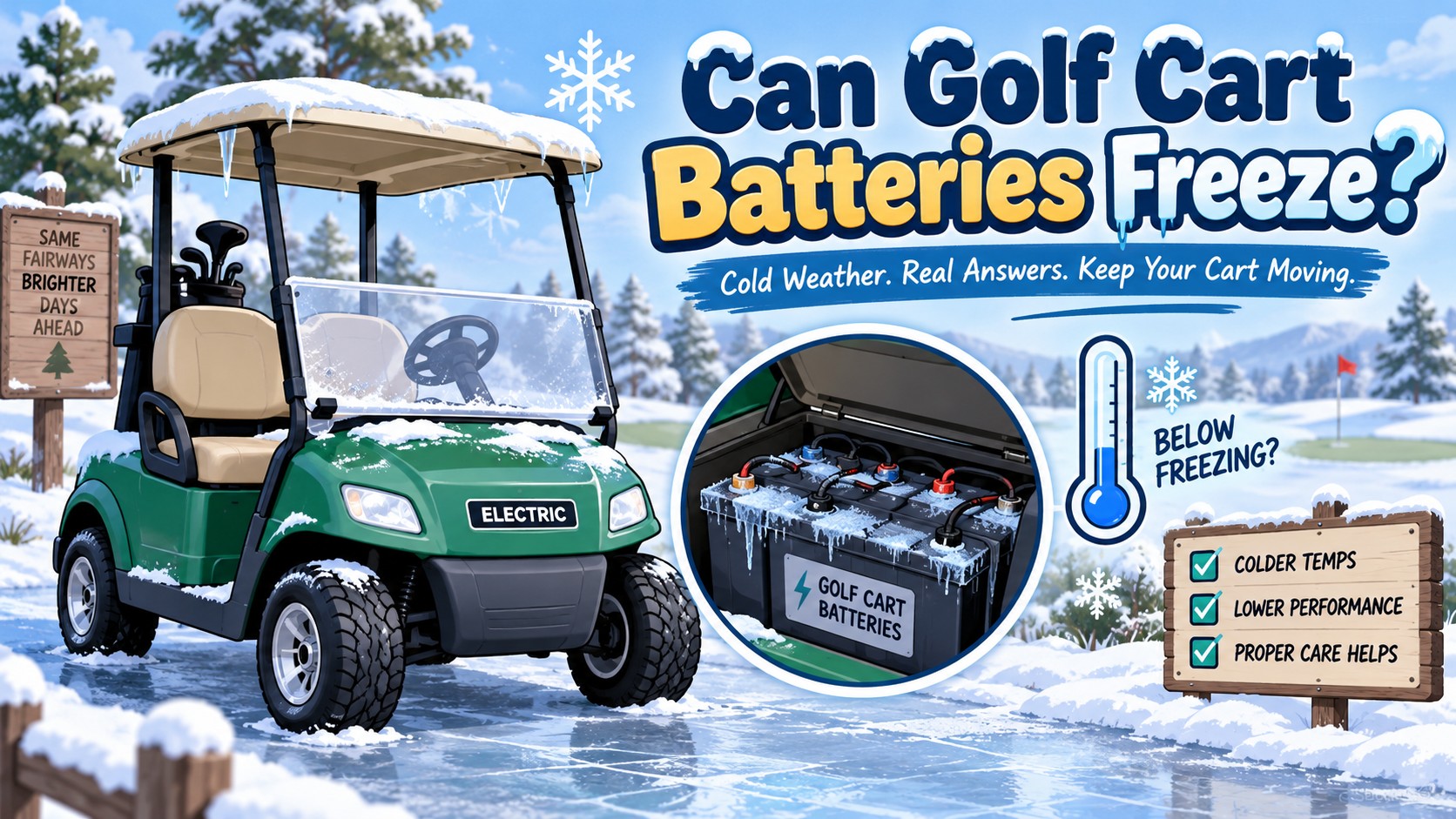
A fully charged lead-acid golf cart battery can tolerate temperatures far below 0°F, while a deeply discharged battery may freeze at around 20°F (-6°C). Lithium batteries do not normally freeze solid in the same way, but charging many lithium batteries below 32°F (0°C) can cause permanent cell damage unless the battery includes low-temperature charging protection or a heating system.
Cold weather affects nearly every type of golf cart battery, but flooded lead-acid and lithium batteries react very differently. Lead-acid batteries can physically freeze when deeply discharged, while lithium batteries are more vulnerable to damage when charged at very low temperatures. Understanding these differences can help prevent expensive winter battery failures.
Why Can Golf Cart Batteries Freeze?
Whether a battery freezes depends primarily on its internal chemistry and state of charge.
Flooded lead-acid batteries contain a liquid electrolyte made from sulfuric acid and water. As the battery discharges, the concentration of sulfuric acid decreases and the electrolyte becomes increasingly water-like. Because water freezes much more easily than concentrated battery acid, a discharged battery is far more vulnerable during winter.
Lithium batteries operate differently. Their electrolyte does not behave like the liquid electrolyte in a traditional flooded lead-acid battery, so physical freezing is generally not the primary concern. Instead, extremely low temperatures can reduce performance and make charging unsafe.
Lead-Acid Golf Cart Batteries in Freezing Weather
Traditional flooded lead-acid batteries remain common in older golf carts. Their winter performance depends heavily on how fully charged they are.
| Battery Condition | Approximate Cold-Weather Risk | What Can Happen |
|---|---|---|
| Fully Charged | Can resist freezing at temperatures well below -50°F (-45°C) | Relatively low freezing risk |
| Partially Discharged | Freezing point rises significantly | Greater risk during severe cold |
| Deeply Discharged | May freeze around 20°F (-6°C) | Case cracking, plate damage, electrolyte leakage |
Why Does State of Charge Matter?
When a lead-acid battery is fully charged, the electrolyte contains a relatively high concentration of sulfuric acid. This lowers the freezing point substantially.
As the battery discharges, more of the sulfuric acid becomes involved in chemical reactions with the battery plates. The remaining electrolyte contains proportionally more water, which makes freezing increasingly possible.
For this reason, leaving a nearly dead golf cart outside during winter is much riskier than storing the same battery fully charged.
What Happens If a Lead-Acid Battery Freezes?
When the electrolyte freezes, it expands. The expansion can create enough internal pressure to physically damage the battery.
Possible damage includes:
- Cracked plastic battery cases
- Warped internal plates
- Broken separators
- Damaged cell connections
- Electrolyte leakage
- Reduced capacity
- Complete battery failure
Never attempt to charge a visibly frozen lead-acid battery. Allow it to thaw naturally in a safe, ventilated location and inspect the case carefully for cracks, leaks, bulging, or other damage before attempting further service.
Can Lithium Golf Cart Batteries Freeze?
Lithium batteries are much less likely to physically freeze in the same manner as flooded lead-acid batteries. However, cold temperatures still affect their chemistry.
A lithium-powered cart can often be driven in below-freezing conditions, although available power and driving range may temporarily decrease.
The larger concern is charging.
Why Is Charging Lithium Below Freezing Dangerous?
Charging some lithium-ion batteries below approximately 32°F (0°C) can cause metallic lithium to accumulate on the surface of the anode instead of being stored normally inside the cell structure.
This phenomenon is commonly known as lithium plating.
Lithium plating can permanently reduce battery capacity and may increase the risk of internal damage. The battery may appear to charge normally even though damage is occurring internally.
This is why many modern lithium golf cart batteries include a Battery Management System, or BMS, that monitors temperature.
A modern BMS may automatically prevent charging when cell temperature falls below the permitted charging limit. Some premium battery systems also include self-heating technology that warms the cells before allowing charging to begin.
Lead-Acid vs. Lithium Batteries in Cold Weather
| Feature | Lead-Acid Battery | Lithium Battery |
|---|---|---|
| Can Physically Freeze? | Yes, especially when discharged | Not normally in the same way |
| Cold Driving | Reduced capacity and performance | Usually possible, but range may temporarily decrease |
| Cold Charging | Possible within manufacturer limits | Charging below 32°F may be restricted |
| Winter Maintenance | Maintain charge and electrolyte level | Monitor charge level and storage temperature |
| Protection System | Usually limited | Modern packs often include BMS protection |
How to Prevent Golf Cart Batteries From Freezing
1. Keep Lead-Acid Batteries Fully Charged
Before storing a golf cart for winter, charge flooded lead-acid batteries fully. Maintaining a high state of charge greatly lowers their freezing point.
Check the batteries periodically during storage because lead-acid batteries slowly self-discharge even when the vehicle is not being used.
2. Store the Cart Indoors
A temperature-controlled garage provides the best winter protection. Even an unheated enclosed garage can protect the batteries from extreme wind chill and rapid temperature changes.
Avoid storing batteries directly on wet surfaces or in areas exposed to snow and rain.
3. Check Charge Monthly
If your golf cart will remain unused for several months, check the battery state of charge regularly.
Lead-acid batteries may require periodic charging. Lithium batteries generally have much lower self-discharge, but their storage level should still follow the manufacturer’s recommendations.
4. Disconnect Electrical Loads
Accessories such as stereos, controllers, tracking equipment, lights, and USB chargers may create small parasitic electrical loads.
During long-term storage, follow the manufacturer’s procedure for disconnecting or shutting down the battery system to reduce unnecessary discharge.
5. Never Charge a Frozen Battery
If you suspect a lead-acid battery is frozen, do not immediately connect a charger.
Move the battery or vehicle to a protected area and allow the battery to thaw naturally. Inspect it thoroughly after thawing.
6. Protect Lithium Batteries From Cold Charging
For lithium systems, verify the minimum charging temperature specified by the manufacturer.
If the pack does not have built-in heating, allow it to warm above the minimum charging temperature before connecting the charger.
Are Batteries Ruined If They Freeze?
Not necessarily, but a battery that has actually frozen should be treated cautiously.
A lead-acid battery may survive a mild freeze if the case and internal plates remain intact. However, severe freezing can crack the housing, warp the plates, and permanently reduce capacity.
After the battery has completely thawed, inspect it for:
- Cracks in the case
- Bulging sides
- Acid leakage
- Loose terminals
- Abnormally low voltage
- Failure to accept or hold a charge
A cracked or leaking battery should not be returned to service.
A damaged lead-acid battery contains corrosive sulfuric acid and can create electrical hazards. Wear appropriate eye and hand protection and have a severely damaged battery handled by a qualified battery technician or recycler.
What Is the Average Lifespan of Golf Cart Batteries?
Battery lifespan depends strongly on chemistry, charging habits, temperature, maintenance, and frequency of use.
| Battery Type | Typical Lifespan | Typical Cycle Life |
|---|---|---|
| Flooded Lead-Acid | About 3–6 years | Often several hundred to around 1,000 cycles depending on use |
| AGM / Sealed Lead-Acid | About 4–7 years | Depends heavily on depth of discharge |
| LiFePO4 Lithium | Often 8–12 years | Commonly 3,000+ cycles depending on design |
Lithium batteries generally cost more initially but can provide significantly longer service life and require less routine maintenance.
Does Cold Weather Shorten Battery Life?
Temporary cold weather does not automatically destroy a healthy battery. However, repeated exposure to inappropriate charging conditions, deep discharge, or extreme temperatures can shorten long-term battery life.
For lead-acid batteries, allowing the pack to remain discharged during winter dramatically increases freezing risk and promotes sulfation.
For lithium batteries, repeated charging below the permitted temperature can permanently damage cell chemistry.
Correct winter storage is therefore more important than simply protecting the battery from one cold night.
Winter Storage Checklist for Golf Cart Batteries
- Fully charge lead-acid batteries before storage.
- Check electrolyte levels before charging if you use flooded batteries.
- Clean battery terminals and remove corrosion.
- Park the cart in a dry, protected location.
- Disconnect unnecessary electrical accessories.
- Check battery state of charge approximately once a month.
- Follow the manufacturer’s lithium storage recommendations.
- Do not charge lithium batteries below their permitted temperature.
- Inspect batteries for swelling, leakage, cracks, or physical damage.
- Use only a charger designed for the battery chemistry.
Conclusion
So, can golf cart batteries freeze? Lead-acid batteries definitely can, particularly when deeply discharged. A fully charged battery can withstand extremely low temperatures, while a nearly discharged battery may freeze at temperatures around 20°F (-6°C).
Lithium golf cart batteries do not normally freeze solid in the same way, but charging below approximately 32°F (0°C) can cause permanent internal damage unless the battery system includes appropriate low-temperature protection or heating.
Whether you use lead-acid or lithium power, keeping the battery properly charged, storing the cart in a protected environment, and following the manufacturer’s cold-weather charging limits will help your golf cart remain reliable throughout winter and extend overall battery life.
