
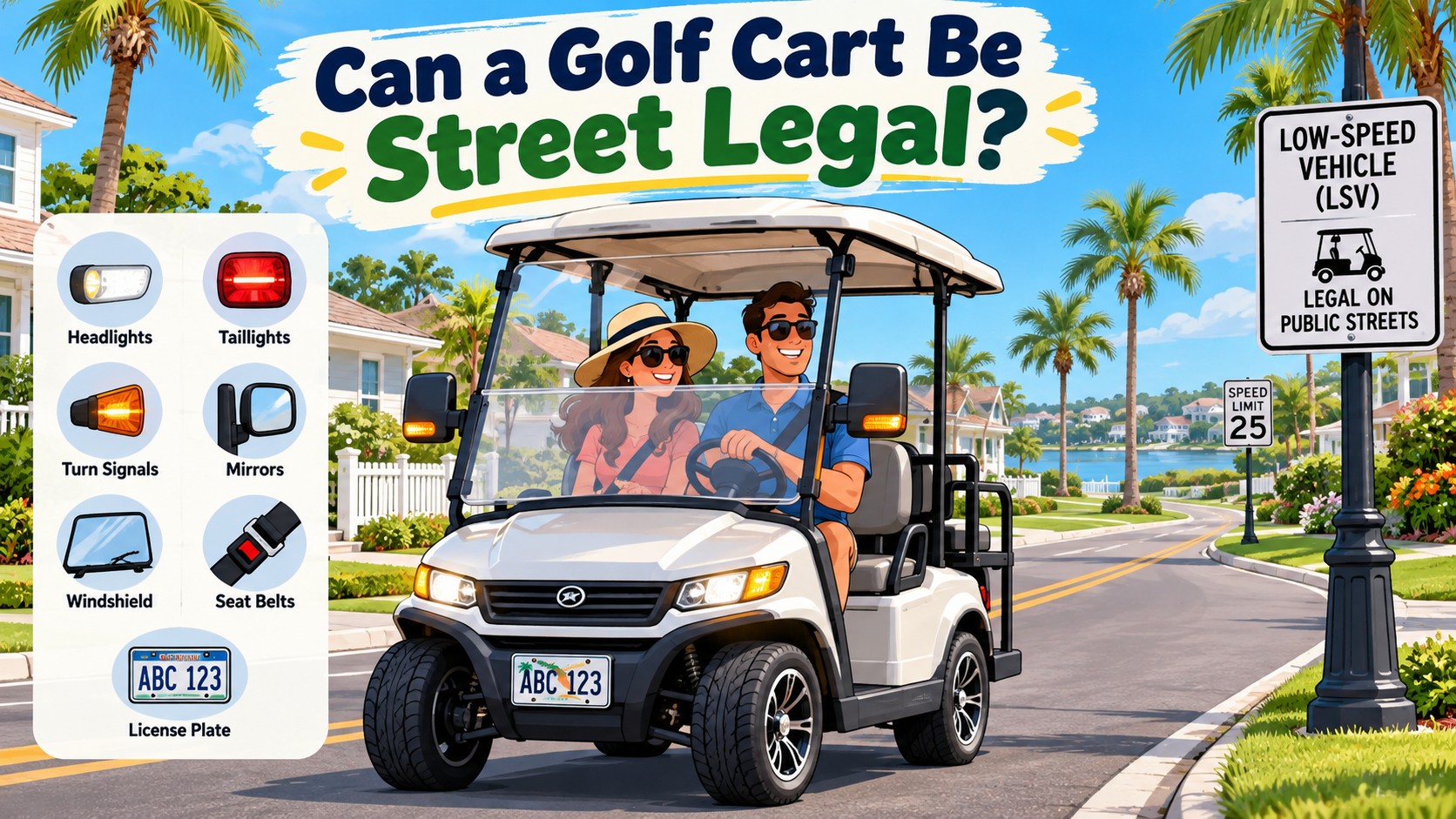
Yes. A golf-cart-style vehicle can be street legal if it qualifies as a federally compliant Low-Speed Vehicle. An LSV is a four-wheeled vehicle capable of more than 20 mph but no more than 25 mph, with a GVWR under 3,000 pounds. It must meet FMVSS 500 safety requirements and then satisfy the registration, insurance, licensing, and road-use rules of the state where it is driven.
A traditional golf cart designed mainly for golf-course use is generally not intended for unrestricted operation on public roads. However, a vehicle can legally operate on certain public streets when it is manufactured and certified as a Low-Speed Vehicle, or LSV, and meets state and local registration requirements. Models from Tara EV include purpose-built personal transportation vehicles designed for this type of use where local laws permit.
What Is the Difference Between a Golf Cart and an LSV?
The most important distinction is legal classification.
A conventional golf cart is usually designed for private property, golf courses, resorts, and similar low-speed environments. Its speed may be around 15 mph or lower depending on the model and jurisdiction.
A Low-Speed Vehicle is a federally defined motor vehicle.
| Feature | Traditional Golf Cart | Low-Speed Vehicle |
|---|---|---|
| Typical Purpose | Golf course and private-property transportation | Low-speed public-road transportation |
| Federal Speed Definition | Not classified as an LSV | More than 20 mph and no more than 25 mph |
| Federal Safety Certification | Usually no FMVSS 500 certification | Must comply with applicable LSV standards |
| VIN | May not have a road-vehicle VIN | Requires a compliant manufacturer-assigned VIN |
| Registration | Depends on limited local golf-cart laws | Normally required for public-road operation |
What Makes a Golf Cart Street Legal?
To qualify federally as an LSV, the vehicle must have four wheels, travel faster than 20 mph but no faster than 25 mph on a paved level surface, and have a gross vehicle weight rating under 3,000 pounds.
It must also comply with Federal Motor Vehicle Safety Standard No. 500.
Required Safety Equipment
Federal LSV requirements include equipment such as:
- Headlights
- Front and rear turn signals
- Taillights
- Brake lights
- Rear and side reflex reflectors
- Driver-side exterior mirror
- Passenger-side exterior or interior rearview mirror
- Parking brake
- Compliant windshield
- Seat belts for designated seating positions
- Vehicle Identification Number
Some states or municipalities may require additional equipment, such as a horn or other road-safety features.
Adding headlights and mirrors to an ordinary golf cart does not automatically turn it into a federally certified LSV. The vehicle itself must satisfy the applicable certification requirements.
How Fast Must a Street-Legal Golf Cart Go?
Under the federal definition, an LSV must be capable of traveling more than 20 mph but no faster than 25 mph on a paved, level surface.
That means a traditional cart limited to approximately 15 mph does not become an LSV simply because it has road lights installed.
Conversely, modifying a vehicle to exceed the 25 mph LSV limit can move it outside the federal Low-Speed Vehicle category and potentially trigger substantially more demanding motor-vehicle standards.
Can an LSV Drive on Any Public Road?
No. Federal law defines and regulates the vehicle itself, but states and local governments decide where LSVs may operate.
Many states allow LSVs on roads with posted speed limits of 35 mph or less, but this is not a universal nationwide rule.
Depending on the jurisdiction, local authorities may:
- Restrict LSVs to 25 mph roads
- Allow them on roads posted at 35 mph or less
- Prohibit them on particular streets
- Permit crossing higher-speed roads at intersections
- Create special community or neighborhood routes
Always check state, county, and city rules before driving.
Do You Need a Driver’s License?
In most jurisdictions, a valid driver’s license is required to operate a registered LSV on public roads.
This is another major difference between private golf-course use and public-road operation.
The driver may also be subject to the same basic traffic rules that apply to other motor vehicles, including:
- Traffic signals
- Stop signs
- Right-of-way laws
- Seat-belt requirements
- Impaired-driving laws
Do Street-Legal Golf Carts Need Insurance?
Registered LSVs normally require liability insurance or another approved form of financial responsibility.
Exact minimum coverage varies by state.
For example, California currently requires minimum liability limits of:
| Coverage | California Minimum |
|---|---|
| Bodily Injury / One Person | $30,000 |
| Bodily Injury / Multiple People | $60,000 |
| Property Damage | $15,000 |
Owners in other states should verify their local insurance requirements rather than assuming California limits apply nationwide.
Why Converting a Standard Golf Cart Can Be Difficult
A common question is whether an older golf cart can simply be upgraded with road equipment.
You can physically install:
- Headlights
- Turn signals
- Mirrors
- Seat belts
- A windshield
- A horn
But adding these parts does not necessarily change the vehicle’s legal classification.
True LSV road eligibility depends on federal certification, VIN documentation, vehicle specifications, and state registration requirements.
For that reason, buying a vehicle manufactured and documented as an LSV is often considerably easier than attempting to convert an ordinary golf cart after purchase.
If regular public-road driving is your main goal, choose a factory-built LSV from the beginning. This reduces uncertainty around certification, VIN documentation, equipment requirements, and registration.
What Documents May Be Needed?
Registration requirements vary, but owners may need documents such as:
- Manufacturer’s Certificate of Origin
- 17-digit VIN documentation
- Federal certification label
- Proof of ownership
- Insurance documentation
- State registration application
The exact documents depend on the DMV or motor vehicle agency in your state.
LSV Models Offered by Tara EV
Tara EV currently offers several personal transportation models with maximum speeds of 25 mph, including Roadster 2, Roadster 2+2, and Explorer 2+2. Tara lists these vehicles within its LSV-oriented product range for community and personal transportation.
| Tara Model | Seats | Battery | Maximum Speed |
|---|---|---|---|
| Tara Roadster 2 | 2 | 48V 105Ah Lithium | 25 mph |
| Tara Roadster 2+2 | 4 | 48V 160Ah Lithium | 25 mph |
| Tara Explorer 2+2 | 4 | 48V 160Ah Lithium | 25 mph |
Tara Roadster 2
The Tara Roadster 2 is a compact two-passenger personal transportation vehicle designed for easy maneuvering through neighborhoods and community environments.
Tara currently lists:
- 6.3 kW electric motor
- Electromagnetic brake
- 48V 105Ah lithium battery
- 25A onboard charger
- Maximum speed of 25 mph
- Estimated driving range of approximately 40 miles
Its compact two-seat configuration makes it especially suitable for owners who prioritize maneuverability over passenger capacity.
Tara Roadster 2+2
The Tara Roadster 2+2 provides a four-passenger layout for families, communities, resorts, and personal transportation.
Its powertrain includes a 6.3 kW electric motor with an electromagnetic brake.
A 48V 160Ah lithium battery provides greater energy capacity than the two-seat Roadster 2, while a 25A onboard charger simplifies daily charging.
Tara lists a maximum speed of 25 mph for the Roadster 2+2.
Tara Explorer 2+2
The Tara Explorer 2+2 is designed for customers who want a four-passenger vehicle with a more rugged appearance and increased ground clearance.
Its current specifications include:
- Four-passenger seating
- 6.3 kW electric motor
- Electromagnetic braking
- 48V 160Ah lithium battery
- 25A onboard charger
- 25 mph maximum speed
The Explorer 2+2 also uses larger wheels and an elevated chassis configuration suited to customers looking for a more adventure-oriented personal vehicle.
Why Buy a Purpose-Built LSV?
For buyers who expect to drive regularly on permitted public roads, a purpose-built LSV provides several advantages.
- Vehicle designed around the LSV speed range
- Integrated road-safety equipment
- Manufacturer documentation
- VIN availability
- Cleaner registration process
- No need for extensive aftermarket conversion
This can reduce both installation work and regulatory uncertainty.
Even when a model is marketed for LSV use, verify the certification label, VIN, state registration eligibility, insurance requirements, and local road restrictions for the specific vehicle you are purchasing.
Street-Legal Golf Cart Checklist
- Confirm that the vehicle qualifies as an LSV.
- Verify its maximum speed is within the 20–25 mph federal LSV range.
- Check that GVWR is below 3,000 pounds.
- Verify the federal certification label.
- Confirm the VIN documentation.
- Check headlights, taillights, brake lights, and turn signals.
- Confirm mirrors, windshield, seat belts, and parking brake.
- Register the vehicle with the appropriate state agency.
- Obtain required liability insurance.
- Make sure the driver meets licensing requirements.
- Check local road-speed restrictions before driving.
Golf Cart vs. LSV: Which Should You Buy?
If you only need transportation on a golf course, private resort, campground, farm, or private community, a traditional golf cart may be sufficient.
If the vehicle needs to travel regularly on public roads, a factory-certified LSV is usually the more practical choice.
| Primary Use | Better Choice |
|---|---|
| Golf Course | Standard Golf Cart |
| Private Resort | Golf Cart or LSV |
| Neighborhood Public Roads | Factory-Built LSV |
| Community Transportation | Factory-Built LSV |
| Regular Street Transportation | LSV where permitted by local law |
Conclusion
So, can a golf cart be street legal? Yes, but the easiest path is usually to purchase a vehicle that was manufactured and certified as a Low-Speed Vehicle rather than attempting to convert an ordinary golf cart afterward.
A federally defined LSV must have four wheels, travel faster than 20 mph but no more than 25 mph, weigh less than 3,000 pounds GVWR, and meet applicable federal safety requirements. State and local governments then determine registration, insurance, licensing, and where the vehicle may be driven.
For buyers looking for factory-built personal transportation options, Tara EV offers the Tara Roadster 2, Tara Roadster 2+2, and Tara Explorer 2+2, all with listed maximum speeds of 25 mph. Before using any vehicle on public roads, confirm the exact certification and road-use requirements in your state and municipality.
