
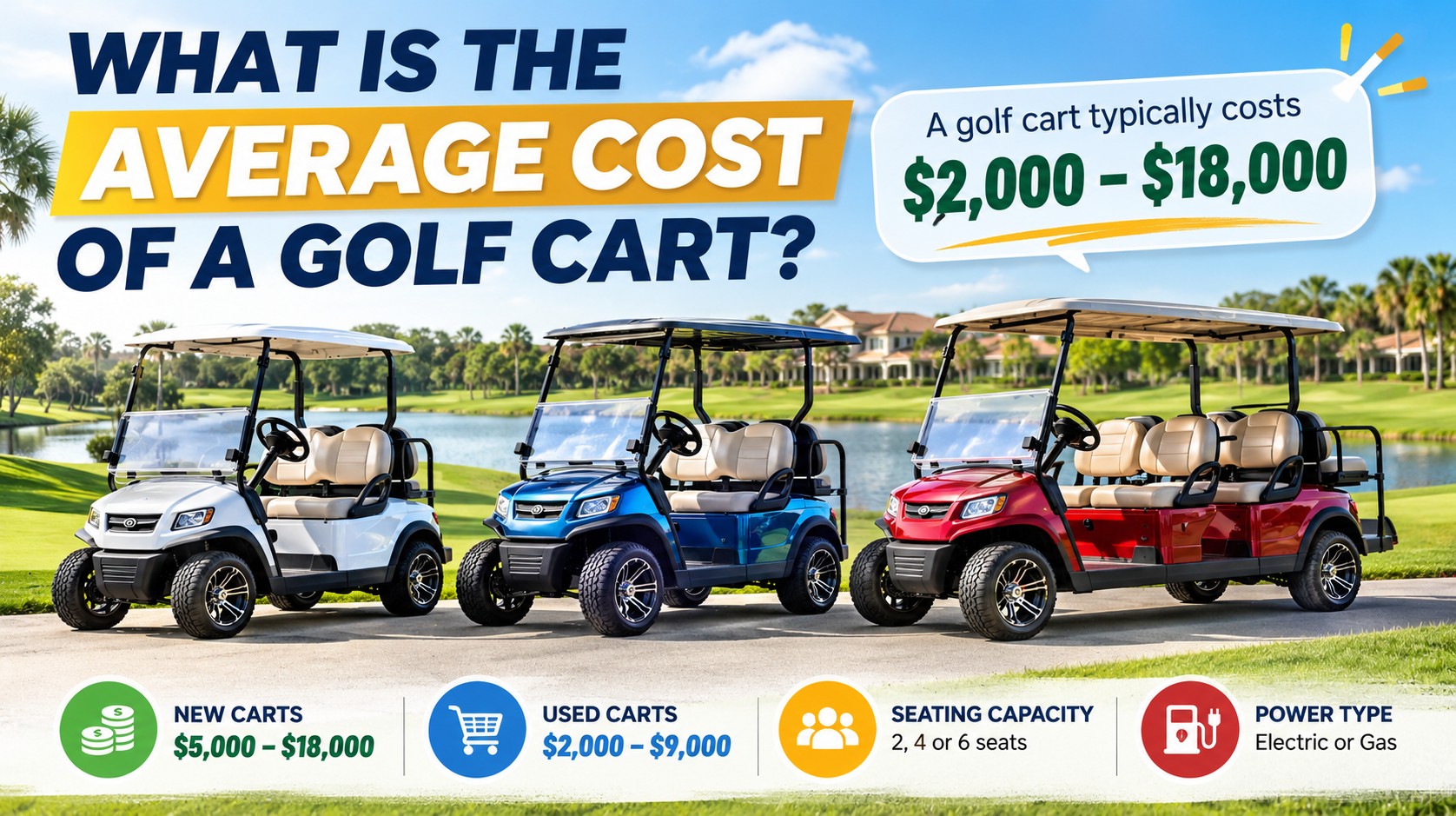
Most golf carts cost about $2,000 to $18,000. New standard carts generally fall in the $5,000 to $18,000 range, while many used carts cost around $2,000 to $9,000. Street-legal Low-Speed Vehicles can cost roughly $9,000 to $22,000 or more depending on equipment and brand.
Golf cart prices vary widely because today’s market includes everything from basic used course carts to premium lithium-powered Low-Speed Vehicles. A clean used cart may cost only a few thousand dollars, while a new four-seat or street-oriented model can exceed $10,000. Buyers comparing models from Tara EV or other manufacturers should look beyond the purchase price and consider battery condition, seating capacity, equipment, registration requirements, and long-term ownership costs.
Average Golf Cart Costs by Category
The easiest way to understand golf cart pricing is to divide the market by condition, seating capacity, and intended use.
| Cart Category & Condition | Average Price Range |
|---|---|
| Basic 2-Seater – New | $5,000 – $9,000 |
| 4-Seater Family Cart – New | $9,000 – $13,000 |
| 6-Seater Cart – New | $10,000 – $16,000 |
| Street-Legal LSV – New | $9,000 – $22,000+ |
| Used Cart – Older, 7+ Years | $2,000 – $4,500 |
| Used Cart – Modern, 1–3 Years | $6,000 – $11,000 |
These ranges are useful for budgeting, but individual carts can cost more or less depending on battery condition, accessories, local dealer pricing, customization, and vehicle specifications.
How Much Does a New Golf Cart Cost?
A basic new two-seat golf cart commonly starts around $5,000 and can approach $9,000 as features are added.
Four-seat models generally cost more because they require additional seating, stronger chassis components, greater battery capacity in some configurations, and more equipment.
Premium models may also include:
- Lithium batteries
- Touchscreen displays
- Apple CarPlay or Android Auto
- Premium seats
- LED lighting
- Large wheels and tires
- Improved suspension
- Onboard chargers
- Road-oriented safety equipment
Once a vehicle moves into the LSV category, pricing can increase further because the vehicle is designed for more demanding public-road applications.
How Much Does a Used Golf Cart Cost?
Used golf carts can offer excellent value, especially for buyers who mainly need transportation around private property, golf courses, resorts, farms, or communities.
Older carts may sell for around $2,000 to $4,500, while newer used models can cost approximately $6,000 to $11,000.
However, age alone does not determine value.
Buyers should inspect:
- Battery age and condition
- Frame corrosion
- Suspension wear
- Brake condition
- Tires
- Charger operation
- Electrical system
- Motor and controller condition
A low purchase price can become expensive very quickly if the battery pack is near the end of its life. Always ask about battery age, type, charging history, and replacement cost before buying.
The Used Golf Cart Battery Trap
Battery condition is one of the biggest hidden costs when purchasing a used electric golf cart.
A $3,000 used cart may look like a bargain, but if its flooded lead-acid batteries are already weak, replacement could immediately add approximately $800 to $2,000 to the total cost.
Other battery-related expenses may include:
- Replacement cables
- Battery trays
- Chargers
- Installation labor
- Terminal repairs
Lithium-equipped used carts may have a higher purchase price, but a healthy lithium battery can offer a longer remaining service life and lower routine maintenance.
Key Price Driver: Battery Type
Electric golf carts may use either traditional lead-acid batteries or modern lithium batteries.
| Battery Type | Purchase Cost | Ownership Characteristics |
|---|---|---|
| Flooded Lead-Acid | Lower initial cost | Requires watering and more routine maintenance |
| AGM / Sealed Lead-Acid | Moderate | Lower maintenance but still relatively heavy |
| Lithium-Ion | Higher initial cost | Lower weight, faster charging, longer cycle life, low maintenance |
A lithium-powered golf cart typically costs more upfront, but many owners value the reduced maintenance, lighter battery weight, and longer battery life.
Gas vs. Electric Golf Cart Costs
Powertrain choice also affects total ownership cost.
Gas carts use small internal combustion engines and require fuel, engine oil, filters, belts, and routine engine maintenance.
Electric carts instead require battery charging and periodic inspection of electrical components.
Electric models may have higher battery replacement costs, while gas carts have recurring fuel and engine-maintenance expenses.
For buyers who primarily drive around communities, resorts, campuses, or golf courses, electric carts are increasingly popular because they operate quietly and produce no direct tailpipe emissions.
Street-Legal Requirements Can Increase the Price
A standard golf cart and a street-oriented Low-Speed Vehicle are not the same product.
LSVs typically require additional equipment such as:
- Headlights
- Taillights
- Brake lights
- Turn signals
- Mirrors
- Windshield
- Seat belts
- VIN documentation
- Parking brake
Depending on the jurisdiction, registration, insurance, title fees, taxes, and dealer charges may also increase the total amount paid.
When comparing standard golf carts with LSVs, compare the total drive-away cost rather than only the advertised vehicle price. Registration, taxes, freight, dealer fees, insurance, and optional equipment can significantly affect the final amount.
Does Seating Capacity Affect Golf Cart Price?
Yes. Larger carts usually cost more.
A two-seat vehicle generally represents the entry point, while four-seat and six-seat carts require more chassis length, additional seating, and potentially greater battery capacity.
Buyers should choose seating based on actual use rather than simply purchasing the largest configuration available.
| Seats | Best For | Typical Price Impact |
|---|---|---|
| 2 Seats | Golf, couples, personal transportation | Lowest |
| 4 Seats | Families, communities, resorts | Moderate |
| 6 Seats | Commercial passenger transportation | Higher |
Other Features That Increase Golf Cart Cost
Golf carts can be highly customizable, and accessories can substantially increase the final purchase price.
Common upgrades include:
- Premium upholstery
- Lift kits
- Larger wheels
- Audio systems
- Touchscreen displays
- GPS systems
- Coolers
- Storage systems
- Weather enclosures
- Custom paint
Buyers should separate essential features from cosmetic upgrades before setting a budget.
What Street-Legal Low-Speed Electric Vehicles Does Tara EV Offer?
Tara EV offers three personal low-speed electric vehicle models suitable for buyers seeking more road-oriented transportation: the two-seat Roadster 2 and the four-seat Roadster 2+2 and Explorer 2+2.
| Model | Battery | Maximum Speed | Seats | MSRP |
|---|---|---|---|---|
| Roadster 2 | 105 Ah Lithium | 25 mph | 2 | $8,999 |
| Roadster 2+2 | 160 Ah Lithium | 25 mph | 4 | $9,695 |
| Explorer 2+2 | 160 Ah Lithium | 25 mph | 4 | $9,995 |
The prices shown above are Manufacturer’s Suggested Retail Prices (MSRP) and are not actual advertised dealer selling prices. Final dealer pricing may vary and can include taxes, title, registration, freight, delivery, accessories, dealer-installed options, and other charges.
Tara Roadster 2
The Roadster 2 is the most affordable of the three listed models at an MSRP of $8,999.
It combines a compact two-passenger layout with a 105Ah lithium battery and a maximum speed of 25 mph.
This configuration can suit buyers who primarily need personal or two-person transportation and do not require rear passenger seating.
Tara Roadster 2+2
The Roadster 2+2 increases seating capacity to four passengers and uses a larger 160Ah lithium battery.
At a listed MSRP of $9,695, it provides additional passenger capacity for families, communities, resorts, and recreational users.
Tara Explorer 2+2
The Explorer 2+2 also provides four seats and a 160Ah lithium battery, with an MSRP of $9,995.
Its elevated, adventure-oriented design can appeal to buyers who want a more rugged appearance while retaining a four-passenger configuration.
How Much Should You Budget for a Golf Cart?
A realistic golf cart budget should include more than the vehicle purchase price.
- Set the base vehicle budget.
- Decide whether you need two, four, or six seats.
- Choose gas, lead-acid electric, or lithium electric power.
- Determine whether public-road capability is needed.
- Check battery age on used carts.
- Budget for registration and insurance if applicable.
- Add desired accessories.
- Consider freight and dealer charges.
- Estimate future battery replacement costs.
Is a More Expensive Golf Cart Worth It?
Sometimes. A more expensive cart may include a larger lithium battery, better seating, more safety equipment, stronger suspension, advanced displays, or features that would cost significantly more to add later.
However, the best-value cart is not necessarily the most expensive one.
A buyer who only needs transportation around a private property may not benefit from paying for LSV equipment, while someone who regularly carries four passengers may quickly outgrow a two-seat model.
Conclusion
So, what is the average cost of a golf cart? Most buyers can expect to spend approximately $2,000 to $18,000, although premium and street-oriented models can exceed this range.
New basic two-seat carts often cost around $5,000 to $9,000, while four-seat models commonly reach $9,000 to $13,000. Used carts can provide significant savings, but battery condition should always be checked before purchase.
For buyers comparing new lithium-powered personal vehicles, Tara EV offers the Roadster 2 at $8,999 MSRP, the Roadster 2+2 at $9,695 MSRP, and the Explorer 2+2 at $9,995 MSRP. The best choice depends on seating needs, driving environment, battery capacity, desired features, and overall ownership budget.
