
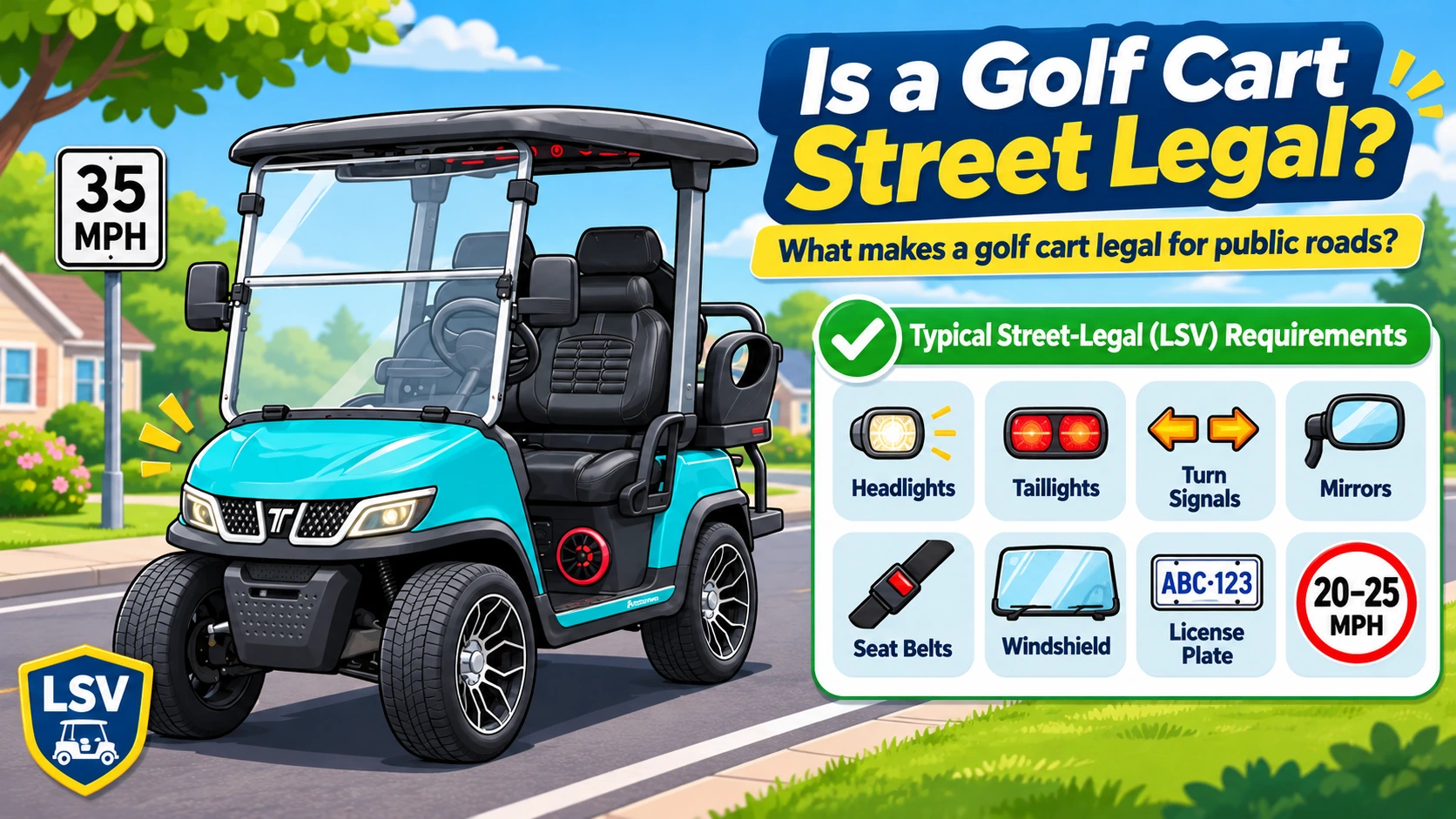
The answer depends on the type of vehicle and where you plan to drive it. A conventional golf cart and a street-legal Low-Speed Vehicle may look similar, but legally they are not necessarily the same thing.
Traditional golf carts are commonly designed for relatively low speeds and private or recreational environments. They may be allowed on certain public roads when a city, county, or state specifically permits golf-cart use, but that does not make every standard cart street legal everywhere.
An LSV, by contrast, is a federally recognized motor-vehicle category. Under federal rules, an LSV is designed to travel faster than 20 mph but no faster than 25 mph and must meet Federal Motor Vehicle Safety Standard No. 500.
For buyers interested in neighborhood transportation rather than course-only use, choosing a purpose-built road-oriented vehicle from manufacturers such as Tara EV can be more practical than trying to convert a basic golf cart after purchase.
| Feature | Standard Golf Cart | Street-Oriented LSV |
|---|---|---|
| Typical Speed | Usually around 15 mph or lower depending on model and jurisdiction | More than 20 mph but no more than 25 mph under federal LSV rules |
| Primary Use | Golf courses, private property, resorts, designated local routes | Low-speed public-road transportation where permitted |
| VIN | May use a manufacturer serial number rather than an on-road VIN | Must have a compliant VIN |
| Federal Safety Equipment | Not necessarily equipped to FMVSS No. 500 | Must satisfy applicable FMVSS No. 500 requirements |
| Registration | Depends on state and type of use | Normally required for public-road operation |
| Insurance | Depends on jurisdiction and use | Generally required by state motor-vehicle law |
| Seat Belts | May not be standard | Required at every designated seating position |
For a golf-cart-style vehicle to qualify as an LSV under federal rules, speed is only part of the equation. The vehicle must also have specific safety equipment and be properly certified.
Federal Motor Vehicle Safety Standard No. 500 requires an LSV to have:
States may impose additional equipment requirements. Depending on the jurisdiction, these can include a horn, license-plate illumination, specific tire requirements, or other equipment.
A federally compliant LSV needs a VIN that satisfies federal vehicle-identification requirements. This is an important difference between a purpose-built LSV and many traditional course carts, which may have only a manufacturer’s serial number.
Installing headlights and seat belts on a standard cart does not automatically create a federally compliant VIN or certification label.
Before buying a vehicle for street use, ask the manufacturer or dealer for documentation showing the vehicle’s classification, VIN, certification status, and whether it can be titled and registered in your state.
When an LSV is operated on public roads, registration and motor-vehicle insurance are generally required. Exact paperwork and minimum insurance limits differ by state.
A typical road-registration process may require:
Some states may also require an inspection before issuing registration.
Drivers of registered LSVs generally need to meet the driver-licensing rules of the state in which the vehicle is operated.
Do not assume that a teenager who is allowed to drive a golf cart within a private community can legally operate an LSV on public roads. Age and licensing requirements can be very different once a vehicle enters a public street.
Many states allow LSVs primarily on lower-speed roads, and a posted speed limit of 35 mph or less is a common threshold. However, this is not a universal nationwide road-access rule.
States, counties, municipalities, planned communities, and transportation authorities may establish different restrictions.
Before driving, verify:
Sometimes, but conversion can be more complicated than adding an accessory kit.
Headlights, turn signals, mirrors, seat belts, a windshield, and other hardware may make a cart physically resemble an LSV, but legal classification depends on certification and documentation as well as equipment.
Before spending money on a conversion, check with your state motor-vehicle agency to determine whether a modified cart can actually be titled and registered as an LSV.
For buyers who know from the beginning that they want public-road capability, purchasing a factory-built road-oriented vehicle can avoid many of these complications.
Tara EV currently lists several personal transportation models with published maximum speeds of 25 mph, putting their speed specification within the federal LSV range.
| Model | Seats | Battery | Published Maximum Speed |
|---|---|---|---|
| Roadster 2 | 2 | 48V 105Ah lithium | 25 mph |
| Roadster 2+2 | 4 | 48V 160Ah lithium | 25 mph |
| Explorer 2+2 | 4 | 48V 160Ah lithium | 25 mph |
The Roadster 2 is a compact two-passenger personal vehicle equipped with a 48V 105Ah lithium battery and a published maximum speed of 25 mph.
Its two-seat configuration can suit neighborhood transportation, resorts, residential communities, and short local trips where the vehicle is properly certified, registered, and legally permitted.
The Roadster 2+2 expands seating capacity to four passengers and uses a larger 48V 160Ah lithium battery. Its published maximum speed is also 25 mph.
The additional rear seating can make it more practical for families, community transportation, hospitality properties, and users who regularly carry additional passengers.
The Explorer 2+2 provides four-passenger seating, a 48V 160Ah lithium battery, and a published top speed of 25 mph.
Its configuration is aimed at users who want the convenience of low-speed transportation while preferring a more rugged vehicle appearance.
If you are shopping for a vehicle to use on public streets, check these items before purchasing:
A standard golf cart is not automatically street legal simply because it has lights or can reach 20 mph. For broader public-road use, a vehicle generally needs to qualify as a properly certified LSV and satisfy applicable registration, insurance, driver, and local road requirements. Road-oriented models such as the Tara EV Roadster 2, Roadster 2+2, and Explorer 2+2 are currently listed with 25 mph maximum speeds, but buyers should always verify the certification and legal requirements for the exact vehicle and location before driving on public streets.
