
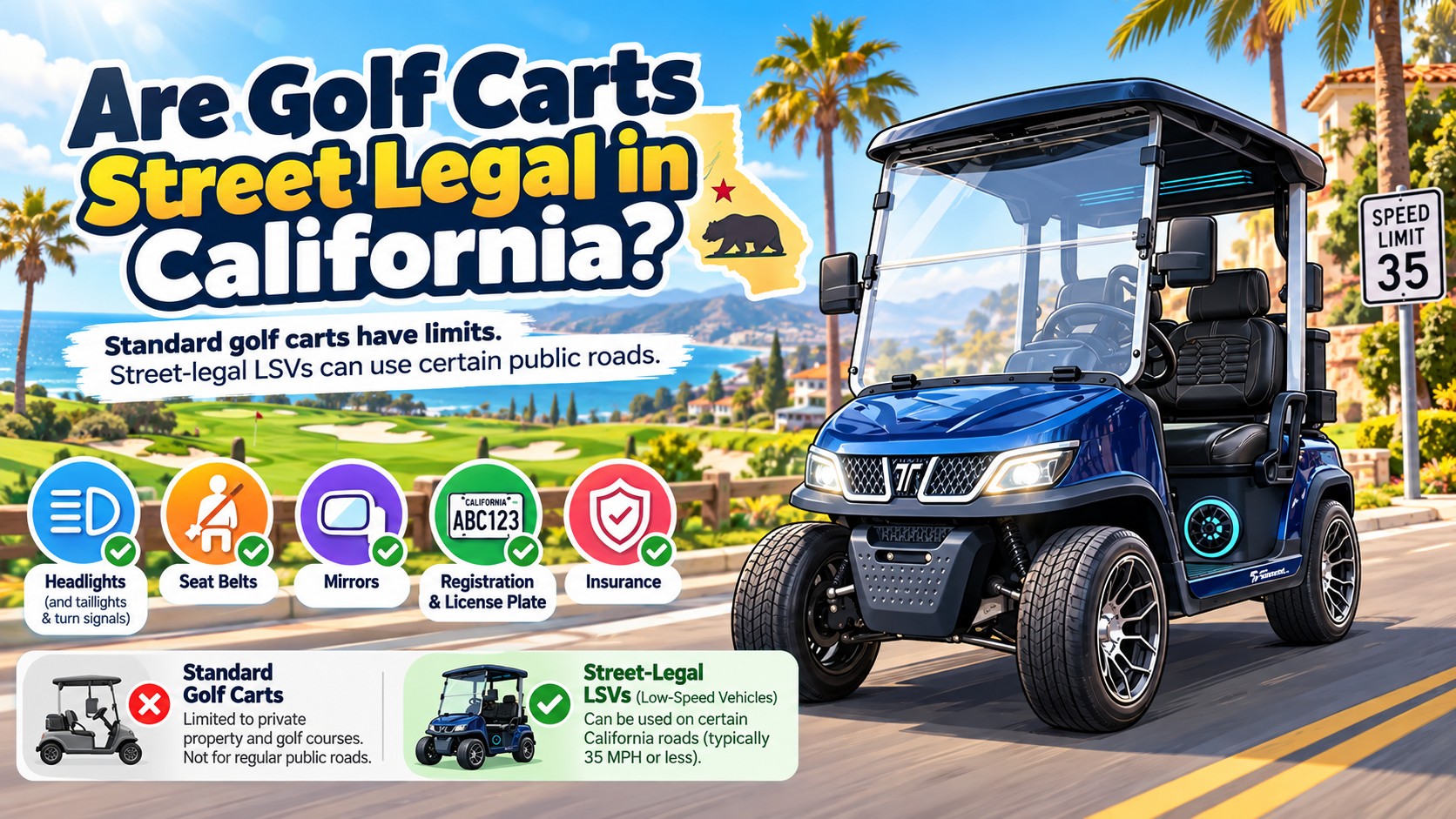
A standard golf cart is not legal for unrestricted general street use in California. It is limited to certain low-speed roads and locally authorized routes. A properly certified and registered LSV or NEV can generally operate on California roads with posted speed limits of 35 mph or less, although local authorities may impose additional restrictions.
California law treats a standard golf cart differently from a Low-Speed Vehicle, also called an LSV or Neighborhood Electric Vehicle. A traditional golf cart is designed for low-speed golf-course transportation and has limited public-road privileges. An LSV is a federally certified motor vehicle that can travel at up to 25 mph and, once properly registered and insured, can operate on many California streets. Buyers considering Tara EV models should therefore understand which vehicle category matches their intended use.
Standard Golf Carts in California
California has a specific legal definition for a golf cart. It is not simply any small electric vehicle that looks like a golf cart.
| Standard Golf Cart Requirement | California Definition |
|---|---|
| Maximum Speed | Designed and operated at no more than 15 mph |
| Weight | No more than 1,300 lbs. unladen |
| Wheels | At least three wheels in contact with the ground |
| Passengers | No more than two persons, including the driver |
| Primary Design | Designed to carry golf equipment |
A standard golf cart cannot simply travel anywhere a normal automobile can travel. California law generally limits golf-cart operation to roads with speed limits of 25 mph or less, and local ordinances can further control where these vehicles may be used.
When Can a Standard Golf Cart Use a Public Road?
California allows limited on-road golf-cart operation, but the details matter.
One important exemption applies when a golf cart travels no more than one mile from a golf course on a highway that has been specifically designated for golf-cart use by a local ordinance or resolution.
Golf carts operated under this particular provision can be exempt from normal vehicle registration requirements.
A road having a 25 mph speed limit does not automatically mean every golf cart can use it without additional requirements. Check the city or county ordinance, route designation, registration status, and local traffic rules before driving on a public street.
Do Standard Golf Carts Need California DMV Registration?
Some qualifying golf-cart operations are exempt from registration, particularly certain locally designated routes near a golf course.
However, a golf cart used outside an applicable registration exemption may become subject to California registration requirements.
California DMV specifically distinguishes between exempt golf-cart operation and on-road vehicles that must be titled and registered.
Because local rules can vary considerably, owners should verify the intended route with the California DMV and the local city or county before operating on public roads.
What Is an LSV or NEV in California?
An LSV is a separate legal vehicle category from a standard golf cart.
Under California law, a Low-Speed Vehicle must:
- Have four wheels
- Reach more than 20 mph but no more than 25 mph on a paved level surface
- Have a gross vehicle weight rating below 3,000 lbs.
- Meet applicable federal Low-Speed Vehicle safety standards
An LSV is also commonly referred to as a Neighborhood Electric Vehicle, or NEV.
Where Can an LSV Be Driven in California?
California generally allows LSVs and NEVs to operate on roads with posted speed limits of 35 mph or less.
They generally cannot travel along roads with speed limits above 35 mph. California law does, however, permit certain crossings of higher-speed roads where the crossing begins and ends on roads limited to 35 mph or less and other legal conditions are met.
| Road Condition | LSV / NEV Use |
|---|---|
| Road posted at 25 mph | Generally permitted, subject to local restrictions |
| Road posted at 35 mph | Generally permitted, subject to local restrictions |
| Road posted above 35 mph | Generally prohibited for normal travel |
| Crossing a road above 35 mph | May be permitted at qualifying intersections |
Local governments and law-enforcement agencies can also restrict or prohibit LSV operation on specific roads for safety reasons.
What Does a Street-Legal LSV Need?
A California LSV operated on public roads must meet the federal safety standards applicable to Low-Speed Vehicles and comply with normal motor-vehicle requirements.
Typical LSV equipment includes:
- Headlights
- Tail lights
- Brake lights
- Front and rear turn signals
- Seat belts
- Rearview and side mirrors as required
- Windshield meeting applicable standards
- Parking brake
- Vehicle Identification Number
The vehicle also needs proper California registration, financial responsibility such as liability insurance, and a qualified licensed driver.
An LSV is treated as a motor vehicle. The driver must follow applicable traffic laws, and the vehicle must remain compliant with its federal LSV certification when operated on public roads.
Do You Need Insurance for an LSV in California?
Yes. Vehicles operated or parked on California public roadways are generally required to maintain financial responsibility.
For a registered LSV, this normally means carrying qualifying liability insurance or another legally accepted form of financial responsibility.
California’s current minimum liability limits for private passenger, commercial, and fleet vehicles are:
| Coverage | Minimum Amount |
|---|---|
| Injury or Death to One Person | $30,000 |
| Injury or Death to Multiple People | $60,000 |
| Property Damage | $15,000 |
How Do You Make a Golf Cart Street Legal in California?
This is where California rules are especially important.
You generally cannot take an ordinary 15 mph golf cart, install headlights, mirrors, seat belts, turn signals, and a faster motor, and then automatically register it as an LSV.
California Highway Patrol guidance states that vehicles registered and operated as LSVs must have been specifically certified by the manufacturer to comply with Federal Motor Vehicle Safety Standard No. 500.
Adding aftermarket accessories alone does not create that certification.
A DIY conversion may look street-ready but still fail California LSV registration requirements. The simplest route for public-road use is usually to purchase a vehicle that was manufactured and certified as an LSV from the beginning.
What Happens If You Modify a Standard Golf Cart?
California DMV states that if a golf cart is modified to travel faster than 15 mph or carry more than two persons, it no longer fits the state’s standard golf-cart definition.
Instead, it can be treated as a regular motor vehicle and must satisfy applicable Federal Motor Vehicle Safety Standards.
That requirement is significantly more complex than simply adding lights and mirrors.
Standard Golf Cart vs. LSV in California
| Feature | Standard Golf Cart | LSV / NEV |
|---|---|---|
| Top Speed | 15 mph or less | More than 20 mph, up to 25 mph |
| Weight Standard | Up to 1,300 lbs. unladen | GVWR below 3,000 lbs. |
| General Road Limit | Highly restricted | Roads of 35 mph or less |
| Registration | May be exempt only in qualifying situations | Required |
| Insurance | Depends on operation and registration status | Required for public-road operation |
| Federal LSV Certification | No | Required |
Buying a Factory LSV Is the Easier Option
If the primary goal is driving around a California community, resort, neighborhood, or other permitted public-road environment, purchasing a factory LSV is generally more straightforward than attempting to modify an ordinary golf cart.
A purpose-built LSV is engineered around the required speed range and road-oriented safety equipment from the beginning.
You will still need to confirm the individual vehicle’s certification, California registration eligibility, insurance, and local road restrictions before driving it on public streets.
Tara EV LSV Models
Tara EV currently lists three personal transportation models in its LSV category: Roadster 2, Roadster 2+2, and Explorer 2+2.
| Tara Model | Seats | Battery | Listed LSV Speed |
|---|---|---|---|
| Roadster 2 | 2 | 48V 105Ah Lithium | Up to 25 mph |
| Roadster 2+2 | 4 | 48V 160Ah Lithium | Up to 25 mph |
| Explorer 2+2 | 4 | 48V 160Ah Lithium | Up to 25 mph |
Tara Roadster 2
The Roadster 2 provides a compact two-passenger configuration powered by a 48V 105Ah lithium battery.
Its smaller passenger layout makes it suitable for couples, individual transportation, resorts, and community travel where permitted.
Tara Roadster 2+2
The Roadster 2+2 adds rear passenger seating and uses a larger 48V 160Ah lithium battery.
The four-passenger arrangement can be useful for families and community transportation where the vehicle is legally registered and permitted to operate.
Tara Explorer 2+2
The Explorer 2+2 also provides four-passenger seating and a 48V 160Ah lithium battery, with a lifted design intended for broader personal transportation applications.
Tara identifies Roadster 2, Roadster 2+2, and Explorer 2+2 as LSV-category models. For California road use, confirm that the specific vehicle being purchased carries the required federal LSV certification label and VIN, then complete DMV registration and insurance before operating it on public roads.
California Street-Legal Checklist
- Determine whether the vehicle is a standard golf cart or factory-certified LSV.
- Check the manufacturer’s federal certification label.
- Verify the VIN and vehicle documentation.
- Confirm California DMV registration eligibility.
- Obtain required financial responsibility or liability insurance.
- Make sure all required lighting, mirrors, restraints, and safety equipment are present.
- Use a valid driver’s license.
- Check city and county ordinances.
- Confirm the posted speed limit of every road on the intended route.
- Avoid roads where LSV operation has been locally restricted or prohibited.
Conclusion
So, are golf carts street legal in California? Standard golf carts have limited public-road privileges and are not designed for unrestricted street transportation. Their operation depends on vehicle specifications, road speed limits, registration rules, and local ordinances.
A factory-certified LSV provides broader road access. California generally allows LSVs on streets with posted speed limits of 35 mph or less, provided the vehicle meets federal LSV standards, is registered and insured, and is operated by a qualified driver.
For buyers who want a vehicle primarily for community or permitted public-road transportation, choosing a purpose-built LSV can be considerably simpler than attempting to convert a traditional golf cart. Tara EV currently places the Roadster 2, Roadster 2+2, and Explorer 2+2 in its LSV category, offering two- and four-passenger lithium-powered options for this type of use.
