
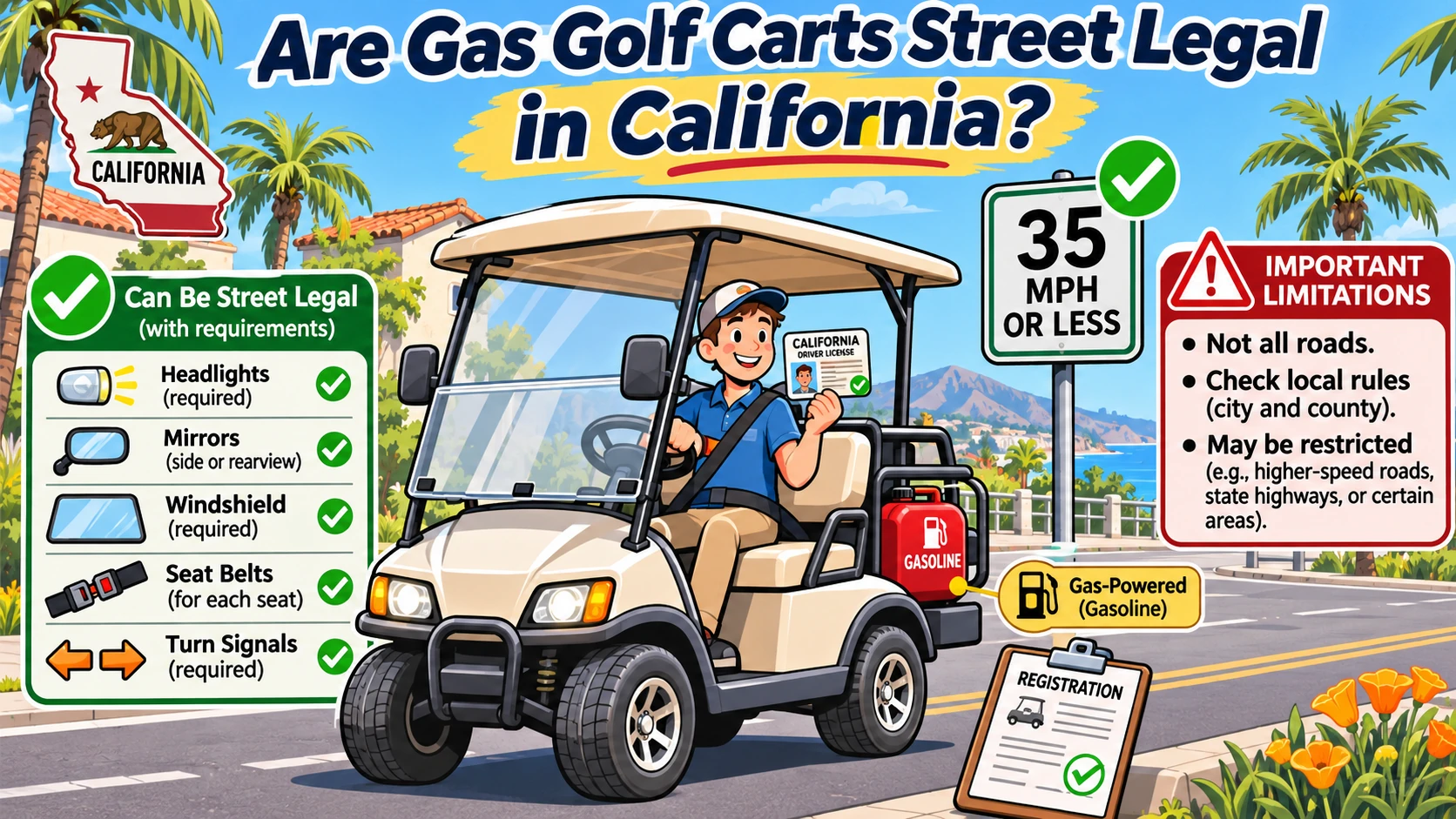
The answer is sometimes, but only under specific conditions. California law treats a conventional golf cart differently from a Low-Speed Vehicle, or LSV, and differently again from a regular passenger vehicle.
A conventional golf cart in California is generally defined as a vehicle designed to carry golf equipment and no more than two people, with an unladen weight of no more than about 1,300 pounds and a designed operating speed of no more than 15 mph.
This means a typical gasoline-powered golf cart should not be treated like a normal automobile simply because it has headlights or turn signals.
However, certain golf carts may legally operate on designated public roads when local ordinances and state requirements allow it.
Understanding the difference between a standard golf cart and an LSV is essential before attempting to drive a gas cart on public roads.
| Requirement | Standard Golf Cart | Low-Speed Vehicle |
|---|---|---|
| Typical Maximum Speed | 15 mph | More than 20 mph but no more than 25 mph |
| Primary Use | Golf courses, private property, and limited designated-road use | Low-speed public-road transportation |
| Public Road Limit | Subject to local and state restrictions | Generally roads posted at 35 mph or less |
| Registration | May be exempt in certain limited situations | Generally requires registration |
| Safety Equipment | Basic golf-cart configuration | Must meet applicable LSV safety standards |
| Insurance | Depends on road use and registration | Required for public-road operation |
This is where many owners misunderstand California law. Adding lights, mirrors, seat belts, and a higher-speed controller does not automatically turn a conventional golf cart into a legal LSV.
Federal rules define an LSV as a four-wheel motor vehicle with a gross vehicle weight rating below 3,000 pounds and a top speed greater than 20 mph but no more than 25 mph.
In addition, an LSV must satisfy Federal Motor Vehicle Safety Standard No. 500. The vehicle must have required equipment and proper certification.
California DMV guidance also states that when a conventional golf cart is modified to travel faster than 15 mph or carry more than two people, it may be treated as a regular motor vehicle rather than simply remaining registered as a golf cart.
Federal LSV standards require several important safety components. A compliant low-speed vehicle generally needs the following equipment:
California law also requires motor vehicles operated on highways to have a working horn that can normally be heard from at least 200 feet.
These requirements are one reason buyers interested in street use often benefit from purchasing a vehicle originally designed and certified for on-road operation instead of converting ordinary golf carts after purchase.
California limits where LSVs and Neighborhood Electric Vehicles can operate. In general, an LSV cannot be driven on a public road where the posted speed limit is greater than 35 mph.
This restriction applies even though the vehicle itself may be capable of reaching 25 mph.
Drivers should also check city and county ordinances because local governments can establish designated routes, additional restrictions, or special golf-cart transportation plans.
A street-compliant low-speed vehicle should not be treated like a full-speed passenger car. Drivers should avoid:
Gasoline-powered golf carts face an additional issue that electric carts do not: emissions compliance.
California DMV guidance states that gasoline-powered golf carts may be exempt from emissions testing, but they are not automatically exempt from California Air Resources Board emission requirements.
For on-road registration, the vehicle may need a valid label showing that it complies with California emissions requirements.
If the required emissions-compliance label is missing, a gasoline golf cart may be limited to off-highway registration and use.
This makes emissions certification one of the most important items to verify before buying a gasoline cart that you plan to use on public roads.
A vehicle intended for legal public-road use must also satisfy California registration requirements for its classification.
Depending on the vehicle, documentation may include:
Modern motor vehicles intended for ordinary highway registration generally require a compliant 17-digit VIN. A valid VIN alone, however, does not prove that a gas cart is street legal.
For registered LSVs and similar road-going motor vehicles, the operator must comply with California driver licensing and financial-responsibility requirements.
California currently requires minimum liability coverage of:
| Coverage | California Minimum |
|---|---|
| Injury or death to one person | $30,000 |
| Injury or death to more than one person | $60,000 |
| Property damage | $15,000 |
Drivers must also carry evidence of financial responsibility when operating a registered motor vehicle on California roads.
California provides limited exceptions for qualifying golf carts operated near golf courses.
A qualifying golf cart may be exempt from registration when it is operated no more than one mile from a golf course on a highway specifically designated for golf-cart operation by a local ordinance or resolution.
This is a much narrower rule than saying a cart can travel freely anywhere within one mile of a golf course.
Standard golf carts are also generally restricted from highways with posted speed limits above 25 mph unless a local authority has specifically authorized their operation.
Before taking a gasoline-powered golf cart onto a California public road, check each of the following:
Electric vehicles avoid the gasoline-emissions issue, but that does not mean every electric cart is automatically street legal. The same questions about vehicle classification, speed, safety certification, registration, insurance, and local road restrictions still matter.
For buyers who plan to travel beyond a golf course, choosing purpose-built golf carts with appropriate road-oriented equipment can be more practical than attempting to convert a basic course cart later.
Gas golf carts can have limited legal road use in California, but a conventional cart is not automatically street legal. Standard golf carts are generally limited to 15 mph and specific permitted situations, while LSVs must satisfy separate speed, safety, registration, insurance, and road-use requirements. Gas-powered vehicles also need particular attention to California emissions compliance, so owners should verify the vehicle’s certification and DMV classification before driving on public streets.
