
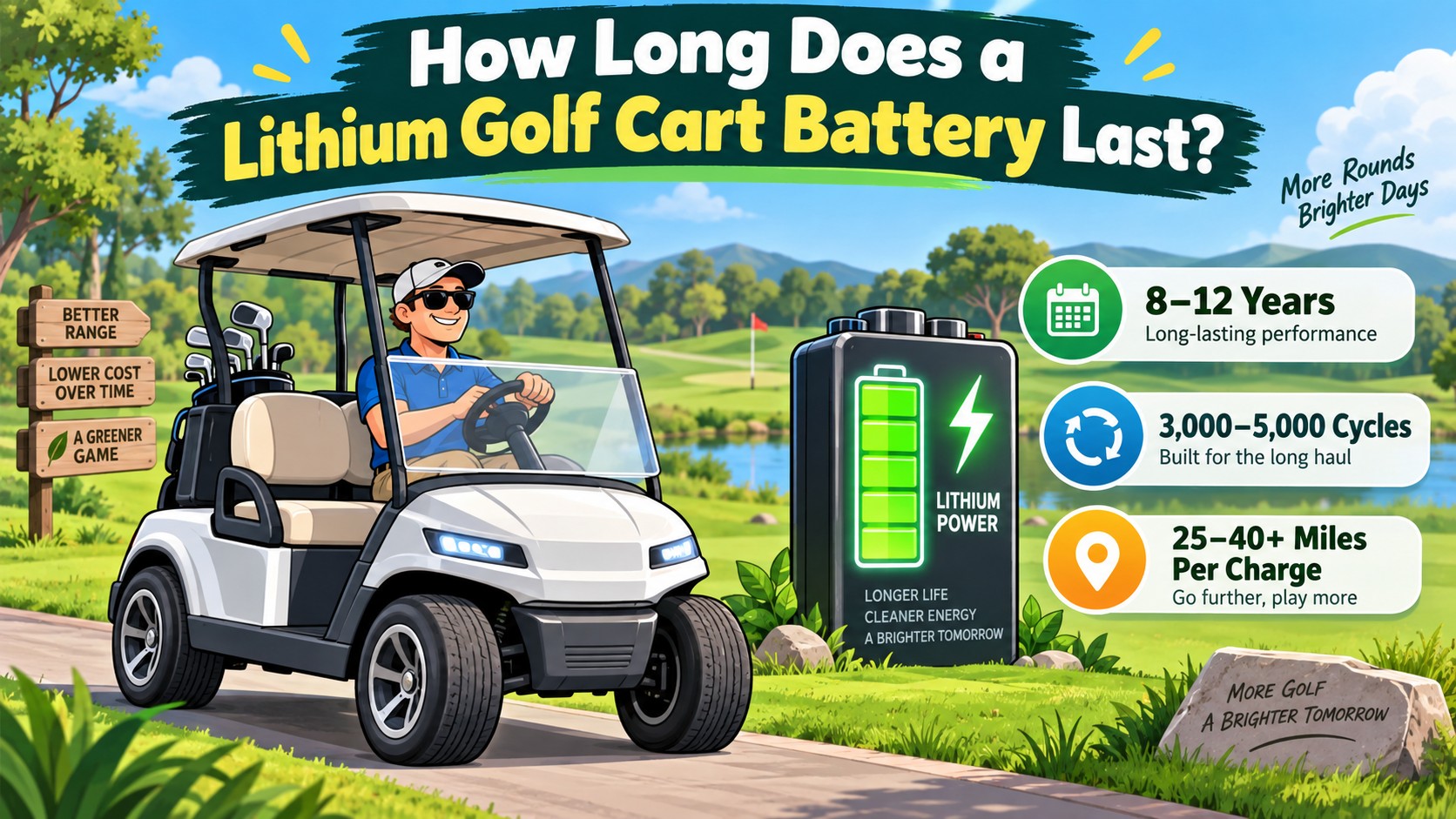
A quality lithium golf cart battery commonly lasts about 8 to 12 years, with many LiFePO4 systems rated for approximately 3,000 to 5,000 charge cycles depending on depth of discharge, temperature, charger quality, and battery management. Under ideal operating and storage conditions, some packs may remain usable even longer.
Lithium batteries have become a popular upgrade for electric golf carts because they generally offer longer service life, faster charging, lower weight, and less routine maintenance than traditional flooded lead-acid batteries. Modern vehicles from Tara EV, for example, use 48V lithium battery systems designed for reliable daily golf-course and personal transportation.
How Many Years Does a Lithium Golf Cart Battery Last?
For most personal golf carts, a realistic lithium battery lifespan is approximately 8 to 12 years. Actual service life depends heavily on how frequently the cart is driven and how the battery is treated.
A residential owner who drives a few times per week may accumulate relatively few full equivalent cycles each year. In contrast, a golf course, resort, or commercial fleet may use the same cart every day and accumulate cycles much faster.
| Use Pattern | Typical Life Expectancy | Main Factors |
|---|---|---|
| Light Residential Use | 8–12+ years | Low annual mileage, regular charging, protected storage |
| Frequent Personal Use | 7–10 years | More charge cycles and deeper regular discharge |
| Golf Course Fleet | 5–10 years | Daily use, multiple rounds, frequent opportunity charging |
| Heavy Commercial Use | Varies significantly | High annual cycle count, load, temperature, and charging schedule |
How Many Charge Cycles Does a Lithium Golf Cart Battery Last?
Cycle life is often a better way to evaluate lithium battery longevity than calendar age.
A charge cycle represents the equivalent of using 100% of the battery’s capacity. It does not necessarily mean one charging session. For example, using 50% today and 50% tomorrow before recharging represents approximately one full equivalent cycle.
Many quality LiFePO4 golf cart batteries are designed for roughly 3,000 to 5,000 cycles under specified conditions.
The exact rating depends on:
- Depth of discharge
- Cell chemistry
- Battery quality
- Charge current
- Operating temperature
- Battery Management System settings
- Manufacturer testing standards
Do not assume that every lithium battery with a similar voltage has the same lifespan. Compare the manufacturer’s cycle-life rating at a specified depth of discharge, such as 80% DOD, rather than relying only on an advertised number of years.
How Far Can a Lithium Golf Cart Go on One Charge?
A standard 48V lithium golf cart may travel approximately 25 to 40 miles or more on one charge, depending on battery capacity, vehicle weight, speed, terrain, tires, passenger load, and driving conditions.
| Factor | Effect on Driving Range |
|---|---|
| Battery Ah Capacity | Higher capacity generally provides more available energy and longer range. |
| Hills | Frequent climbing increases energy consumption. |
| Passengers | More weight increases power demand. |
| Speed | Continuous high-speed driving can reduce range. |
| Tire Pressure | Low pressure increases rolling resistance. |
| Temperature | Extreme temperatures can temporarily reduce available performance. |
A larger battery does not necessarily make the cart faster; instead, it primarily increases the amount of energy available for driving.
What Factors Affect Lithium Golf Cart Battery Life?
1. Depth of Discharge
Lithium batteries tolerate deeper discharge much better than traditional lead-acid batteries, but constantly pushing a battery to its lowest permitted charge level can still increase long-term wear.
Charging before the pack becomes completely depleted can help reduce battery stress and is convenient because lithium batteries do not normally require full discharge before charging.
2. Temperature
Temperature has a major effect on lithium battery performance and longevity.
Extreme heat accelerates chemical aging, particularly when the battery remains fully charged for long periods. Very cold temperatures can reduce available capacity, and charging at temperatures below the manufacturer’s permitted limit should be avoided.
For long battery life, store and charge the cart within the temperature range specified by the manufacturer.
3. Usage Frequency
A privately owned cart that is driven on weekends accumulates cycles much more slowly than a commercial cart that completes several rounds or transportation routes every day.
This explains why two identical batteries installed at the same time can have very different replacement dates.
4. Charger Compatibility
Always use a charger designed for the battery’s chemistry and voltage.
A lithium charger uses a charging profile appropriate for lithium cells and works with the battery system to prevent excessive voltage or current. Using an incompatible charger can reduce performance and potentially damage the battery.
5. Battery Management System
A Battery Management System, or BMS, monitors important battery conditions such as cell voltage, current, temperature, and state of charge.
The BMS can protect the battery by limiting or stopping operation when conditions move outside safe limits. A well-designed BMS is therefore an important part of long-term lithium battery reliability.
Do Lithium Golf Cart Batteries Need Maintenance?
Lithium batteries are often described as maintenance-free because they eliminate several tasks associated with flooded lead-acid batteries.
You normally do not need to:
- Add distilled water
- Clean routine acid overflow
- Perform traditional equalization charging
- Check individual electrolyte levels
However, maintenance-free does not mean inspection-free.
Owners should still inspect the battery compartment, cables, charger connection, terminals, mounting hardware, and battery case periodically.
Keep the area clean and dry, and investigate unusual heat, odors, error codes, swelling, damaged wiring, or sudden changes in driving range.
Lithium vs. Lead-Acid Golf Cart Battery Lifespan
| Feature | Lithium / LiFePO4 | Flooded Lead-Acid |
|---|---|---|
| Typical Service Life | Often 8–12 years | Often about 3–6 years |
| Cycle Life | Often 3,000–5,000 cycles depending on design | Generally much lower |
| Watering | Not required | Required regularly |
| Charging Speed | Generally faster | Generally slower |
| Weight | Lower | Higher |
| Opportunity Charging | Well suited | Less convenient for frequent partial charging |
How Much Does It Cost to Replace a Lithium Golf Cart Battery?
A complete lithium golf cart battery replacement or conversion can commonly cost approximately $1,500 to $4,500, with many owners budgeting around $2,000 to $3,000 for a complete system.
The final cost depends heavily on battery capacity, brand, chemistry, warranty, charger requirements, communication hardware, installation, and whether additional electrical components are required.
| Cost Factor | Why It Matters |
|---|---|
| Battery Capacity | 160Ah and larger packs generally cost more than 100–105Ah systems. |
| Battery Quality | Premium cells, stronger BMS protection, and certification can increase price. |
| Charger | A compatible lithium charger may be required. |
| Installation | Professional installation adds labor cost. |
| Conversion Components | Some lead-acid-to-lithium conversions require additional wiring or mounting parts. |
| Warranty | Longer manufacturer coverage can increase initial purchase price. |
Do not choose a lithium battery only by purchase price. Compare usable capacity, cycle-life rating, BMS features, warranty, compatible charger, physical fit, and total installed cost.
Does Tara EV Use Lithium Batteries?
Yes. Modern Tara EV models use 48V lithium battery systems.
For example, Tara’s L48105 battery is a 48V 105Ah LiFePO4 battery with approximately 5.04 kWh of energy capacity. The manufacturer’s current data sheet rates this battery at more than 3,500 cycles at 80% depth of discharge.
The battery also includes an integrated Battery Management System and is designed specifically for electric golf cart applications.
| Tara Battery Specification | L48105 |
|---|---|
| Nominal Voltage | 48V |
| Capacity | 105Ah |
| Energy | 5.04 kWh |
| Chemistry | LiFePO4 |
| Cycle Rating | More than 3,500 cycles at 80% DOD |
| Charge Efficiency | Greater than 98% |
Golf-focused Tara EV models such as the Spirit Air and Spirit Plus currently use 48V 105Ah lithium batteries and list an estimated driving range of at least 40 miles.
Tara’s current 48V 105Ah LiFePO4 battery provides 5.04 kWh of energy and is rated for more than 3,500 cycles at 80% depth of discharge. Actual service life depends on driving conditions, charging habits, temperature, storage, and annual usage.
How Can You Make a Lithium Golf Cart Battery Last Longer?
- Use only the correct lithium-compatible charger.
- Avoid repeatedly running the battery to its absolute minimum state of charge.
- Keep the battery within the manufacturer’s temperature limits.
- Avoid storing the cart fully discharged for long periods.
- Inspect cables and terminals regularly.
- Keep the battery compartment clean and dry.
- Follow long-term storage instructions when the cart will not be used for several months.
- Investigate BMS warnings rather than repeatedly resetting faults.
When Should You Replace a Lithium Golf Cart Battery?
A lithium battery does not suddenly become unusable when it reaches a specific age. Capacity normally declines gradually over time.
Possible replacement signs include:
- Noticeably shorter driving range
- Longer or abnormal charging behavior
- Repeated BMS fault codes
- Unexpected power shutdowns
- Battery swelling or physical deformation
- Difficulty maintaining normal performance under load
A battery showing swelling, severe physical damage, smoke, unusual heat, or a strong abnormal odor should be removed from normal operation and inspected immediately.
Conclusion
So, how long does a lithium golf cart battery last? A quality LiFePO4 system can often provide around 8 to 12 years of useful service and approximately 3,000 to 5,000 charge cycles, although actual longevity depends on usage, battery quality, temperature, charging habits, and depth of discharge.
Lithium batteries also offer faster charging, lower weight, reduced routine maintenance, and a longer service life than conventional lead-acid batteries. Replacement systems commonly cost between $1,500 and $4,500 depending on capacity and configuration.
Modern Tara EV vehicles use 48V lithium batteries, including a 105Ah LiFePO4 system rated for more than 3,500 cycles at 80% DOD, providing a practical long-life power solution for golf-course and personal transportation applications.
