
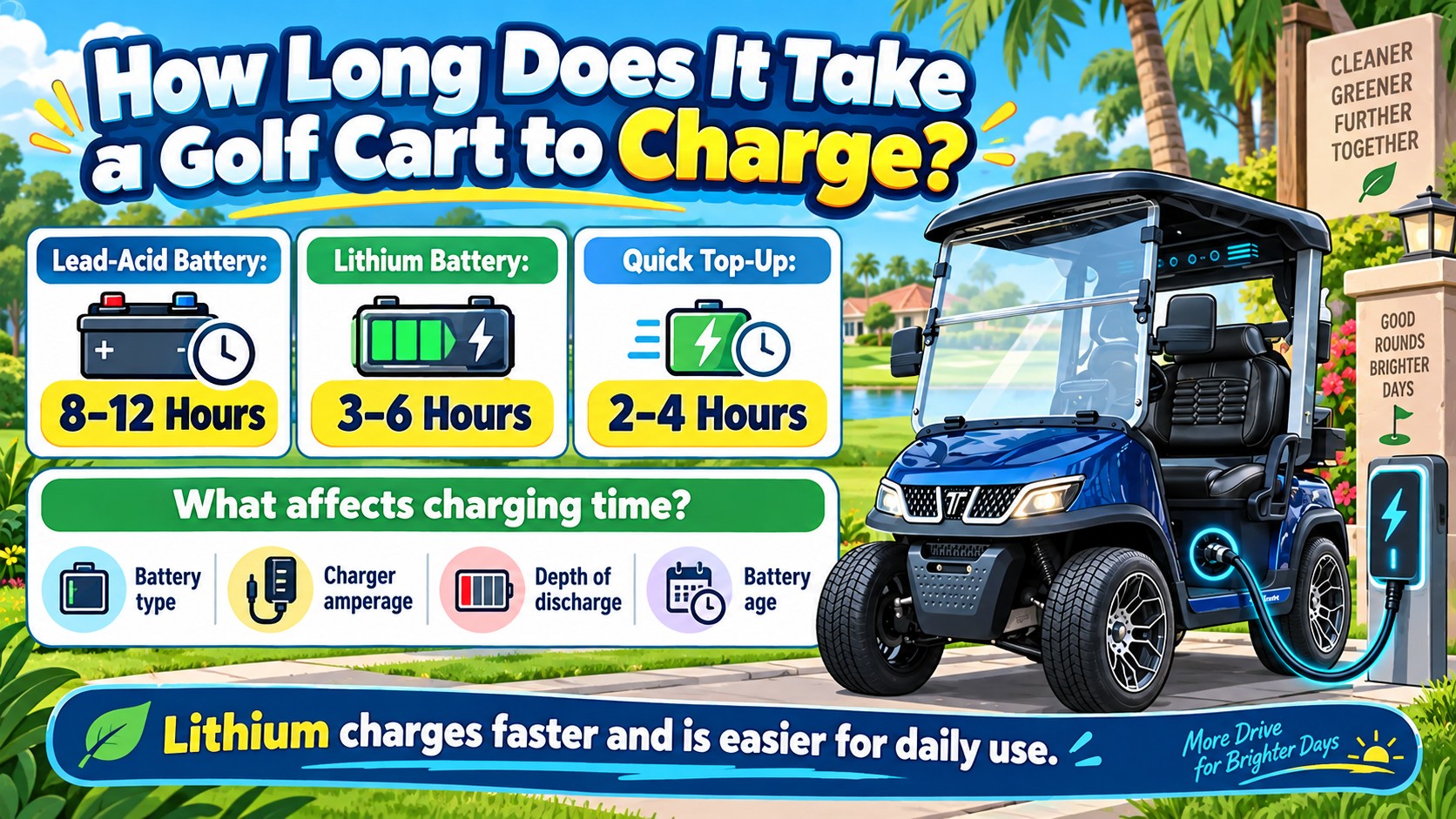
A lead-acid golf cart generally takes about 8 to 12 hours to charge from a heavily discharged state, while a lithium golf cart typically takes around 3 to 6 hours. Some modern lithium-powered golf carts can complete a normal charge in approximately 4 hours. Partial charging may require only 1 to 3 hours, depending on how much energy has been used.
Charging time is an important consideration for anyone using an electric golf cart for golf courses, resorts, communities, or daily transportation. Traditional lead-acid battery packs generally require much longer charging periods, while modern lithium-powered carts can often return to service within only a few hours. Vehicles from Tara electric vehicles, for example, use 48V lithium battery systems designed to provide convenient charging and consistent electric performance.
Golf Cart Charging Time by Battery Type
Battery chemistry is one of the biggest factors determining how long a golf cart takes to charge. Most electric golf carts use either traditional lead-acid batteries or lithium batteries.
| Battery Type | Typical Full Charge Time | Partial Charge | Main Advantage |
|---|---|---|---|
| Flooded Lead-Acid | 8–12 hours | 3–6 hours | Lower initial battery cost |
| Older Lead-Acid Pack | 10–16 hours in some cases | 4–8 hours | Widely available |
| Lithium Battery | 3–6 hours | 1–3 hours | Fast charging and high efficiency |
| Modern 48V Lithium System | About 4 hours on some golf carts | About 1–2 hours for opportunity charging | Convenient daily charging |
How Long Does a Lead-Acid Golf Cart Take to Charge?
A golf cart with flooded lead-acid batteries normally takes approximately 8 to 12 hours to reach a full charge when the battery pack has been significantly discharged.
A deeply discharged, cold, old, or poorly maintained battery pack may need even longer. In some situations, charging can approach 14 to 16 hours because the charger reduces current during the final stage of the charging cycle.
Lead-acid batteries usually use a multi-stage charging process. The charger delivers relatively high current during the bulk stage and then gradually reduces current during the absorption stage as the battery approaches full charge.
This slower final stage is important because charging a lead-acid battery too aggressively can increase heat, water consumption, and battery wear.
How Long Does a Lithium Golf Cart Take to Charge?
Lithium golf cart batteries generally charge much faster than traditional lead-acid batteries. A typical lithium system may require around 3 to 6 hours for a complete charge from a low state of charge.
Some modern carts are designed around approximately four-hour charging cycles. This can be particularly helpful for golf courses and commercial operations where vehicles need to return to service quickly.
Lithium batteries also work well with opportunity charging. Instead of waiting until the battery is nearly empty, operators can connect the charger during lunch breaks, between rounds, or whenever the cart is temporarily parked.
You do not need to completely discharge a lithium golf cart battery before recharging it. Frequent partial charging is generally acceptable when using the correct charger and battery management system.
What Factors Affect Golf Cart Charging Time?
1. Depth of Discharge
The amount of energy remaining in the battery has a direct effect on charging time.
If a golf cart finishes the day with 60% battery remaining, it may need only a short top-up charge. A battery that has been discharged close to its lower limit will naturally take much longer.
| Approximate Battery Level | Possible Charging Situation |
|---|---|
| 70–80% remaining | Short top-up, often around 1–2 hours with lithium |
| 40–60% remaining | Moderate charging period |
| 20–30% remaining | Several hours normally required |
| Nearly depleted | Expect close to the battery’s maximum normal charging time |
2. Charger Amperage
Charger output also plays a major role. A higher-amperage compatible charger can deliver energy to the battery faster than a lower-amperage charger.
However, owners should never assume that a more powerful charger is automatically better. The battery has a specified maximum charging current, and the charger must match the battery chemistry, voltage, capacity, and Battery Management System requirements.
3. Battery Capacity
A larger battery stores more energy and may take longer to recharge when using the same charger.
For example, a 48V 160Ah lithium battery contains substantially more usable energy than a 48V 105Ah battery. If both use chargers with similar output, the larger battery normally requires more charging time.
4. Battery Age and Condition
Battery age can also influence charging behavior.
Older lead-acid batteries may develop sulfation, reduced capacity, increased internal resistance, or weak cells. These problems can cause irregular or longer charging cycles.
Lithium batteries experience gradual capacity loss as they accumulate cycles, although their Battery Management Systems help monitor voltage, current, and temperature during charging.
5. Temperature
Very high or low temperatures can affect charging performance. Modern lithium systems may reduce or stop charging when battery temperature moves outside the permitted range.
Always follow the battery manufacturer’s specified charging temperature limits.
Can You Leave a Golf Cart Charging Overnight?
Many modern automatic golf cart chargers are designed to stop or significantly reduce charging after the battery reaches its target state of charge.
However, owners should use only the approved charger, keep the charging area dry and ventilated, and regularly inspect plugs, cables, outlets, and battery connections.
If you use lead-acid batteries, adequate ventilation is particularly important because flooded batteries can release hydrogen gas while charging.
Never use a damaged charger or extension cord, and do not substitute a charger designed for a different battery chemistry or voltage. Always follow the golf cart and battery manufacturer’s charging instructions.
Does It Take a Lot of Electricity to Charge a Golf Cart?
Compared with a full-size electric car, a golf cart generally requires a relatively small amount of electricity.
A 48V 105Ah lithium battery stores approximately 5.04 kWh of energy. Because some energy is lost through the charger and electrical system, recharging a nearly empty battery may require somewhat more electricity from the wall than the battery’s rated capacity.
For example, if a charging session consumes approximately 5.5 kWh and electricity costs $0.15 per kWh, the approximate electricity cost would be:
5.5 kWh × $0.15 = $0.83 per full charge
Actual cost varies with electricity rates, battery capacity, charger efficiency, and how deeply the battery is discharged.
| Electricity Rate | Example 5.5 kWh Charge |
|---|---|
| $0.10/kWh | About $0.55 |
| $0.15/kWh | About $0.83 |
| $0.20/kWh | About $1.10 |
| $0.30/kWh | About $1.65 |
This relatively low energy requirement is one reason electric golf carts can be economical for short-distance transportation.
What Type of Battery Do Tara Electric Vehicles Use?
Tara electric vehicles use 48V lithium battery systems across their modern electric vehicle lineup.
One available Tara battery specification is a 48V 105Ah LiFePO4 battery with approximately 5.04 kWh of energy capacity. Tara also offers larger lithium battery options for applications requiring greater driving range.
The lithium system provides several practical benefits compared with conventional flooded lead-acid batteries:
- Faster charging
- No routine battery watering
- High charging efficiency
- Lower battery weight
- Consistent voltage during use
- Thousands of potential charge cycles
- Integrated battery management
- Convenient opportunity charging
Certain Tara electric vehicles list charging times of approximately four hours, although the exact time depends on battery capacity, charger specification, and remaining state of charge.
Tara uses 48V lithium battery technology for modern electric golf cart applications. A 48V 105Ah battery stores about 5.04 kWh and can support faster, more convenient charging than traditional lead-acid battery packs.
How Can You Charge a Golf Cart Faster?
- Use the charger recommended by the vehicle manufacturer.
- Charge before the battery becomes completely depleted.
- Use opportunity charging during periods when the cart is not being driven.
- Keep charging connectors clean and secure.
- Keep the battery within its recommended temperature range.
- Replace damaged or inefficient charging equipment.
- Do not use an undersized charger if the manufacturer specifies a higher compatible output.
The goal should not simply be to force as much current into the battery as possible. The best charging system balances speed, battery temperature, cell protection, and long-term battery life.
How Do You Know When a Golf Cart Is Fully Charged?
Most modern chargers provide an indicator showing when charging is complete. Lithium golf carts may also provide battery percentage information through the dashboard, touchscreen, or battery management system.
Automatic chargers reduce or stop current when the required charge level is reached. If a charger repeatedly runs much longer than normal, becomes excessively hot, displays fault codes, or fails to complete the charging cycle, inspect the charger and battery system before continuing regular operation.
Conclusion
So, how long does it take a golf cart to charge? Traditional lead-acid golf carts generally require around 8 to 12 hours, while lithium-powered carts can often recharge in approximately 3 to 6 hours. Modern systems may complete a normal charge in roughly four hours, while partial opportunity charging can require much less time.
Depth of discharge, battery capacity, charger amperage, battery condition, and temperature all influence the final charging time. Modern 48V lithium-powered Tara electric vehicles provide a convenient alternative to older lead-acid systems by offering faster charging, efficient energy use, and simplified battery maintenance.
