
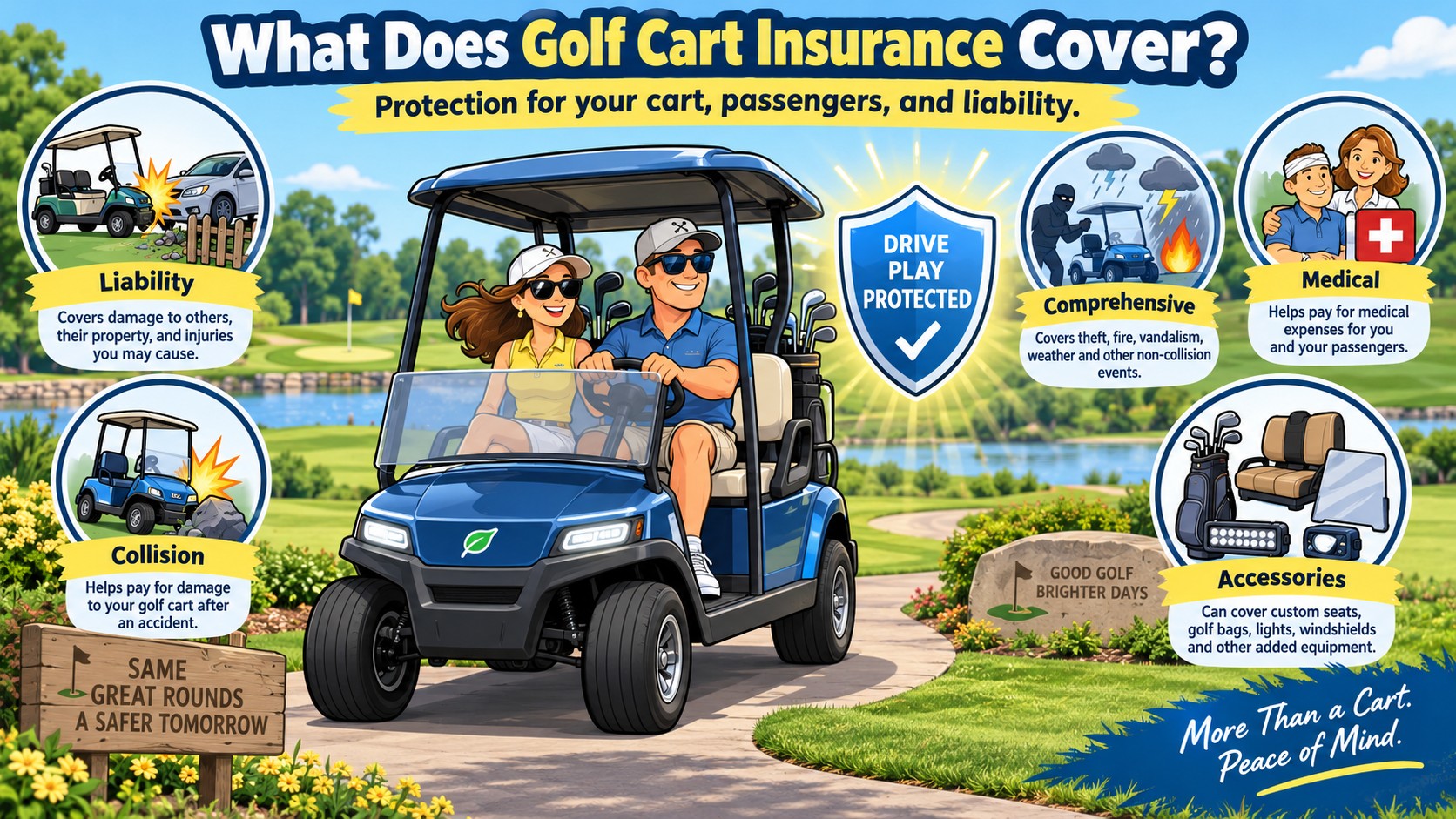
Golf cart insurance can include liability, collision, comprehensive, medical payments, uninsured motorist protection, and accessory coverage. The exact protection depends on the policy you purchase, where you drive the cart, how the vehicle is classified, and the limits and deductibles you select.
Golf carts are increasingly used beyond golf courses, including gated communities, resorts, campuses, neighborhoods, and private properties. That wider use can create risks that may not be fully covered by a standard homeowners or auto policy. Owners of vehicles such as Tara EV models should therefore understand what a dedicated golf cart insurance policy can cover and when additional protection may be worthwhile.
What Does Golf Cart Insurance Typically Cover?
Golf cart insurance works similarly to many automobile insurance policies, although the available coverages and eligibility requirements vary by insurance company and state.
| Coverage | What It May Cover |
|---|---|
| Liability | Injuries or property damage you cause to other people in a covered accident. |
| Collision | Damage to your golf cart after colliding with another vehicle or object. |
| Comprehensive | Theft, vandalism, fire, severe weather, glass damage, and other non-collision losses. |
| Medical Payments | Reasonable medical expenses for you or covered passengers after an accident. |
| Uninsured Motorist | Certain losses when an at-fault driver has no insurance or insufficient coverage. |
| Accessory Coverage | Eligible aftermarket equipment, custom seats, audio systems, paint, lighting, and other upgrades. |
Liability Coverage
Liability coverage is one of the most important parts of a golf cart insurance policy. If you cause an accident that injures another person or damages someone else’s property, liability insurance may pay covered costs up to the limits of your policy.
For example, if you accidentally hit another golf cart, damage a parked vehicle, or injure a pedestrian, liability coverage may help pay medical costs, property repairs, and certain legal expenses.
Higher liability limits generally provide greater financial protection but may also increase the premium.
Collision Coverage
Collision coverage protects the golf cart itself when it is damaged in an accident involving another vehicle or object.
Examples include:
- Hitting another golf cart
- Backing into a wall
- Striking a fence
- Colliding with a parked vehicle
- Running into a tree or utility pole
Collision coverage normally involves a deductible. If the cost of repairing the cart exceeds the deductible and the loss is covered, the insurer may pay the remaining eligible repair costs up to the applicable policy limits.
Comprehensive Coverage
Not every golf cart loss involves a collision. Comprehensive coverage is designed for many non-collision events.
Depending on the policy, comprehensive insurance may cover:
- Theft
- Vandalism
- Fire
- Storm damage
- Falling objects
- Glass breakage
- Damage caused by animals
This protection can be particularly valuable for expensive lithium-powered carts, custom vehicles, or carts stored outdoors.
Comprehensive coverage is normally the portion of a golf cart policy that addresses theft. Liability-only coverage generally does not pay to replace your own cart if it is stolen.
Medical Payments Coverage
Golf carts have open passenger compartments and less crash protection than conventional passenger cars. Medical payments coverage can therefore be useful if the driver or passengers are injured.
Depending on the policy, this coverage may help pay reasonable medical expenses resulting from a covered golf cart accident, regardless of who caused the crash.
Does Golf Cart Insurance Cover Accessories?
It can. Accessory coverage is especially important for owners who have invested in upgrades.
Examples of accessories that may be eligible include:
- Custom seats
- Premium wheels
- Custom paint
- Lighting kits
- Audio equipment
- Golf bag accessories
- Windshields
- Storage systems
Coverage limits vary considerably. Keep receipts and photographs of expensive modifications so you can document their value if you ever need to make a claim.
Does Homeowners Insurance Cover a Golf Cart?
Sometimes, but coverage can be limited.
A homeowners policy may provide some protection when a golf cart is used exclusively on the insured property. However, coverage can become much more restrictive when the vehicle leaves the property or is registered or regularly operated on public roads.
A standard automobile policy also generally does not automatically cover a traditional golf cart because golf carts are not normally classified as ordinary passenger cars.
This is why dedicated golf cart insurance can be useful for owners who regularly drive in communities, resorts, golf-course developments, or other areas beyond their own property.
Is Golf Cart Insurance Required?
The answer depends on the vehicle, state, municipality, and where it is driven.
Public Roads
If a vehicle is registered for public-road operation or legally classified as a low-speed vehicle, state motor-vehicle insurance requirements may apply. Some states or municipalities also impose insurance requirements for golf carts used on designated public streets.
Private Property and Golf Communities
State law may not require insurance when a golf cart is used only on private property. However, homeowners associations, golf communities, resorts, country clubs, or property managers may establish their own liability insurance requirements.
Check your state law, local ordinances, community rules, golf course requirements, and insurance policy. Golf cart regulations can vary significantly from one community to another.
How Much Does Golf Cart Insurance Usually Cost?
There is no single national price because golf cart insurance rates depend on the vehicle and owner.
Progressive currently advertises basic golf cart insurance starting as low as about $75 per year for qualifying customers. Broader policies containing collision, comprehensive, medical payments, higher liability limits, and accessory coverage can cost more.
| Pricing Factor | How It Can Affect Cost |
|---|---|
| Cart Value | More expensive carts may cost more to insure for physical damage. |
| Coverage Level | Adding comprehensive, collision, and other optional coverage generally increases premiums. |
| Driving Location | Public-road use may create different risks from golf-course-only use. |
| Driver History | Age and driving history can influence rates. |
| Location | Insurance pricing varies by state, ZIP code, theft risk, and other local factors. |
| Custom Accessories | Additional coverage may be needed for expensive upgrades. |
| Deductible | A higher deductible may reduce premiums but increases your out-of-pocket cost after a claim. |
The most accurate approach is to compare quotes from insurers that specifically offer golf cart coverage, such as GEICO, Progressive, Foremost, or other providers available in your state.
Is Golf Cart Insurance Worth It?
For many owners, golf cart insurance is worth considering even when it is not legally required.
A modern electric golf cart can represent a substantial investment, especially after adding lithium batteries, premium seats, wheels, displays, golf accessories, or other equipment.
Insurance may be particularly valuable if:
- You frequently drive away from your own property
- You use the cart in a residential community
- You drive near pedestrians and other vehicles
- Your cart is expensive to replace
- You have significant custom accessories
- The cart is stored where theft is possible
- You regularly carry passengers
- Your HOA or golf community requires insurance
On the other hand, an inexpensive cart used only occasionally on private property may justify a different level of coverage. Compare the annual premium, deductible, replacement value, and potential liability exposure before choosing a policy.
What Golf-Course Models Does Tara EV Offer?
Tara EV offers golf-course-focused models including the Spirit Air and Spirit Plus.
Both are two-passenger electric golf carts designed around golf-course operation. Tara currently lists an estimated driving range of approximately 40 miles and a maximum speed of 13 mph for both models, although actual range varies with operating conditions.
| Feature | Spirit Air | Spirit Plus |
|---|---|---|
| Seating | 2 passengers | 2 passengers |
| Estimated Range | About 40 miles | About 40 miles |
| Maximum Speed | 13 mph | 13 mph |
| Charging Time | Approximately 3–5 hours | Approximately 3–5 hours |
| Golf Bag Equipment | Golf bag holder and retractable bag cover | Golf bag holder and retractable bag cover |
| Golf Accessories | Ball washer, sand bottle, Caddy Master cooler | Ball washer, sand bottle, Caddy Master cooler |
Golf Features on the Spirit Air and Spirit Plus
The Spirit Air is designed for convenient movement around the golf course and includes equipment such as a golf ball washer, sand bottle, Caddy Master cooler, golf bag cover, and a steering wheel with a scorecard clip.
The Spirit Plus adds premium comfort and technology while maintaining a golf-focused design. Its available golf equipment includes a golf bag holder and storage basket, ball washer, sand bottle, Caddy Master cooler, retractable golf bag cover, and storage for golf balls and tees.
These features make the Spirit series well suited to golf clubs and players who want organized equipment storage and quick access to commonly used golf accessories throughout a round.
The Spirit Air and Spirit Plus each provide an estimated 40-mile driving range and include golf-focused equipment such as bag storage, sand bottles, ball washers, coolers, and other accessories designed to support a full day on the course.
How to Choose Golf Cart Insurance
- Determine whether insurance is required where you drive.
- Calculate the approximate replacement value of your golf cart.
- List all custom accessories and upgrades.
- Choose appropriate liability limits.
- Decide whether collision and comprehensive protection are worthwhile.
- Consider medical payments and uninsured motorist coverage.
- Compare deductibles and annual premiums.
- Ask specifically whether golf-course, community, and public-road use are covered.
- Read exclusions before purchasing the policy.
Conclusion
So, what does golf cart insurance cover? A well-designed policy can protect against liability claims, collision damage, theft, vandalism, fire, weather-related losses, passenger medical expenses, uninsured drivers, and damage to eligible accessories.
Coverage requirements and prices vary by location, vehicle classification, and use. Standard homeowners and automobile policies may provide limited or no protection in many golf cart situations, making dedicated coverage worth considering when the cart regularly leaves your property.
Owners of golf-focused electric vehicles such as the Tara Spirit Air and Spirit Plus should consider the value of the vehicle, its golf accessories, passenger use, storage location, and where it will be driven when comparing insurance options.
