
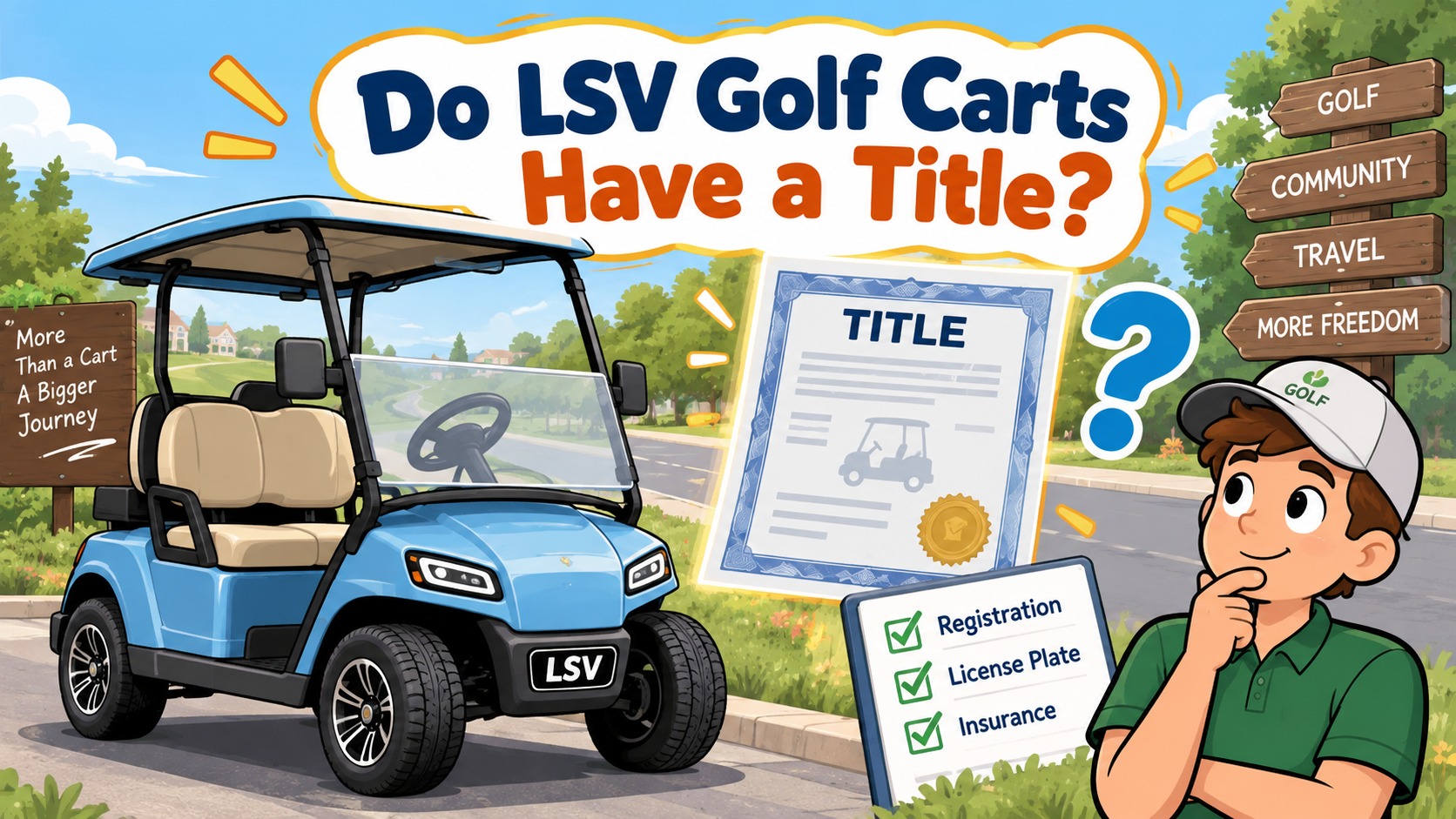
Yes. An LSV generally has a title or equivalent state ownership document because it is classified and registered as a motor vehicle. A standard golf cart used only on private property or a golf course often does not require a state-issued title. Exact procedures vary by state, so owners should check their local DMV requirements.
An LSV, or Low-Speed Vehicle, is legally different from a traditional golf cart. In the United States, LSVs are built to meet federal safety requirements for low-speed motor vehicles and are intended for use on permitted public roads. Because of this motor-vehicle classification, states generally require ownership documentation, registration, a license plate, and insurance before an LSV can be operated on public streets.
Why Do LSV Golf Carts Need a Title?
A title is the official document used by a state to identify the legal owner of a motor vehicle.
Because an LSV is designed for regulated road use, it is treated more like a small automobile than a recreational cart. This means the state usually needs a formal record showing:
- Who owns the vehicle
- The Vehicle Identification Number
- The make and model
- The year of manufacture
- Any recorded lienholder
- The vehicle’s registration status
This title record helps prevent ownership disputes and supports registration, insurance, resale, and transfer of ownership.
LSV Title Requirements
| Requirement | Typical LSV Situation |
|---|---|
| Title or Ownership Document | Generally required by the state for registered road use |
| VIN | Required for vehicle identification and registration |
| Registration | Generally required for public-road operation |
| License Plate | Normally issued after registration |
| Insurance | Commonly required by state law |
| Driver’s License | Generally required for public-road operation |
Legal Classification of an LSV
An LSV is not simply a golf cart with extra accessories. It is a recognized motor-vehicle category.
Federal Motor Vehicle Safety Standard No. 500 establishes safety requirements for Low-Speed Vehicles. A compliant LSV normally includes equipment such as:
- Headlamps
- Front and rear turn signals
- Taillamps
- Brake lights
- Reflectors
- Rearview mirrors
- Parking brake
- Windshield meeting applicable requirements
- Seat belts
- Vehicle Identification Number
The VIN is particularly important because it links the vehicle to its ownership, registration, and insurance records.
Does Every State Issue a Title for an LSV?
Most states treat LSVs as motor vehicles and require titling or equivalent ownership documentation, but the exact process is not identical nationwide.
Some states may have:
- A conventional certificate of title
- A special low-speed vehicle registration category
- Inspection requirements
- State-specific equipment requirements
- Different registration fees
Always check your state’s Department of Motor Vehicles before purchasing or registering an LSV. Federal vehicle classification does not replace state-level title, registration, insurance, and road-access rules.
Standard Golf Cart vs. LSV Title Requirements
The biggest difference is how the vehicle is legally classified and where it is intended to operate.
| Feature | Standard Golf Cart | LSV |
|---|---|---|
| Primary Use | Golf courses and private property | Permitted public roads and private property |
| State Title | Often not required | Generally required |
| VIN | May use only a manufacturer serial number | Road-vehicle VIN required |
| Registration | Usually not required for private use | Generally required for road use |
| License Plate | Usually no | Normally yes |
| Insurance | Depends on use and location | Commonly required |
| Required Safety Equipment | Varies | Must meet applicable LSV requirements |
What Documents Do You Need to Title an LSV?
The exact documents depend on the state and whether the vehicle is new or used.
Common documents may include:
- Manufacturer’s Certificate of Origin or Manufacturer’s Statement of Origin
- Vehicle Identification Number
- Purchase invoice or bill of sale
- Proof of identity
- Proof of insurance
- State title application
- Applicable taxes and fees
For a used LSV, the previous owner’s title may also be required to transfer ownership legally.
What Is a Manufacturer’s Certificate of Origin?
A Manufacturer’s Certificate of Origin, often called an MCO or MSO, is an important document for a new vehicle.
It is issued by the manufacturer and contains information such as:
- Manufacturer name
- VIN
- Vehicle model
- Model year
- Vehicle type
When the first owner registers the vehicle, the state typically uses this document as part of the process of creating the official title.
Can I Sell an LSV Without a Title?
Selling an LSV without the required title can be difficult because the buyer may not be able to register it for public-road use.
If the title is lost, the current legal owner should usually apply for a duplicate title before completing the sale.
A bill of sale alone may not be enough for an LSV if the state requires a title transfer.
If you plan to sell an LSV, locate the title, confirm the VIN, and make sure any liens have been released before accepting payment from a buyer.
Can I Sell a Standard Golf Cart Without a Title?
Yes, in many cases you can sell a conventional golf cart without a state-issued title because traditional golf carts used on golf courses or private property often were never titled in the first place.
Instead, ownership may be transferred using:
- A bill of sale
- Manufacturer serial number
- Original sales receipt
- Dealer invoice
- Previous bill of sale
However, state rules can differ. Some jurisdictions may require additional documentation even for conventional golf carts.
How to Prove Ownership of a Golf Cart
If a standard golf cart does not have a title, the best proof of ownership is usually a detailed bill of sale combined with the cart’s serial or identification number.
A good golf cart bill of sale should include:
- Seller’s full name
- Buyer’s full name
- Date of sale
- Purchase price
- Manufacturer
- Model
- Model year if known
- Serial number
- Signatures of both parties
Where Is the Golf Cart Serial Number?
The location varies by manufacturer and model. It may be found under a seat, near the dashboard, inside a glove compartment, on the frame, or near the battery compartment.
The serial number should be checked against any purchase documentation before buying a used cart.
Is a Serial Number the Same as a VIN?
Not necessarily.
A traditional golf cart may have a manufacturer serial number used for production identification, parts selection, or warranty purposes.
An LSV, by contrast, requires vehicle identification documentation suitable for motor-vehicle registration. Do not assume a golf cart’s internal serial number is automatically equivalent to a road-vehicle VIN.
Why Is a Title Important When Buying a Used LSV?
A valid title helps protect the buyer from several problems.
It can help confirm:
- The seller legally owns the vehicle
- The VIN matches the vehicle
- There are no undisclosed liens
- The vehicle can potentially be registered
- The ownership history is properly transferred
A missing title should be investigated before purchasing a used LSV.
Compare the VIN on the vehicle with the ownership documents, verify that the seller’s name matches the title, confirm that any liens have been released, and check your state’s registration requirements before completing the purchase.
Does an LSV Need Registration?
Yes, an LSV generally must be registered before operating on public roads where such operation is permitted.
Registration normally results in the issuance of a license plate or other state registration credentials.
The vehicle owner may also need to renew the registration periodically, just as with other motor vehicles.
Does an LSV Need Insurance?
Liability insurance is commonly required for registered LSVs.
The required minimum coverage varies by state, so owners should contact their insurer and confirm that the policy specifically covers a Low-Speed Vehicle.
Can an LSV Be Driven Anywhere?
No. A title and registration do not mean an LSV can be driven on every public road.
Many jurisdictions restrict LSV operation to lower-speed roads, often those posted at approximately 35 mph or less. States and local governments may establish different limits or prohibit use on certain roads entirely.
Drivers should check local rules before traveling outside familiar neighborhoods or communities.
What If You Lose the Title?
If the title is lost, damaged, or destroyed, the registered owner can generally apply for a duplicate through the state motor-vehicle agency.
You may need:
- The VIN
- Proof of identity
- Registration information
- A duplicate-title application
- Payment of a replacement fee
Avoid selling the vehicle until the ownership paperwork is resolved.
Conclusion
LSV golf carts generally have a title because they are treated as motor vehicles rather than ordinary golf-course carts. Their VIN, registration, license plate, insurance, and ownership documentation support legal use on permitted public roads. Standard golf carts used only on private property often do not require titles and may instead rely on a bill of sale and serial number to prove ownership. Before buying, selling, or registering an LSV, always verify the exact requirements with your state’s motor-vehicle agency.
