
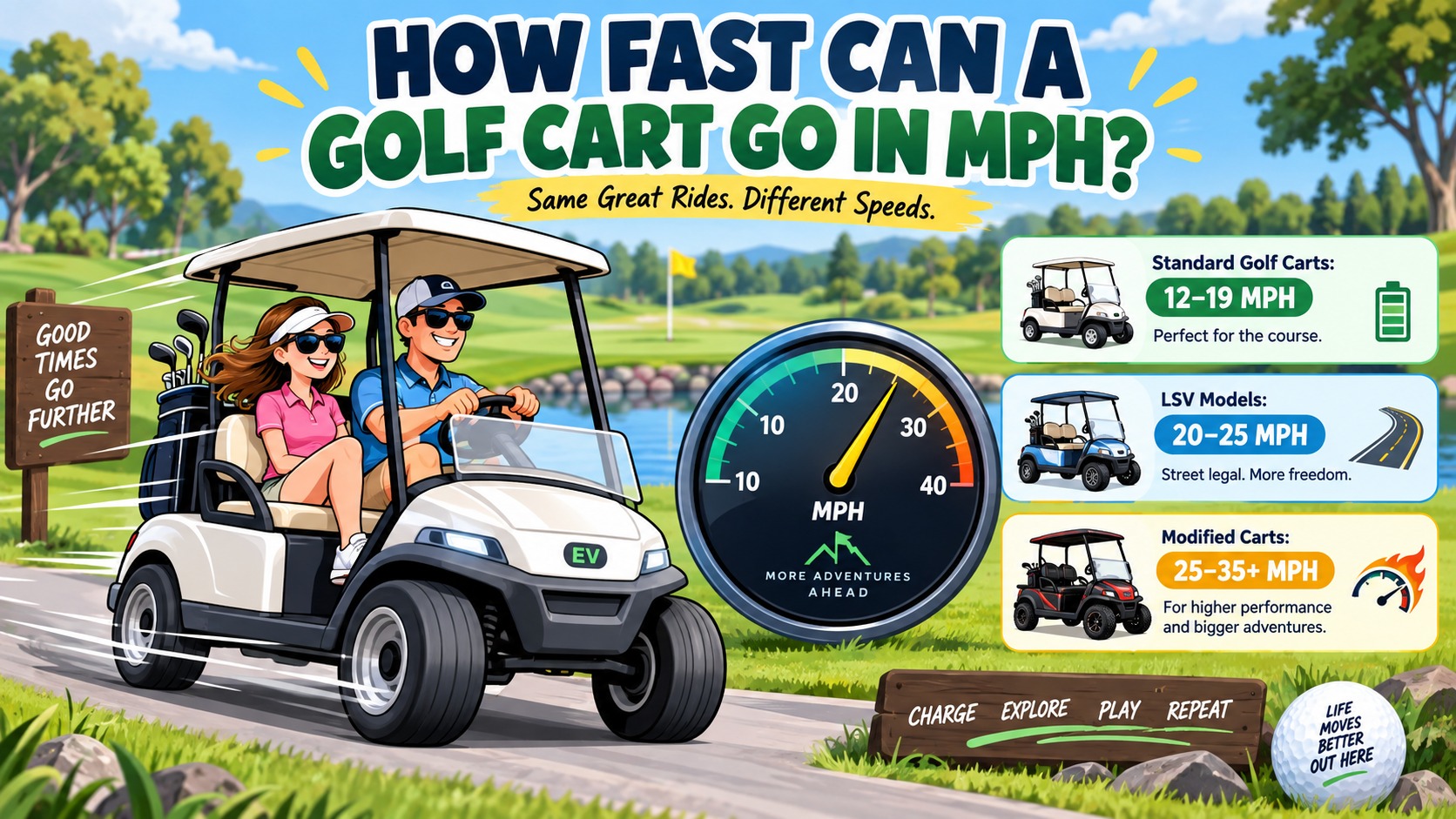
A standard golf cart usually reaches about 12 to 19 mph. Many 36V electric carts operate around 12–14 mph, while 48V electric carts often reach about 14–19 mph. LSVs are designed for the federally defined low-speed vehicle range of more than 20 mph and no more than 25 mph. Modified carts may exceed 25 mph, but additional speed does not automatically make a cart suitable or legal for public-road use.
Golf cart speed varies significantly by vehicle type, voltage, motor, controller, gearing, battery condition, tire size, and factory programming. Standard electric carts generally run between 12 and 19 mph, while gas-powered carts often fall in a similar range. Vehicles designed as Low-Speed Vehicles can reach up to 25 mph, while heavily modified carts may be capable of even higher speeds. Models such as the Roadster 2, Roadster 2+2, and Explorer 2+2 are designed for buyers who want a faster personal transportation option than a basic course cart.
Average Golf Cart Speed by Type
| Golf Cart Type | Typical Speed | Common Use |
|---|---|---|
| 36V Electric Golf Cart | About 12–14 mph | Golf courses, private property, short-distance travel |
| 48V Electric Golf Cart | About 14–19 mph | Golf courses, resorts, communities, personal transportation |
| Standard Gas Golf Cart | About 15–19 mph | Golf, property transportation, utility use |
| LSV | More than 20 mph and up to 25 mph | Permitted public roads and community transportation |
| Modified Golf Cart | About 25–35+ mph in some builds | Custom or private-use applications |
How Fast Does a Standard Electric Golf Cart Go?
Factory electric golf carts typically reach between 12 and 19 mph. The exact speed depends partly on system voltage and drivetrain design.
36V Golf Carts
A stock 36V golf cart often reaches approximately 12–14 mph. These vehicles are generally adequate for traditional golf-course use and flat private-property transportation.
Their lower voltage can limit acceleration and hill performance compared with a more powerful 48V system.
48V Golf Carts
A 48V golf cart commonly reaches approximately 14–19 mph in factory form. A higher-voltage drivetrain can also provide stronger acceleration and better performance on hills when paired with an appropriate motor and controller.
However, voltage alone does not determine speed. A 48V cart can still be electronically limited to a lower top speed.
How Fast Does a Gas Golf Cart Go?
Standard gas golf carts generally reach around 15–19 mph, although exact performance varies by manufacturer, engine, gearing, vehicle weight, and condition.
Gas carts can provide strong sustained performance, especially where frequent refueling is preferred over battery charging.
For many modern recreational and personal transportation applications, electric carts remain popular because they offer quieter operation and simpler drivetrain maintenance.
What Determines Golf Cart Top Speed?
Top speed is determined by several components working together.
- Motor: Motor RPM and torque characteristics strongly affect performance.
- Controller: The controller determines how much electrical power the motor can receive.
- Battery Voltage: Higher voltage can support stronger performance when the drivetrain is designed for it.
- Gear Ratio: Taller gearing may increase top speed but reduce acceleration.
- Tire Diameter: Larger tires can increase distance traveled per wheel rotation.
- Vehicle Weight: More passengers and cargo can reduce acceleration and hill speed.
- Software Limits: Factory programming may restrict maximum speed.
Do not judge a golf cart only by battery voltage. Motor design, controller output, gearing, tires, programming, terrain, and passenger load can all change how fast the cart actually travels.
Which Golf Carts Go 25 MPH?
Golf-cart-style vehicles that are factory-designed and certified to operate at up to 25 mph generally fall into the Low-Speed Vehicle category rather than being ordinary golf carts.
These vehicles are designed for more than golf-course transportation. They typically include additional equipment such as:
- Headlights
- Taillights
- Brake lights
- Turn signals
- Mirrors
- Seat belts
- Windshield
- Parking brake
- Vehicle identification documentation
Public-road access depends on state and local law. Many jurisdictions allow LSV operation on lower-speed roads, often those posted at around 35 mph or less, but the exact rules differ by location.
Popular Factory Models That Can Reach the LSV Speed Range
Roadster 2
The Roadster 2 is a two-passenger personal transportation model designed for compact, comfortable electric mobility.
Its two-seat configuration makes it suitable for individuals or couples who want an efficient vehicle for communities, resorts, recreational areas, and short local trips.
Roadster 2+2
The Roadster 2+2 adds rear passenger seating, increasing capacity to four passengers.
This makes it particularly useful for family transportation, community mobility, and resort environments where carrying additional passengers is important.
Explorer 2+2
The Explorer 2+2 combines a four-passenger layout with a more rugged appearance and versatile personal transportation design.
It can be a good fit for buyers who want both passenger capacity and a more recreational style.
| Model | Seating | Ideal Use |
|---|---|---|
| Roadster 2 | 2 passengers | Personal transportation and short local trips |
| Roadster 2+2 | 4 passengers | Families, communities and resorts |
| Explorer 2+2 | 4 passengers | Recreational and versatile personal transportation |
Can You Make a Golf Cart Go Faster?
Yes. Golf carts can sometimes be modified for higher performance through changes to the motor, controller, gearing, battery system, and tires.
Common upgrades include:
- Installing a higher-performance motor.
- Upgrading the motor controller.
- Installing a compatible lithium battery system.
- Changing gear ratios.
- Using larger-diameter tires.
- Reprogramming compatible vehicle controls.
Some modified carts can reach 25–35 mph or more.
Increasing speed changes braking distance, steering response, tire loads, and vehicle stability. A faster modified cart should use components rated for the new performance level. Higher speed also does not automatically change the vehicle’s legal classification or make it eligible for public-road registration.
Does a Lithium Battery Make a Golf Cart Faster?
A lithium battery can improve acceleration and consistency, but it does not automatically increase maximum speed.
Lithium batteries maintain voltage more consistently under load than aging lead-acid batteries and are usually much lighter. This can make the cart feel more responsive and reduce performance loss as the battery discharges.
Actual maximum speed still depends on the motor, controller, gearing, tires, and software limits.
Do Larger Tires Increase Golf Cart Speed?
Larger tires can increase theoretical top speed because each wheel rotation moves the cart farther.
However, increasing tire diameter also changes the effective gearing. The result may be slower acceleration and weaker hill-climbing performance.
Oversized tires can also affect:
- Brake performance
- Steering geometry
- Suspension clearance
- Motor temperature
- Controller load
How Fast Should a Golf Cart Go on a Golf Course?
Golf-course carts generally do not need high top speeds. A speed in the low-to-mid teens is usually sufficient for moving efficiently between shots while maintaining reasonable control.
Course operators may use electronic speed restrictions in areas such as:
- Clubhouses
- Parking lots
- Bridges
- Steep hills
- Pedestrian areas
- Maintenance zones
Drivers should always follow posted course rules regardless of the vehicle’s maximum capability.
Is 25 MPH Fast for a Golf Cart?
Yes. Compared with a traditional golf cart traveling around 12–15 mph, 25 mph is a noticeable increase.
At 25 mph, steering inputs, braking distances, passenger restraint, tire condition, and road surface become more important. Vehicles designed to operate at that speed should have the appropriate chassis, braking, lighting, and safety equipment.
A 25 mph LSV can travel roughly twice as fast as a basic 12–13 mph course cart. That difference is significant enough that vehicle design and safety equipment matter much more.
What Is the Best Golf Cart Speed?
The best speed depends on where and how you use the vehicle.
| Application | Practical Speed Range |
|---|---|
| Traditional Golf Course | About 12–15 mph |
| Resort or Private Property | About 15–19 mph |
| Community Transportation | About 20–25 mph where permitted |
| Custom Performance Use | 25+ mph only with appropriately engineered components and suitable operating conditions |
Conclusion
Standard golf carts generally travel about 12–19 mph, while vehicles designed for the LSV category can reach up to 25 mph. Modified carts may go faster, but higher speed requires careful attention to braking, stability, tires, drivetrain components, and legal classification. For drivers seeking factory-designed personal transportation with two- or four-passenger layouts, the Roadster 2, Roadster 2+2, and Explorer 2+2 provide options suited to modern low-speed mobility.
