
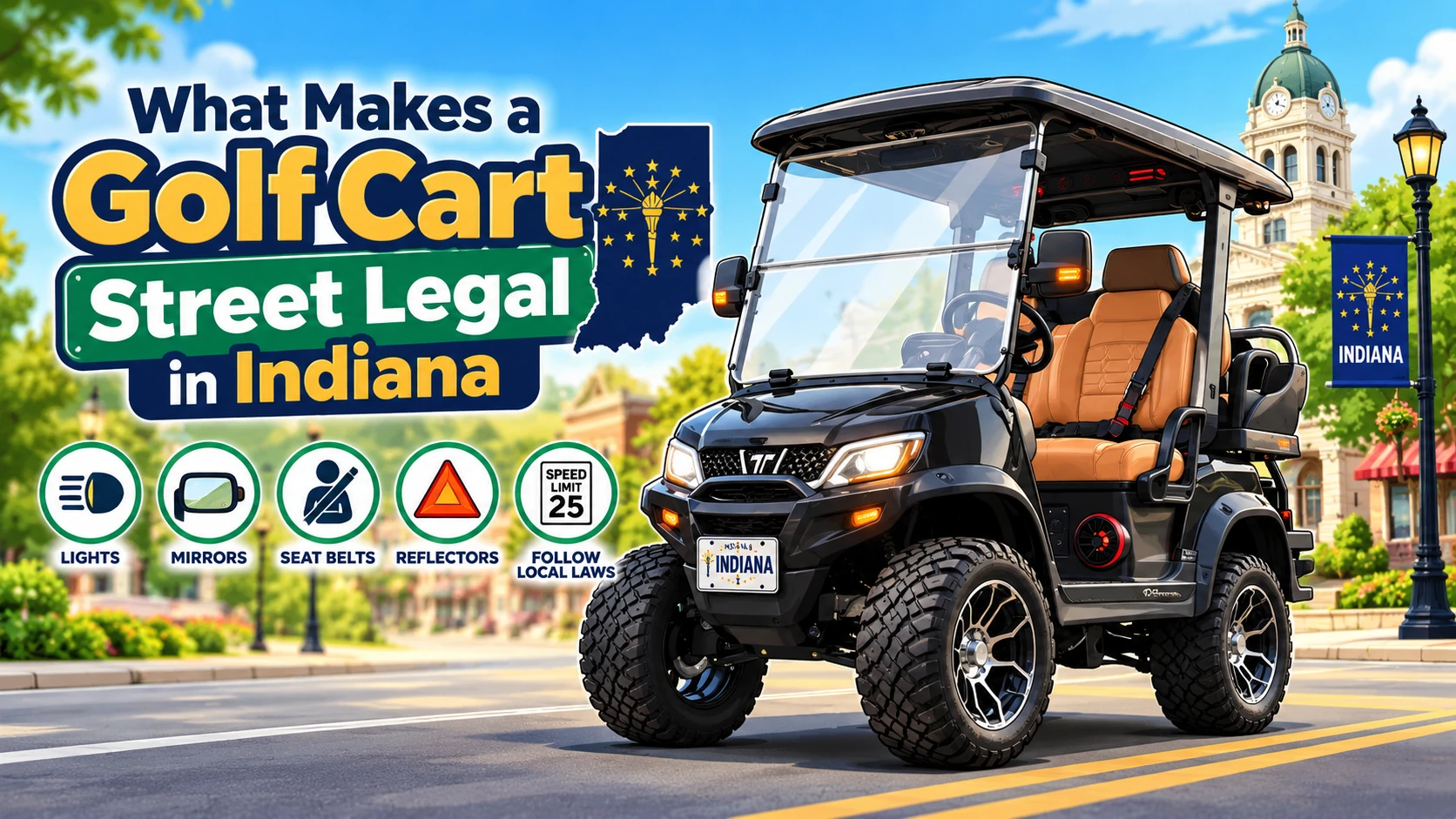
A standard golf cart is not automatically street legal throughout Indiana. Local governments may allow golf carts on roads under their jurisdiction through ordinances. A true LSV is different: Indiana defines it as a four-wheel electric vehicle meeting federal low-speed-vehicle standards, equipped with required lights, mirrors, brakes, windshield, VIN, and seat belts, and having a maximum design speed of no more than 25 mph.
Indiana treats standard golf carts and Low-Speed Vehicles (LSVs) differently. A normal golf cart cannot simply be registered with the Indiana Bureau of Motor Vehicles and used anywhere on public roads. Instead, cities, towns, and counties may adopt local ordinances controlling where and how golf carts can operate. A true LSV is a separate legal vehicle category with specific safety equipment, a VIN, registration requirements, and a maximum design speed of 25 mph. Buyers considering road-oriented models from tara electric vehicles should confirm the individual vehicle’s federal certification, Indiana title and registration eligibility, insurance requirements, and local road restrictions before driving on public streets.
Golf Carts and LSVs Are Not the Same in Indiana
This distinction is the most important part of understanding Indiana street-use rules.
| Vehicle Type | Indiana Treatment | Registration | Road Use |
|---|---|---|---|
| Standard Golf Cart | Not considered an LSV | Cannot be registered by the BMV as a golf cart | Depends on local ordinance |
| Low-Speed Vehicle (LSV) | Separate motor-vehicle classification | Registered as a passenger motor vehicle when eligible | Generally limited to roads posted at 35 mph or less |
Indiana’s Department of Natural Resources specifically states that golf carts cannot be registered through the BMV as off-road vehicles. Indiana law separately defines an LSV as a four-wheel electric vehicle meeting federal safety standards and required equipment specifications.
1. Local Ordinance and Registration for Standard Golf Carts
Indiana does not create one statewide rule that automatically authorizes ordinary golf carts on every public street.
Instead, Indiana law allows cities, counties, and towns to adopt traffic regulations governing golf carts and off-road vehicles on roads under their jurisdiction.
That means a golf cart may be allowed in one Indiana community but restricted or prohibited in another.
A local ordinance may establish requirements such as:
- Local registration or permit
- Vehicle inspection
- Annual decal
- Minimum driver age
- Valid driver’s license
- Insurance
- Operating hours
- Approved roads
- Speed restrictions
Do not assume a local golf cart permit allows statewide travel. A permit issued by one city or county may only apply inside that jurisdiction.
2. Required Safety Equipment
For a vehicle to qualify as an Indiana Low-Speed Vehicle rather than a standard golf cart, Indiana law requires specific equipment and compliance with federal LSV standards.
Required equipment includes:
- Headlamps
- Front turn signals
- Rear turn signals
- Taillamps
- Stop lamps
- Reflex reflectors
- Interior or exterior mirrors
- Required braking equipment
- Windshield
- Vehicle Identification Number (VIN)
- Safety belt at every designated seating position
The vehicle must also comply with the operational and equipment specifications of Federal Motor Vehicle Safety Standard No. 500, referenced as 49 CFR 571.500.
Adding lights and mirrors to a conventional golf cart does not automatically make it a legal LSV. The vehicle itself must meet the applicable federal LSV standard and have the necessary manufacturer certification and VIN.
3. Driver and Insurance Rules
Driver and insurance requirements for standard golf carts may vary by local ordinance.
Some Indiana communities require the operator to hold a valid driver’s license and carry proof of liability insurance. For example, local ordinances may require insurance meeting Indiana’s financial-responsibility requirements.
A registered LSV, meanwhile, is treated much more like a normal passenger motor vehicle and should be titled, registered, plated, and insured accordingly.
Before driving, owners should confirm:
- Driver-license requirements
- Liability insurance requirements
- Registration requirements
- Local permit requirements
- Road-speed restrictions
What Roads Can a Low-Speed Vehicle Use in Indiana?
Indiana law prohibits a low-speed vehicle from operating on a highway with a posted speed limit above 35 mph.
Therefore, an eligible LSV is generally intended for lower-speed community streets, neighborhood roads, resort roads, and similar environments rather than major highways.
Operating an LSV on a highway with a speed limit greater than 35 mph is a Class C infraction under Indiana law.
| Road Type | Typical Indiana LSV Status |
|---|---|
| Road posted 25 mph | Generally compatible with LSV operation, subject to other laws |
| Road posted 30 mph | Generally compatible with LSV operation |
| Road posted 35 mph | Generally within the statutory LSV limit |
| Road above 35 mph | LSV operation prohibited |
Can You Register a Regular Golf Cart With the Indiana BMV?
No. Indiana’s official guidance states that golf carts cannot be registered through the BMV as golf carts.
This is different from a legitimate low-speed vehicle. Indiana classifies an eligible LSV as a passenger motor vehicle for registration purposes.
This distinction is important when shopping for a vehicle advertised as “street legal.”
Before purchasing, ask for:
- Manufacturer’s Certificate of Origin
- 17-digit VIN
- Federal LSV certification label
- Vehicle equipment specifications
- Indiana title eligibility
Can You Convert a Golf Cart Into an LSV?
Simply adding headlights, mirrors, turn signals, seat belts, and a windshield does not necessarily transform an ordinary golf cart into a federally compliant LSV.
Indiana’s statutory definition specifically requires a vehicle that meets federal LSV operating and equipment standards and has a VIN. The definition also explicitly excludes golf carts.
If public-road use is your primary goal, buying a factory-produced and properly certified LSV is generally simpler than trying to modify a standard golf cart after purchase.
Which Tara Electric Vehicles Models Are Street-Legal in Indiana?
tara electric vehicles lists the Roadster 2, Roadster 2+2, and Explorer 2+2 in its road-oriented LSV lineup. Tara’s current materials describe these models with 25 mph maximum-speed configurations and lithium battery systems.
However, Indiana street legality ultimately depends on the individual vehicle being federally certified as an LSV and being eligible for Indiana title, registration, insurance, and operation on the specific road.
| Model | Seats | Maximum Speed | Battery | Type |
|---|---|---|---|---|
| Roadster 2 | 2 | Up to 25 mph | 48V 105Ah Lithium | LSV-Oriented Model |
| Roadster 2+2 | 4 | Up to 25 mph* | 48V 160Ah Lithium | LSV-Oriented Model |
| Explorer 2+2 | 4 | Up to 25 mph | 48V 160Ah Lithium | LSV-Oriented Model |
Tara’s recent blog materials list all three vehicles at up to 25 mph, with the Roadster 2 using a 48V 105Ah lithium battery and the Roadster 2+2 and Explorer 2+2 using 48V 160Ah lithium batteries.
Specifications can vary by production configuration and market. Confirm the VIN, federal certification label, manufacturer’s certificate of origin, actual speed specification, and Indiana registration eligibility of the exact vehicle before treating it as street legal.
Tara Roadster 2
The Roadster 2 is a two-passenger personal transportation model using a 48V 105Ah lithium battery.
Its compact two-seat layout makes it suitable for neighborhood transportation, resorts, planned communities, and other low-speed environments where legally permitted.
Tara Roadster 2+2
The Roadster 2+2 adds a rear passenger row, increasing total seating capacity to four.
It uses a 48V 160Ah lithium battery, giving the larger passenger vehicle more energy capacity than the two-seat Roadster 2.
Tara Explorer 2+2
The Explorer 2+2 also offers four-passenger seating and a 48V 160Ah lithium battery.
It is intended for broader personal transportation use while retaining the low-speed characteristics expected of an LSV-oriented vehicle.
Indiana Street-Legal Golf Cart Checklist
Before operating a golf cart or LSV on Indiana streets, work through this checklist:
- Determine whether your vehicle is legally a golf cart or an LSV.
- Check whether your city, town, or county permits standard golf carts.
- Obtain any required local permit or decal.
- Confirm driver-license requirements.
- Verify required liability insurance.
- Check headlights, brake lights, turn signals, mirrors, and reflectors.
- Confirm seat belts and windshield requirements.
- For an LSV, verify the VIN and federal certification.
- Complete Indiana title and registration when required.
- Do not operate an LSV on roads posted above 35 mph.
If you plan to drive regularly on Indiana public roads, first determine whether you need a locally permitted golf cart or a fully registered LSV. The legal requirements are different, and calling both vehicles a “golf cart” can cause registration and insurance confusion.
Conclusion
What makes a golf cart street legal in Indiana depends first on the type of vehicle. Standard golf carts cannot be registered with the Indiana BMV as golf carts and may only use public roads where a city, town, or county ordinance permits them. A genuine LSV is a separate four-wheel electric motor vehicle that must meet federal safety standards, carry required equipment such as lights, mirrors, windshield, VIN, brakes, and seat belts, and have a maximum design speed of no more than 25 mph. Indiana also prohibits LSVs from roads posted above 35 mph. Buyers considering tara electric vehicles such as the Roadster 2, Roadster 2+2, or Explorer 2+2 should verify the exact vehicle’s federal certification, VIN, Indiana registration eligibility, insurance, and local road rules before operating it on public streets.
