
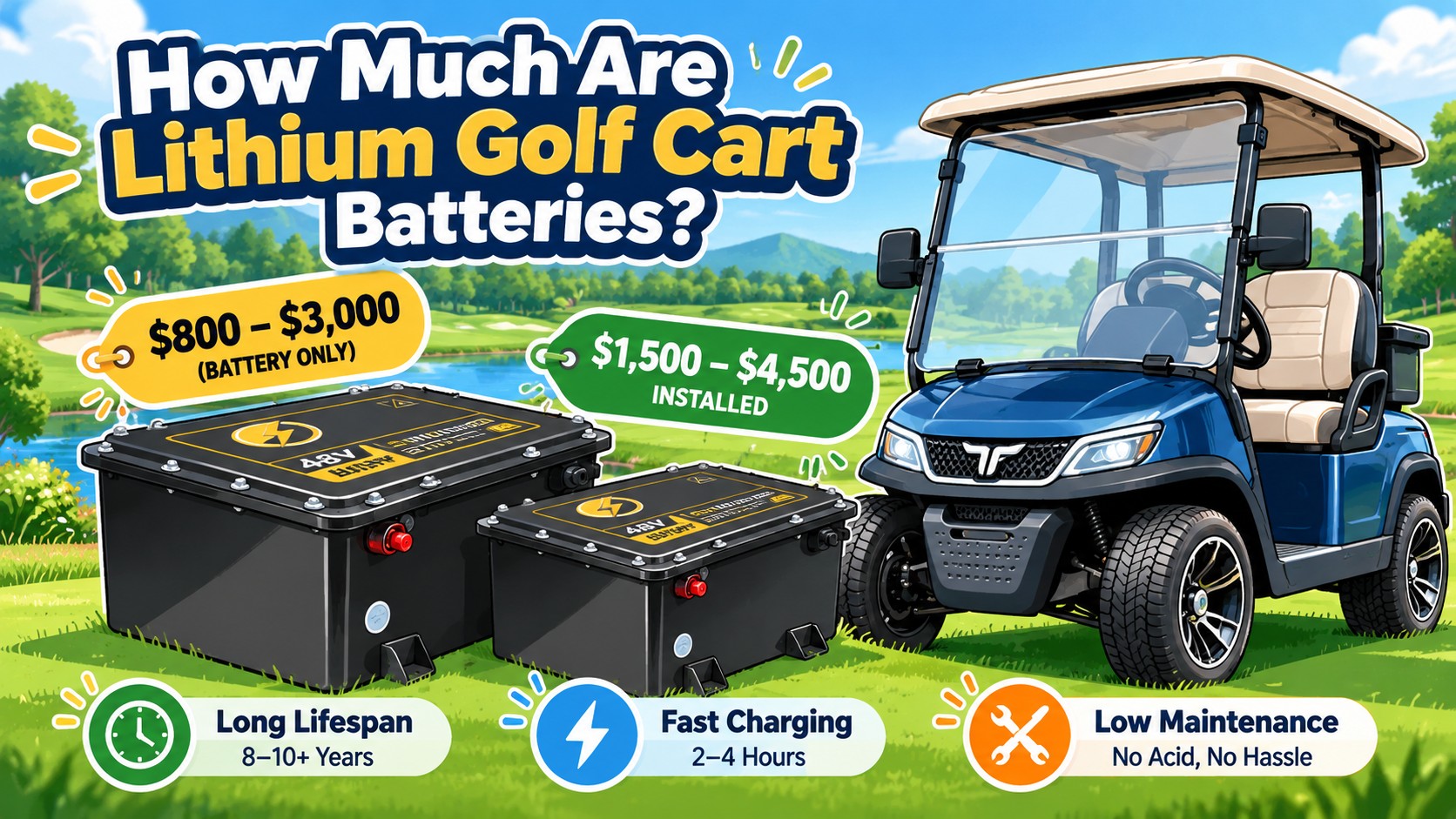
A standalone lithium golf cart battery generally costs about $800–$3,000. A complete lithium conversion kit with charger and mounting hardware usually costs around $1,500–$4,500, while professional installation can bring the total out-the-door cost to roughly $1,800–$4,500.
The final price depends mainly on battery voltage, amp-hour capacity, range, charger compatibility, mounting hardware, and installation labor. A basic lithium battery for casual neighborhood use can cost under $1,000, while a larger high-capacity system for a four-seat cart or heavy-duty use can exceed $3,000. Compared with traditional lead-acid batteries, lithium has a higher upfront cost, but longer service life, faster charging, lower weight, and reduced maintenance can make it more economical over time. Modern vehicles from Tara EV use lithium batteries as standard equipment.
Average Lithium Golf Cart Battery Cost
| Battery / Conversion Type | Typical Price Range |
|---|---|
| Standalone Lithium Battery | $800–$3,000 |
| Complete Conversion Kit | $1,500–$4,500 |
| Professional Installed Conversion | $1,800–$4,500 |
| Traditional Lead-Acid Replacement | About $700–$1,700 installed |
Lithium costs more initially, but the comparison changes when long-term ownership is considered. A quality lithium golf cart battery can often last 8 to 12 years under normal use, while lead-acid packs generally require replacement much sooner.
Cost by Battery Capacity
Amp-hour capacity is one of the largest factors affecting price because it determines how much energy the battery can store and, in turn, how far the golf cart can travel between charges.
| Capacity | Typical Price | Approximate Use Case | Typical Range |
|---|---|---|---|
| 50Ah–60Ah | $600–$1,000 | Casual neighborhood and short-distance use | About 15–25 miles |
| 100Ah–105Ah | $1,200–$2,500 | Standard golf carts and daily recreational use | About 30–50 miles |
| 150Ah–230Ah+ | $2,800–$4,200 | 4-seat carts, hills, utility use, commercial fleets | Can exceed 60 miles depending on vehicle and conditions |
Actual driving range depends on vehicle weight, passenger load, terrain, tire pressure, speed, temperature, accessories, and driving style. Battery capacity alone does not guarantee a specific mileage.
Entry-Level Lithium Batteries
Budget lithium golf cart batteries typically fall into the 50Ah to 60Ah range and cost around $600 to $1,000.
These batteries are best suited for drivers who:
- Use the cart mainly around a neighborhood
- Take short recreational trips
- Do not regularly carry four or six passengers
- Do not need extended daily range
The lower capacity keeps the price and weight down, but it also limits how far the cart can travel between charges.
100Ah to 105Ah Lithium Batteries
The 100Ah to 105Ah class is one of the most popular choices for 48V golf carts.
A typical battery in this category costs roughly $1,200 to $2,500 and may provide around 30 to 50 miles of practical driving range depending on conditions.
This capacity works well for:
- Two-passenger golf carts
- Golf-course use
- Neighborhood transportation
- Resort transportation
- Daily recreational driving
For example, both the Spirit Air and Spirit Plus use 48V 105Ah lithium batteries.
Extended-Range Lithium Batteries
Larger 150Ah to 230Ah or higher battery systems typically cost around $2,800 to $4,200.
These high-capacity packs are useful when a cart must handle:
- Four or more passengers
- Frequent hills
- Commercial fleet operation
- Utility work
- Long daily driving distances
A larger battery does not simply add range. It also gives the vehicle more energy reserve under heavier loads.
Why Lithium Costs More Than Lead-Acid
A lithium battery contains more than individual cells. A complete pack usually includes:
- LiFePO4 cells
- Battery Management System
- Protective enclosure
- High-current terminals
- Temperature protection
- Communication electronics
- State-of-charge monitoring
These components increase upfront cost but also reduce the maintenance requirements associated with flooded lead-acid batteries.
Additional Lithium Conversion Costs
If you are converting an older lead-acid golf cart to lithium, the battery itself may not be the only expense.
Lithium-Compatible Charger
A dedicated lithium charger typically costs around $200 to $400.
Older lead-acid chargers may not provide the correct charging profile, voltage limits, or communication required by a modern lithium battery.
Do not assume your existing lead-acid charger is compatible with lithium. Use a charger approved by the battery manufacturer for the exact voltage and chemistry.
Mounting Hardware and Wiring
Installation accessories may add around $100 to $300.
These can include:
- Battery mounting trays
- Hold-down brackets
- High-gauge cables
- Terminal adapters
- State-of-charge displays
- Communication wiring
Installation Labor
Professional installation commonly costs about $100 to $300 for a straightforward conversion.
More complicated custom work involving rewiring, fabrication, controller upgrades, or significant battery-tray modification can reach approximately $500 or more.
What Is Included in a Lithium Conversion Kit?
| Component | Usually Included? |
|---|---|
| Lithium Battery | Yes |
| Battery Management System | Usually integrated into battery |
| Lithium Charger | Often, but not always |
| Mounting Brackets | Depends on kit |
| Battery Cables | Often included |
| SOC Display | Varies by model |
Is Lithium Worth the Extra Cost?
For many owners, yes—especially if the golf cart is used regularly.
Lithium batteries offer several advantages over lead-acid:
- 8–12 years of typical service life
- Thousands of charge cycles
- Much lower weight
- Faster charging
- No watering
- No acid corrosion cleanup
- More stable voltage during discharge
The higher purchase price can therefore be offset by reduced maintenance and fewer battery replacements.
A lead-acid pack may be cheaper today, but replacing it several times over the life of one lithium battery can narrow or eliminate the initial price advantage.
What Type of Battery Does Tara EV Use?
Tara EV uses lithium batteries throughout its current golf cart and low-speed vehicle lineup.
Two main configurations are used:
- 48V 105Ah lithium battery for two-passenger models
- 48V 160Ah lithium battery for four-passenger 2+2 models
Tara EV Battery Specifications
| Model | Battery | Seats | Top Speed | Estimated Range |
|---|---|---|---|---|
| Spirit Air | 48V 105Ah Lithium | 2 | 13 mph | About 40 miles |
| Spirit Plus | 48V 105Ah Lithium | 2 | 13 mph | About 40 miles |
| Roadster 2 | 48V 105Ah Lithium | 2 | 25 mph | About 40 miles |
| Roadster 2+2 | 48V 160Ah Lithium | 4 | 25 mph | About 40 miles |
| Explorer 2+2 | 48V 160Ah Lithium | 4 | 25 mph | About 40 miles |
Why Do Four-Seat Carts Use Larger Batteries?
A four-passenger vehicle has to move more potential weight than a two-seat golf cart.
It may also require more energy for:
- Higher road speeds
- Additional passenger load
- Lighting and street equipment
- Longer neighborhood trips
- Steeper terrain
That is why models such as the Roadster 2+2 and Explorer 2+2 use larger 48V 160Ah lithium batteries.
Does Battery Voltage Affect Price?
Yes. Golf cart batteries are commonly available for 36V, 48V, and 72V systems.
Higher-voltage packs can cost more because they require more cells, different BMS hardware, and compatible charging equipment.
However, capacity also matters. A 48V 160Ah pack is substantially larger in stored energy than a 48V 60Ah pack even though both operate at the same nominal voltage.
How Long Does a Lithium Golf Cart Battery Last?
A quality lithium golf cart battery commonly lasts around 8 to 12 years under normal recreational use.
Heavy fleet operation, frequent deep cycling, high temperatures, poor charging practices, and extreme loads can shorten battery life.
To maximize lifespan:
- Use the correct lithium charger.
- Avoid prolonged storage at 0% charge.
- Protect the battery from extreme heat.
- Follow the manufacturer’s storage recommendations.
- Keep terminals and electrical connections secure.
What Capacity Should You Buy?
The best capacity depends on how the cart is used.
| Usage | Suggested Capacity Class |
|---|---|
| Short neighborhood trips | 50–60Ah |
| Golf course / everyday recreational use | 100–105Ah |
| 4-passenger vehicle | 105–160Ah+ |
| Heavy utility / commercial operation | 150–230Ah+ |
Do not choose a battery only by Ah rating. Confirm voltage, physical dimensions, maximum discharge current, charger compatibility, BMS requirements, and vehicle weight requirements before purchasing.
Conclusion
Lithium golf cart batteries generally cost $800 to $3,000 as standalone packs, while complete conversions with chargers, mounting equipment, and professional installation can cost roughly $1,800 to $4,500. A 50–60Ah battery works for shorter trips, 100–105Ah systems are a popular choice for everyday two-seat golf carts, and 150–230Ah+ batteries are better suited to four-passenger, commercial, or extended-range use. Although lithium costs more than lead-acid initially, its longer lifespan, faster charging, lighter weight, and minimal maintenance can reduce total ownership costs. Tara EV uses 48V 105Ah lithium batteries in the Spirit Air, Spirit Plus, and Roadster 2, while the Roadster 2+2 and Explorer 2+2 use larger 48V 160Ah lithium systems.
