
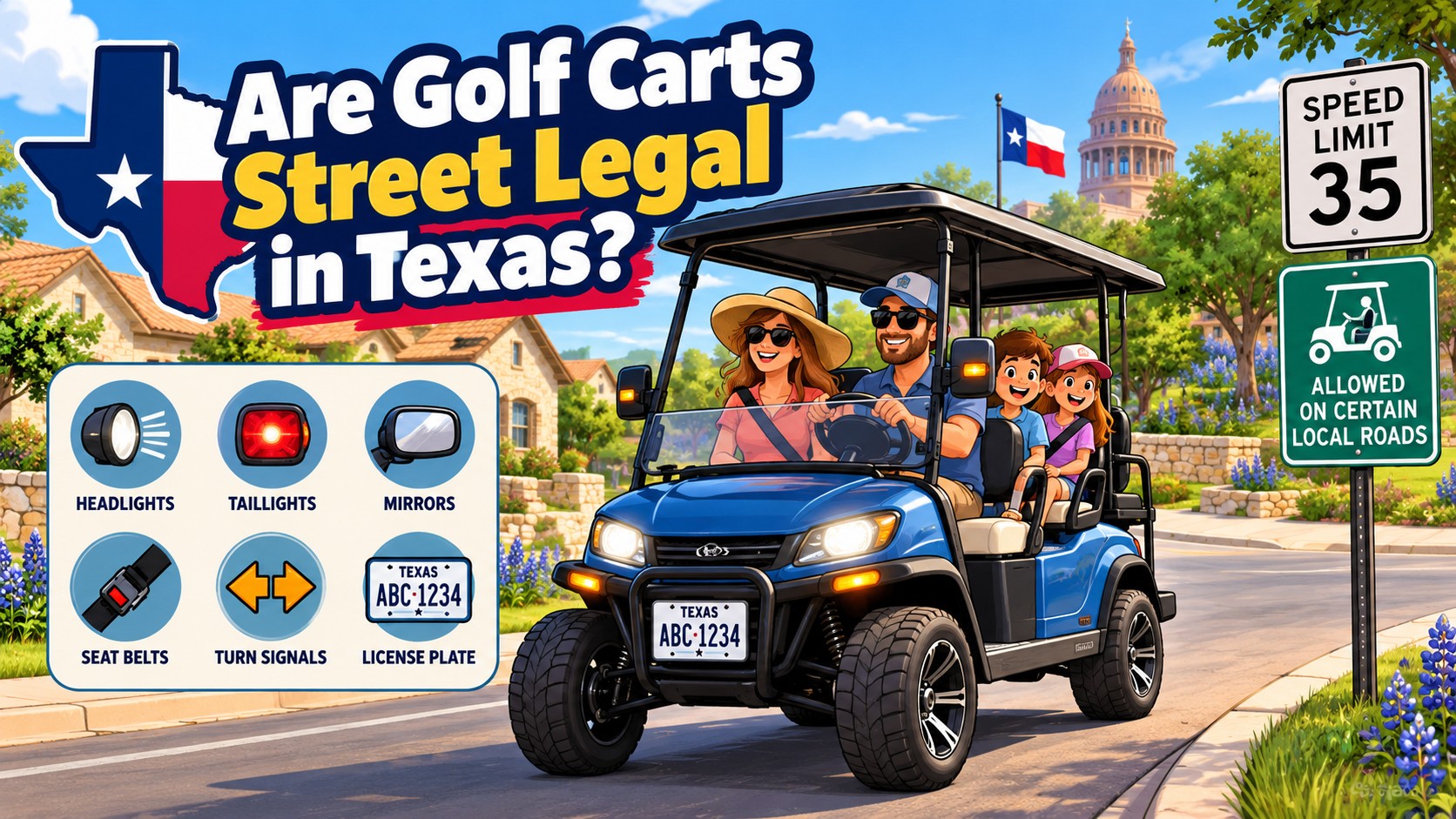
Golf carts can operate on certain Texas roads, but a posted speed limit of 35 mph or less does not automatically make every road legal for golf carts. State law permits specific uses, and municipalities may authorize additional roads. A factory-built LSV or NEV follows a different title, registration, insurance, and equipment framework.
Texas Transportation Code Chapter 551 allows golf carts to operate in several defined situations, while cities and qualifying counties can establish additional local rules. The most important distinction is between a traditional golf cart and a registered Low-Speed Vehicle or Neighborhood Electric Vehicle. For buyers who want a vehicle designed more specifically for public-road transportation, Tara EV offers several models in its LSV-oriented lineup.
Where Can You Drive a Golf Cart in Texas?
Texas law identifies several circumstances where a golf cart may be operated on public roads or other designated areas.
| Location | General Texas Rule |
|---|---|
| Master-Planned Community | Golf cart operation may be allowed in qualifying communities with approved plats or restrictive covenants. |
| Public or Private Beach | Permitted where the beach is open to vehicular traffic and local rules allow operation. |
| Road to or from a Golf Course | May be permitted during daytime on a road posted at 35 mph or less and within five miles of where the cart is normally parked. |
| City-Authorized Streets | A municipality may authorize golf carts on some roads within its boundaries with speed limits of 35 mph or less. |
| Higher-Speed Intersection | A golf cart may cross a higher-speed highway at an intersection where otherwise permitted. |
| Interstates / Limited-Access Highways | Not a normal permitted golf-cart operating environment. |
Does a 35 MPH Speed Limit Automatically Make a Road Legal?
No. This is one of the most common misunderstandings about Texas golf cart laws.
A road having a speed limit of 35 mph or less does not automatically mean any golf cart can use it at any time.
For example, state law allows a golf cart to use a road posted at no more than 35 mph during the daytime when it is being used for transportation to or from a golf course and remains within the permitted distance from its usual parking location.
Municipalities can also adopt ordinances allowing golf carts on additional streets within their boundaries.
Always check the city or county ordinance for the exact road you plan to use. A neighboring Texas city may have completely different golf-cart rules.
Can a Golf Cart Cross a Road Over 35 MPH?
Texas law allows a golf cart to cross a highway at an intersection, including an intersection where the highway has a posted speed limit above 35 mph.
That does not mean the golf cart can travel along the higher-speed roadway. Crossing and traveling on the road are legally different situations.
Does a Texas Golf Cart Need a License Plate?
For many authorized public-road uses, a golf cart must display a Texas Golf Cart license plate.
Texas does not register an ordinary golf cart in the same way it registers a passenger automobile. Instead, qualifying golf carts can obtain a dedicated Golf Cart license plate through the county tax assessor-collector.
The state also provides limited exceptions, including certain qualifying master-planned-community situations.
What Equipment Does a Texas Golf Cart Need?
When a golf cart is operated under locally authorized highway provisions, Texas law requires several basic safety items.
- Headlamps
- Taillamps
- Reflectors
- Parking brake
- Mirrors
Additional equipment may be required by local ordinances or by the vehicle classification under which the vehicle is operated.
Adding lights and mirrors to an ordinary golf cart does not automatically turn it into a registered Low-Speed Vehicle. Golf carts and LSVs/NEVs follow different legal classifications.
How Do I Make My Golf Cart Street Legal in Texas?
Start by determining whether you intend to operate the vehicle as a traditional golf cart under Chapter 551 or whether you need a road-oriented LSV/NEV.
For a Traditional Golf Cart
- Confirm that the intended street allows golf carts.
- Check city and county ordinances.
- Install all equipment required for your permitted use.
- Apply for a Texas Golf Cart license plate when required.
- Stay within applicable road-speed and geographic restrictions.
- Follow all relevant traffic laws.
A traditional golf cart cannot simply be registered as a normal motor vehicle because Texas specifically treats golf carts differently from registered passenger vehicles.
For an LSV or NEV
If you want broader road use, purchasing a factory-built vehicle that qualifies as a Neighborhood Electric Vehicle or Low-Speed Vehicle is generally a cleaner path than trying to convert a basic golf cart afterward.
Texas describes an NEV as a vehicle with equipment including:
- Four tires
- Seat belts
- Headlights and taillights
- Brake lights
- Turn signals
- Windshield
- Parking brake
- Rearview mirrors
- Reflectors
- Valid 17-digit VIN
The vehicle must also satisfy applicable speed and certification requirements.
Golf Cart vs. Low-Speed Vehicle in Texas
| Feature | Traditional Golf Cart | LSV / NEV |
|---|---|---|
| Primary Design | Originally designed primarily for golf-course use | Designed for low-speed road transportation |
| Texas Registration | Not registered like a normal passenger vehicle | Title and registration requirements apply |
| License Plate | Golf Cart plate for applicable uses | Regular registration plate |
| VIN | Not necessarily a standard 17-digit road-vehicle VIN | Valid 17-digit VIN required |
| Insurance | May depend on use and local requirements | Proof of insurance required for registration |
| Road Use | Restricted to authorized situations | Broader low-speed road use subject to Texas and local rules |
Do You Need a Driver’s License?
Drivers should not assume that an unlicensed minor can operate a golf cart simply because the vehicle travels slowly.
Driver-license requirements depend on the vehicle classification and the type of public-road operation involved, while local municipalities may impose additional age and licensing requirements.
For a registered LSV or NEV used as a motor vehicle on public streets, the operator should meet normal applicable driver-license requirements.
Do not allow an unlicensed child to operate a golf cart on a public roadway based solely on the cart’s low maximum speed. Check Texas and local rules before allowing any minor to drive.
Do Texas Traffic Laws Apply to Golf Carts?
When operating on an authorized public roadway, golf cart drivers should follow normal traffic-control requirements.
That includes paying attention to:
- Stop signs
- Traffic lights
- Right-of-way rules
- Pedestrians
- Lane positioning
- Safe speed
Drivers should also use particular caution because golf carts provide much less crash protection than conventional automobiles.
Can You Drive a Golf Cart on a Texas Sidewalk?
A sidewalk should not be treated as a normal golf-cart travel lane.
Cities can regulate golf carts locally, and many municipal ordinances prohibit operating motorized carts on sidewalks, pedestrian routes, or hike-and-bike trails except in specifically authorized circumstances.
Always use the designated roadway or cart route rather than assuming a sidewalk is legal.
Can Golf Carts Drive on Texas Highways?
Ordinary golf carts are not intended for unrestricted highway travel.
The permitted Texas uses focus primarily on lower-speed local roads, communities, beaches, golf-course access, and specifically authorized streets.
Even when crossing a higher-speed highway is permitted at an intersection, traveling along that roadway is a different matter.
Which Tara EV Models Are Designed for Road-Oriented Use?
Tara EV currently places three personal transportation models in its LSV category: the Roadster 2, Roadster 2+2, and Explorer 2+2.
| Tara Model | Seats | Battery | Category |
|---|---|---|---|
| Roadster 2 | 2 | 48V 105Ah Lithium | LSV-Oriented Personal Transportation |
| Roadster 2+2 | 4 | 48V 160Ah Lithium | LSV-Oriented Personal Transportation |
| Explorer 2+2 | 4 | 48V 160Ah Lithium | LSV-Oriented Personal Transportation |
Tara Roadster 2
The Roadster 2 provides a compact two-passenger layout designed for personal transportation in communities, resorts, and other permitted low-speed environments.
For Texas buyers, the important step is confirming that the specific vehicle being purchased carries the required manufacturer certification, VIN, and documentation for the intended road-use classification.
Tara Roadster 2+2
The Roadster 2+2 expands passenger capacity to four seats and uses a larger 48V 160Ah lithium battery.
Its additional seating can make it useful for families and community transportation where public-road use is legally permitted.
Tara Explorer 2+2
The Explorer 2+2 also provides four-passenger seating with a more recreational appearance.
Like the Roadster models, legal public-road use in Texas depends on the certification and registration status of the specific vehicle as well as the rules applying to the road on which it is driven.
Verify the specific vehicle’s 17-digit VIN, federal certification documentation, Texas title and registration eligibility, insurance requirements, and local road restrictions. A model name alone does not determine whether a particular unit may legally operate on every Texas street.
Texas Street-Legal Checklist
- Determine whether the vehicle is a golf cart or an LSV/NEV.
- Check the road’s posted speed limit.
- Review your city’s or county’s golf-cart ordinance.
- Confirm all required safety equipment.
- Obtain the appropriate plate or registration.
- Verify insurance requirements.
- Make sure the operator meets applicable licensing rules.
- Avoid prohibited highways and restricted routes.
Conclusion
So, are golf carts street legal in Texas? Yes, but only under specific state and local rules—not simply because a road has a 35 mph speed limit. Traditional golf carts may operate in qualifying master-planned communities, on vehicle-access beaches, for certain golf-course transportation, and on additional streets authorized by local governments, while factory-built LSVs follow a different title and registration framework. Buyers seeking road-oriented electric transportation can consider Tara EV models such as the Roadster 2, Roadster 2+2, and Explorer 2+2, while confirming the specific vehicle’s certification and the local Texas rules before driving on public streets.
