
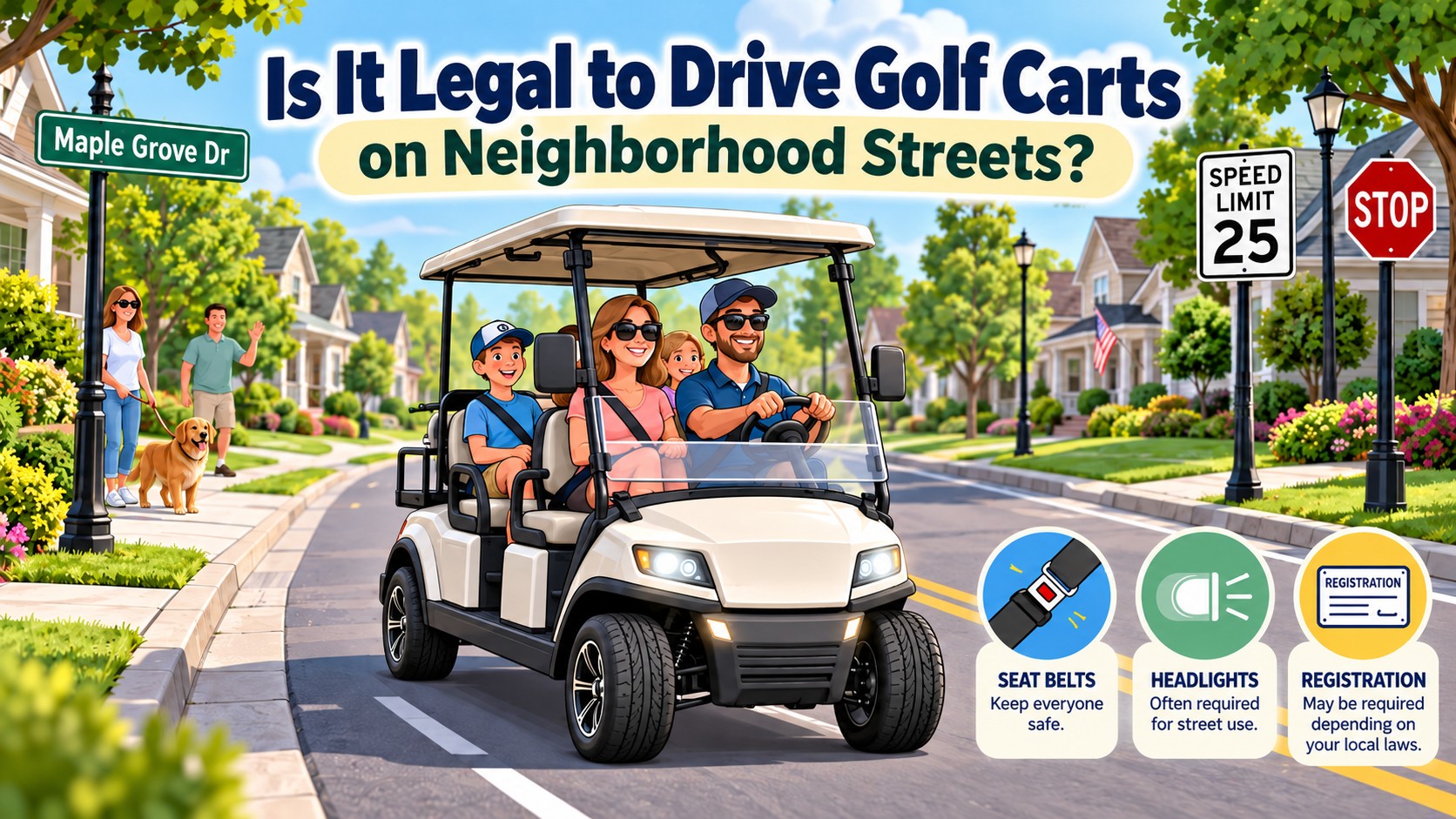
Yes, golf carts can be legal on some neighborhood streets, but there is no single nationwide rule. Standard golf carts are usually restricted to specifically authorized low-speed roads or communities, while properly titled and registered LSVs can generally operate on a broader range of low-speed public roads subject to state and local law.
Whether you can legally drive a golf cart through a neighborhood depends mainly on whether the vehicle is a standard golf cart or a registered Low-Speed Vehicle (LSV) or Neighborhood Electric Vehicle (NEV). State laws establish the basic framework, while cities, counties, gated communities, and homeowners associations may impose additional restrictions. Buyers considering vehicles from Tara Electric Vehicles should therefore distinguish between golf-course models and vehicles designed for low-speed road transportation.
Standard Golf Carts vs. Street-Legal LSVs
The most important question is what type of vehicle you are driving. A traditional golf cart and an LSV may look similar, but legally they can be very different.
| Feature | Standard Golf Cart | LSV / NEV |
|---|---|---|
| Primary Purpose | Golf courses, resorts, private property, community transportation | Low-speed public-road transportation |
| Typical Speed | Often around 15–20 mph | Generally designed for speeds above 20 mph and up to 25 mph |
| Registration | May not require normal vehicle registration, depending on jurisdiction | Usually requires title and registration |
| Insurance | Depends on local rules and use | Generally required for public-road use |
| Road Access | Limited and locally controlled | Broader access to eligible low-speed roads |
Can a Standard Golf Cart Be Driven on Neighborhood Streets?
Sometimes. Many states allow cities, counties, or communities to authorize golf carts on certain low-speed roads.
Typical requirements may include:
- A low posted speed limit
- Local authorization or ordinance
- Headlights and taillights
- Reflectors
- Mirrors
- Turn signals in some jurisdictions
- A horn
- Seat belts where required
- A local permit, decal, or license plate
Some communities only allow golf carts during daylight hours, while others permit nighttime operation if the vehicle has approved lighting.
A golf cart being legal in one neighborhood does not mean it is legal in the next city or county. Always check local ordinances before using a standard golf cart on a public street.
What Is a Street-Legal Low-Speed Vehicle?
A Low-Speed Vehicle is a motor vehicle built to meet specific federal safety standards for low-speed road use.
LSVs generally include equipment such as:
- Headlamps
- Taillamps
- Brake lights
- Turn signals
- Mirrors
- Windshield
- Seat belts
- Parking brake
- Vehicle Identification Number
Unlike a basic golf cart, an LSV is normally titled, registered, and insured similarly to other road vehicles.
What Roads Can an LSV Use?
LSVs are generally intended for lower-speed roads. Many states allow them on streets with posted speed limits of 35 mph or less, although the exact limit varies by state and local jurisdiction.
They may also be allowed to cross higher-speed roads at approved intersections while being prohibited from traveling along those roads.
Interstates, freeways, and high-speed arterial roads are generally outside the intended operating environment of an LSV.
Neighborhood Streets and HOA Rules
Private neighborhoods, gated communities, and homeowners associations may establish their own golf cart rules in addition to state and local law.
An HOA may require:
- Resident registration
- A neighborhood decal
- Minimum driver age
- Proof of insurance
- Specific safety equipment
- Restricted operating hours
An HOA can also prohibit golf carts on privately maintained streets even when broader local law might otherwise allow them.
Before buying a golf cart specifically for neighborhood transportation, check both government regulations and your HOA or community rules.
Can Golf Carts Use Sidewalks or Bike Paths?
In most communities, sidewalks, pedestrian paths, bicycle lanes, and multi-use trails are not intended for ordinary golf cart or LSV traffic unless the local authority specifically designates them for such use.
Driving on these areas can create conflicts with pedestrians and cyclists and may violate local ordinances.
Use designated roads or golf-cart paths rather than assuming a sidewalk or bike trail is legal.
Do DUI Laws Apply to Golf Carts?
Yes. Operating a golf cart or LSV on a public road does not generally exempt a driver from impaired-driving laws.
Alcohol or drug impairment can result in serious legal consequences, especially when the vehicle is being operated on a public street.
Drivers should treat neighborhood golf cart operation with the same level of responsibility as operating other motor vehicles.
Do You Need a Driver’s License?
Driver-license requirements vary significantly by location and vehicle classification.
Registered LSVs generally require a properly licensed driver for public-road operation. Standard golf carts may follow different local rules, but many communities still establish minimum ages or licensing requirements.
Parents should never assume that a minor can legally drive a golf cart on neighborhood streets simply because the vehicle is slow.
Do Golf Carts Need Insurance?
Insurance requirements depend on whether the vehicle is classified as a golf cart or an LSV and whether it is operated on public roads.
Registered LSVs normally require liability insurance. Standard golf carts may have different requirements, but owners should still consider coverage for:
- Liability
- Property damage
- Collision
- Theft
- Medical costs
Can You Convert a Golf Cart Into a Street-Legal Vehicle?
Adding headlights, mirrors, seat belts, and turn signals may satisfy some local golf-cart equipment requirements, but it does not automatically transform a standard golf cart into a federally compliant LSV.
True LSV status can depend on:
- Manufacturer certification
- Vehicle Identification Number
- Federal safety compliance
- Title eligibility
- State registration
If regular public-road use is your goal, purchasing a vehicle designed and documented as an LSV from the manufacturer is usually easier than attempting to convert a basic golf cart afterward.
What Models Does Tara Electric Vehicles Offer?
Tara Electric Vehicles offers both traditional golf-course-oriented vehicles and models designed for low-speed personal transportation.
| Model | Configuration | Primary Category |
|---|---|---|
| Spirit Air | 2 Seats | Standard Golf Cart |
| Spirit Plus | 2 Seats | Standard Golf Cart |
| Roadster 2 | 2 Seats | LSV-Oriented Personal Transportation |
| Roadster 2+2 | 2+2 / 4 Seats | LSV-Oriented Personal Transportation |
| Explorer 2+2 | 2+2 / 4 Seats | LSV-Oriented Personal Transportation |
Spirit Air and Spirit Plus
The Spirit Air and Spirit Plus are designed primarily for golf-course applications.
They feature two-passenger seating and can be equipped with golf-related accessories and GPS technology.
Whether these standard golf carts can be operated on neighborhood streets depends on the rules of the state, city, county, or private community.
Roadster 2
The Roadster 2 is a two-passenger vehicle designed more specifically for low-speed personal transportation.
For buyers who primarily need transportation around neighborhoods, communities, resorts, or other permitted road environments, this type of platform may be more appropriate than a traditional golf-course cart.
Roadster 2+2
The Roadster 2+2 adds rear passenger seating, allowing up to four occupants.
Its larger passenger capacity can make it useful for families and community transportation where local road laws permit operation.
Explorer 2+2
The Explorer 2+2 also provides four-passenger seating with a more recreational design.
As with any road-oriented low-speed vehicle, buyers should confirm the certification, VIN, title, registration, and insurance requirements for their specific state before driving on public streets.
Checklist Before Driving in Your Neighborhood
- Determine whether the vehicle is a golf cart or an LSV.
- Check your state law.
- Check city and county ordinances.
- Review HOA or gated-community rules.
- Confirm the road’s posted speed limit.
- Verify required lighting and safety equipment.
- Check registration and plate requirements.
- Confirm insurance requirements.
- Verify driver age and licensing rules.
- Avoid sidewalks, trails, and prohibited high-speed roads.
If neighborhood street use is your main purpose, choose a vehicle specifically designed for road-oriented low-speed transportation and verify that the individual vehicle can be titled and registered where you live.
Conclusion
So, is it legal to drive golf carts on neighborhood streets? It can be, but legality depends on vehicle classification and local regulations. Standard golf carts such as the Spirit Air and Spirit Plus are primarily designed for golf-course use and may only operate on neighborhood streets where local rules specifically permit them. For buyers who want more road-oriented transportation, Tara Electric Vehicles also offers the Roadster 2, Roadster 2+2, and Explorer 2+2. Before driving any cart or LSV on public neighborhood streets, confirm state law, local ordinances, HOA requirements, registration, insurance, and driver rules.
