
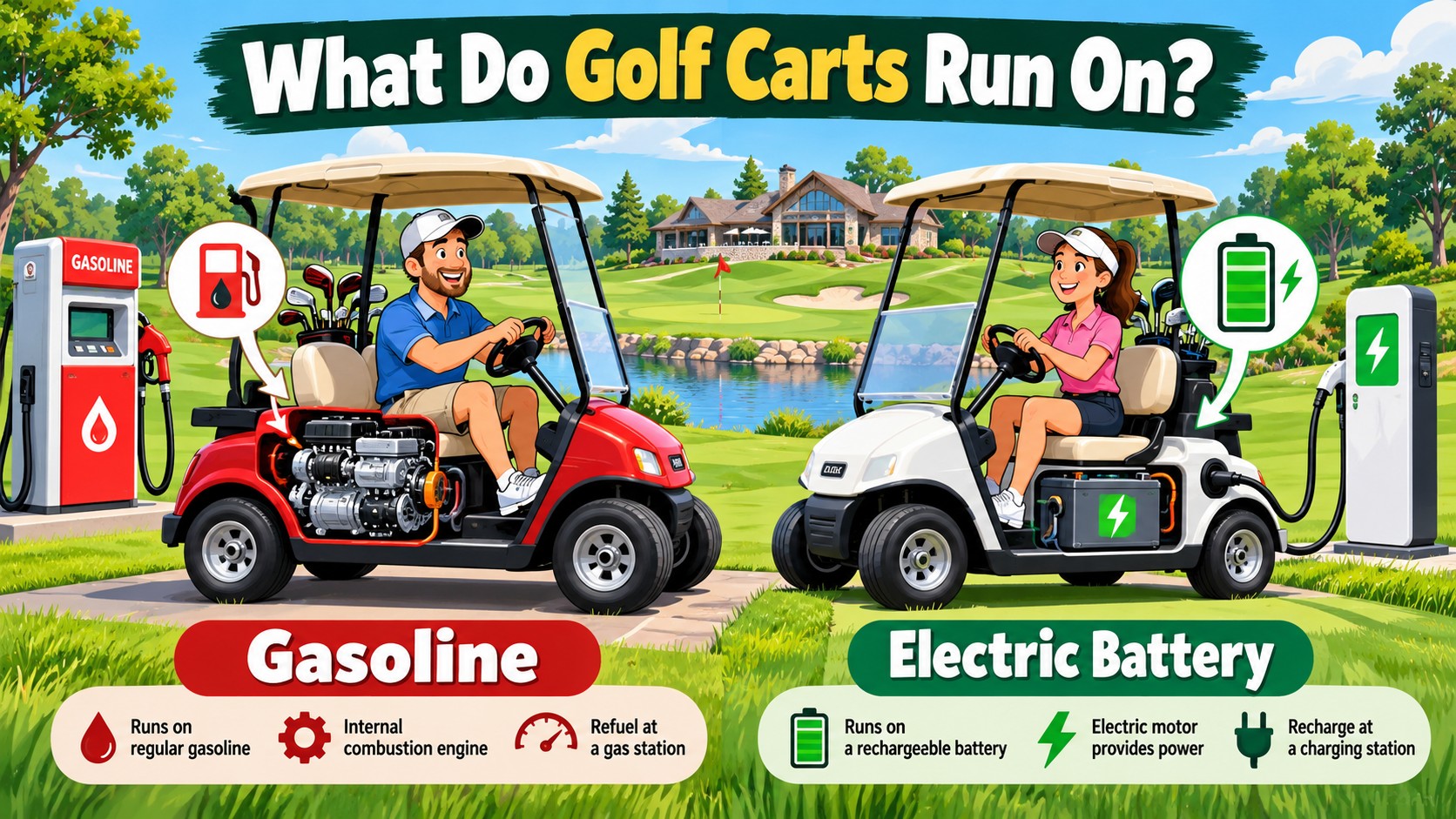
Golf carts run on either gasoline or electricity. Gas-powered carts use regular unleaded gasoline and small four-stroke engines, while electric carts use rechargeable lead-acid or lithium-ion battery packs. Electric golf carts are quieter and require less routine maintenance, while gas carts are often chosen for long operating hours where quick refueling is important.
The power source is one of the biggest differences between golf carts. Traditional gas carts use small internal-combustion engines, while electric carts rely on rechargeable battery packs that power an electric motor. Modern Tara golf carts use lithium battery systems, offering quiet operation, lower maintenance, and efficient daily use for golf courses, resorts, communities, and personal transportation.
What Powers a Golf Cart?
There are two main golf cart power systems: gasoline engines and electric drivetrains.
| Power Type | Energy Source | Main Advantage | Main Maintenance |
|---|---|---|---|
| Gas-Powered | Regular unleaded gasoline | Fast refueling and long operating time | Oil, filters, spark plugs, fuel system |
| Electric Lead-Acid | Rechargeable battery pack | Quiet operation and lower fuel cost | Charging, watering, terminal cleaning |
| Electric Lithium | Lithium-ion / LiFePO4 battery | Low maintenance, fast charging, long life | Charging and basic inspection |
Gas-Powered Golf Carts
Fuel
Gas golf carts normally run on regular unleaded gasoline. They have a fuel tank similar to other small gasoline-powered vehicles and can be refueled quickly when the tank runs low.
Engine
Most gas golf carts use compact four-stroke internal-combustion engines, commonly in the range of approximately 250cc to 450cc depending on the model.
The engine burns fuel to create mechanical power, which is transferred through the drivetrain to the wheels.
Maintenance
Gas carts require routine engine maintenance, including:
- Engine oil changes
- Air filter replacement
- Spark plug service
- Fuel system inspection
- Drive belt inspection
- Exhaust system checks
They also create engine noise and exhaust emissions during operation.
How Does a Gas Golf Cart Work?
When the driver presses the accelerator, the cart’s electrical starting system activates the engine. Fuel and air enter the combustion chamber, where the mixture burns and produces mechanical force.
This power moves through the transmission or continuously variable transmission system and ultimately turns the wheels.
Many golf carts are designed so the engine starts automatically when the accelerator is pressed and shuts down when the cart stops, helping reduce unnecessary idling.
Gas golf carts can be useful in applications where the vehicle must operate for many hours and quick refueling is more convenient than waiting for battery charging.
Electric-Powered Golf Carts
Electric golf carts operate without gasoline or engine oil. Instead, they use rechargeable battery systems connected to an electric motor.
Traditional Lead-Acid Batteries
Older electric golf carts often use several deep-cycle lead-acid batteries connected together in series to create the required system voltage.
A typical pack may contain four, six, or eight individual batteries depending on the cart’s voltage and battery size.
Lead-acid systems are relatively affordable but require more maintenance, including checking electrolyte levels and adding distilled water.
Lithium-Ion Batteries
Modern golf carts increasingly use lithium batteries because they provide several advantages:
- Lower weight
- Faster charging
- Longer cycle life
- No routine watering
- Stable power delivery
- Integrated Battery Management System
Lithium battery systems are especially attractive for fleet operators because they reduce daily maintenance and can improve vehicle availability.
How Does an Electric Golf Cart Work?
An electric golf cart stores energy in its battery pack. When the driver presses the accelerator, the controller regulates how much electrical power flows from the battery to the motor.
The electric motor converts electrical energy into mechanical rotation, which drives the wheels through the differential and drivetrain.
When the accelerator is released, the controller reduces power to the motor. Some systems may also use regenerative braking to recover a portion of energy during deceleration.
The entire system typically includes:
- Battery pack
- Battery Management System
- Motor controller
- Electric motor
- Charger
- Drive axle and differential
How Are Electric Golf Carts Charged?
Electric golf carts are charged by connecting the vehicle to a dedicated charger or charging port.
The charger converts AC electricity from the power source into the DC power required by the battery pack.
Modern lithium systems often charge significantly faster than traditional lead-acid packs and are well suited to daily fleet use.
Electric golf carts require no gasoline and no engine oil changes. For golf courses and resort fleets, this can reduce fuel handling, engine maintenance, noise, and daily service requirements.
When to Choose a Gas-Powered Golf Cart
A gas-powered golf cart may be the better choice when:
- The cart needs to operate for extended periods without charging
- Quick refueling is essential
- The vehicle is used in remote areas without charging infrastructure
- The workload involves frequent long-distance travel
- Fuel availability is easier than electrical charging access
Gas carts are still widely used in commercial environments where uptime depends on being able to refuel in just a few minutes.
When to Choose an Electric-Powered Golf Cart
Electric golf carts are generally a better fit when:
- Quiet operation matters
- The cart is used on a golf course
- Indoor or resort environments require zero tailpipe emissions
- Maintenance reduction is a priority
- Charging infrastructure is available
- Fleet operators want predictable operating costs
Electric vehicles are especially suitable for golf courses because quiet operation helps maintain a relaxed playing environment.
Gas vs. Electric Golf Carts
| Feature | Gas Golf Cart | Electric Golf Cart |
|---|---|---|
| Power Source | Gasoline | Rechargeable batteries |
| Noise | Higher | Very quiet |
| Tailpipe Emissions | Yes | None during operation |
| Refueling / Charging | Few minutes | Several hours depending on battery |
| Routine Maintenance | Higher | Lower |
| Best Use | Extended remote operation | Golf courses, resorts, communities, fleets |
What Are the Advantages of Tara Golf Carts?
Tara golf carts are built around modern electric platforms and are designed for both golf-course fleet use and personal transportation.
One important advantage is fleet management. Tara offers GPS-based fleet technology that can help golf course operators monitor cart locations, manage vehicle movement, improve pace-of-play visibility, and support geofencing.
Golf-focused equipment can also include:
- Ball washers
- Sand bottles
- Golf bag holders
- Coolers
- Onboard storage
- GPS fleet management systems
These features help make the carts practical for daily golf-course operation while also improving player convenience.
Tara Standard Golf Cart Models
Tara currently offers two standard two-passenger models designed specifically for golf-course operation.
| Model | Seats | Battery | Maximum Speed | Main Use |
|---|---|---|---|---|
| Spirit Air | 2 | 48V 105Ah Lithium | 13 mph | Golf-course fleet |
| Spirit Plus | 2 | 48V 105Ah Lithium | 13 mph | Golf-course fleet |
The Spirit Air and Spirit Plus both use lithium battery systems and are designed to meet the needs of golf clubs, resorts, and managed vehicle fleets.
Tara Low-Speed Vehicle Models
Tara also offers Low-Speed Vehicle configurations for personal transportation and public-road use where local laws permit.
| Model | Seats | Battery | Maximum Speed | Category |
|---|---|---|---|---|
| Roadster 2 | 2 | 48V 105Ah Lithium | 25 mph | LSV |
| Roadster 2+2 | 4 | 48V 160Ah Lithium | 25 mph | LSV |
| Explorer 2+2 | 4 | 48V 160Ah Lithium | 25 mph | LSV |
The Roadster 2 provides a compact two-seat configuration, while the Roadster 2+2 and Explorer 2+2 provide four-passenger layouts and larger 160Ah battery packs.
Whether a golf cart or LSV can legally operate on public roads depends on local and state regulations, vehicle equipment, registration, insurance, and road-speed limits.
Why Lithium Power Works Well for Tara
Lithium batteries complement Tara’s focus on modern fleet and personal transportation because they provide lower maintenance and consistent daily performance.
Compared with traditional flooded lead-acid packs, lithium systems can reduce:
- Battery watering
- Terminal corrosion
- Long charging periods
- Battery weight
- Routine maintenance labor
This is especially useful for golf courses managing dozens or hundreds of carts where small maintenance savings per vehicle can add up quickly.
Which Power Type Is Better for Most Golf Courses?
For most golf courses, electric carts are usually the better fit because they operate quietly, produce no tailpipe emissions during use, and require less routine mechanical maintenance.
Lithium-powered models further improve this by offering faster charging, longer battery life, and lower maintenance than traditional lead-acid systems.
Gas carts remain useful in specific environments, but for modern golf fleets, electric power has become increasingly attractive.
Conclusion
So, what do golf carts run on? They generally use either gasoline engines or rechargeable electric battery systems.
Gas-powered carts offer fast refueling and long operating periods, while electric carts provide quiet operation, lower maintenance, and no direct exhaust emissions. Modern lithium battery systems improve electric golf carts further by reducing weight, speeding up charging, and extending battery life.
Tara golf carts use lithium power across both their golf-course models and LSV lineup. The Spirit Air and Spirit Plus are two-seat golf carts with 105Ah batteries and 13 mph maximum speeds, while the Roadster 2, Roadster 2+2, and Explorer 2+2 provide faster 25 mph LSV configurations for broader transportation needs.
