
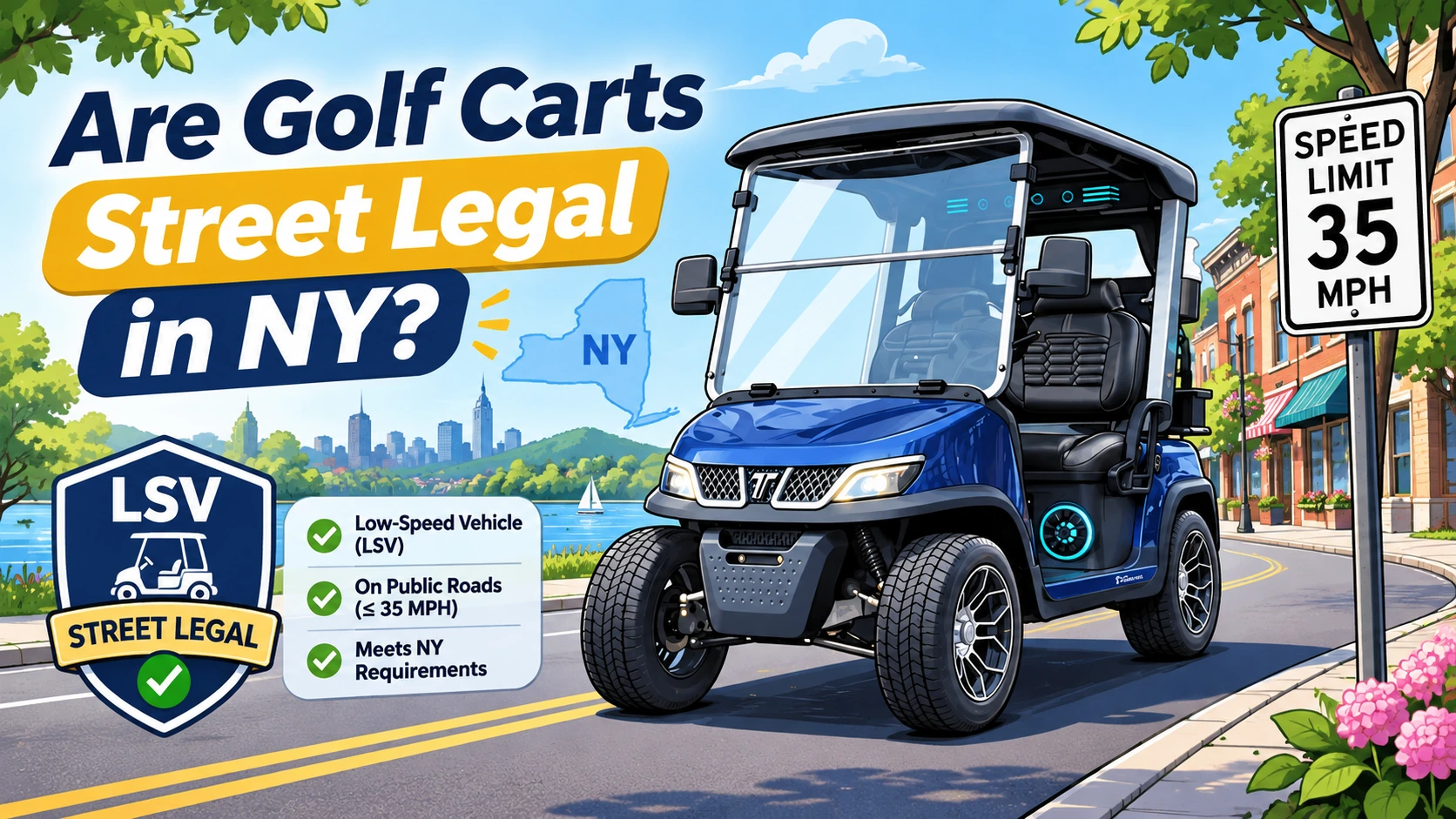
A conventional golf cart is generally not eligible for normal public-road use in New York simply because it has lights, mirrors, or seat belts. New York does recognize Low-Speed Vehicles, or LSVs, which must have a maximum performance speed above 20 mph but no more than 25 mph and comply with federal LSV safety standards. A properly registered and insured LSV may operate on eligible New York roads with posted speed limits of 35 mph or less unless a state or local authority prohibits LSVs on that road.
Are Golf Carts Street Legal in NY?
The answer depends on whether the vehicle is a conventional golf cart or a legally recognized Low-Speed Vehicle.
A standard golf cart intended primarily for golf-course or private-property use is not automatically street legal in New York. Adding headlights, turn signals, mirrors, or seat belts does not by itself change the vehicle’s legal classification.
New York law does, however, recognize Low-Speed Vehicles. These vehicles can look similar to golf carts but are manufactured and documented to meet a different legal standard.
For buyers considering road-oriented electric transportation, Tara Electric Vehicles offers several personal models with published maximum speeds within the federal LSV speed range.
Do not assume that a vehicle is legal on New York roads simply because it can travel 20–25 mph. VIN documentation, federal certification, New York registration eligibility, insurance, equipment, and local road restrictions all matter.
Standard Golf Carts vs Low-Speed Vehicles
Standard Golf Carts
A traditional golf cart is generally designed for golf courses, resorts, private communities, campuses, and private property.
Many standard carts operate below the federal LSV speed range and may not carry the manufacturer certification required for road registration.
Installing aftermarket road equipment does not necessarily make the vehicle registrable as an LSV. New York registration depends on the vehicle’s legal classification and documentation, not simply the accessories installed by the owner.
Low-Speed Vehicles
Under New York Vehicle and Traffic Law, a Low-Speed Vehicle is generally a limited-use automobile with a maximum performance speed greater than 20 mph but no more than 25 mph. Applicable vehicles must comply with the federal safety standard in 49 CFR 571.500, commonly called FMVSS 500.
For qualifying trucks in this category, New York also specifies a GVWR below 3,000 pounds.
| Feature | Standard Golf Cart | Low-Speed Vehicle |
|---|---|---|
| Typical Speed | Often below 20 mph | More than 20 mph, up to 25 mph |
| Federal LSV Certification | Usually no | Required |
| VIN / Road Documentation | May not have road-use documentation | Required for registration eligibility |
| NY Public-Road Use | Generally not as a conventional golf cart | Possible when properly registered and allowed |
| 35 mph Road Access | No general street privilege | May operate where permitted |
Requirements to Drive an LSV in New York
For public-road operation, a qualifying LSV must satisfy both vehicle requirements and New York registration requirements.
Federal Safety Equipment
FMVSS 500 requires low-speed vehicles to include specified road-safety equipment. Depending on configuration, this includes items such as headlights, turn signals, taillights, brake lights, reflectors, mirrors, a parking brake, windshield, VIN, and seat belts.
New York Registration
New York requires a limited-use vehicle operating on a public highway to be registered with the Department of Motor Vehicles and to display the assigned registration plate.
Registration also depends on acceptable ownership documentation and the vehicle’s eligibility as a limited-use automobile.
Insurance
Registered vehicles in New York generally must maintain New York-compliant liability insurance. The insurance and registration must remain in the correct registered name.
Driver Requirements
A road-going LSV should be treated as a motor vehicle rather than as golf-course equipment. Drivers should have the appropriate valid driver’s license and comply with New York traffic laws applicable to the vehicle.
New York law specifically requires limited-use vehicles used on public highways to be registered. A road-equipped cart without proper registration is not equivalent to a legally registered LSV.
Where Can an LSV Be Driven in New York?
New York places an important road-speed restriction on LSV operation.
An LSV cannot normally operate on a public highway with a posted speed limit above 35 mph. It may cross a road with a higher speed limit when that road intersects with an eligible road of 35 mph or less.
In addition, local governments and the New York State Department of Transportation can prohibit Low-Speed Vehicles on particular roads for safety reasons.
Controlled-access highways are also generally unavailable unless a specific section has been expressly designated for limited-use vehicles.
The 35 mph number refers to the maximum posted road speed where New York generally permits LSV operation. The LSV itself remains a vehicle with a maximum performance speed of no more than 25 mph.
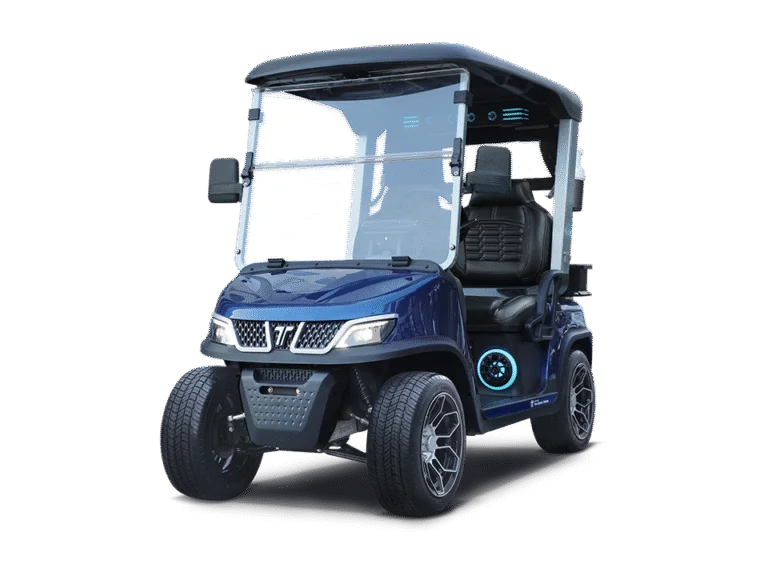
Tara Electric Vehicles
Low-Speed Vehicles (LSVs)
Properly certified and registered Low-Speed Vehicles can be operated on eligible public roads in New York with speed limits of 35 mph or less, subject to state and local restrictions.
Request a QuoteWhat LSV-Style Models Does Tara Offer?
Tara Electric Vehicles currently offers three road-oriented personal models with published maximum speeds of 25 mph: Roadster 2, Roadster 2+2, and Explorer 2+2.
Their speed falls within the federal LSV speed range, but speed alone does not guarantee that every individual vehicle can be registered in New York.
Before purchase, buyers should verify the exact vehicle’s VIN, manufacturer certification label, Manufacturer’s Certificate of Origin or equivalent documentation, and New York DMV registration eligibility.
Tara Model Comparison
| Model | Seats | Battery | Published Maximum Speed |
|---|---|---|---|
| Roadster 2 | 2 | 48V 105Ah Lithium | 25 mph |
| Roadster 2+2 | 4 | 48V 160Ah Lithium | 25 mph |
| Explorer 2+2 | 4 | 48V 160Ah Lithium | 25 mph |
Roadster 2
The Roadster 2 is a compact two-passenger personal vehicle powered by a 48V 105Ah lithium battery.
Tara currently publishes a maximum speed of 25 mph and an estimated driving range of approximately 40 miles, making the Roadster 2 relevant for communities, resorts, private properties, and short-distance personal transportation.
Roadster 2+2
The Roadster 2+2 provides four-passenger seating and uses a 48V 160Ah lithium battery.
Its published maximum speed is also 25 mph. The additional rear seating makes it more practical for families, resort transportation, communities, and other passenger-focused applications.
Explorer 2+2
The Explorer 2+2 is another four-passenger option with a 48V 160Ah lithium system and a published maximum speed of 25 mph.
Its design is aimed at buyers looking for more recreational styling while retaining the basic performance characteristics associated with Tara’s road-oriented personal models.
A 25 mph top speed does not by itself make a Tara vehicle street legal in New York. Always verify the exact vehicle’s federal certification, VIN, ownership documents, registration eligibility, insurance, and local road rules before public-road operation.
Can You Convert a Golf Cart Into an LSV?
Adding lights, mirrors, turn signals, seat belts, or a higher-speed controller may make a golf cart look similar to an LSV, but it does not automatically change its legal classification.
Federal LSV status involves manufacturer certification to FMVSS 500 and appropriate identifying documentation.
If a conventional golf cart lacks the required certification and paperwork, aftermarket upgrades may not be enough to make it eligible for New York registration.
For buyers who know from the beginning that they want road capability, a factory-built vehicle with the appropriate certification is generally easier to evaluate than attempting to convert a golf-course cart later.
New York Street-Legal Checklist
- Confirm the vehicle is an LSV. Its maximum performance speed should be above 20 mph but no more than 25 mph.
- Verify FMVSS 500 compliance. Confirm the manufacturer certification rather than relying only on installed accessories.
- Check the VIN. The vehicle should have the documentation needed for registration.
- Confirm ownership paperwork. Ask the dealer what documentation will be supplied for New York registration.
- Register the vehicle. Public-highway operation requires valid registration for an eligible limited-use vehicle.
- Obtain insurance. Maintain New York-compliant coverage for the registered vehicle.
- Check the route. Use roads posted at 35 mph or less unless only crossing a higher-speed road where permitted.
- Check local restrictions. A city, town, village, or NYSDOT may prohibit LSVs on particular roads.
Conclusion
Standard golf carts are generally not street legal on New York public roads simply because lights, mirrors, or other road equipment have been added. New York does recognize Low-Speed Vehicles with maximum performance speeds above 20 mph and no more than 25 mph, provided they meet applicable federal safety standards and qualify for registration. Registered and insured LSVs may generally operate on eligible public roads posted at 35 mph or less, although local governments and NYSDOT can impose additional restrictions. Tara Electric Vehicles currently lists the Roadster 2, Roadster 2+2, and Explorer 2+2 with published maximum speeds of 25 mph, making them relevant options for buyers exploring road-oriented low-speed transportation. However, New York buyers should verify the exact vehicle’s certification, VIN, registration eligibility, insurance requirements, and local road rules before driving on public streets.
