
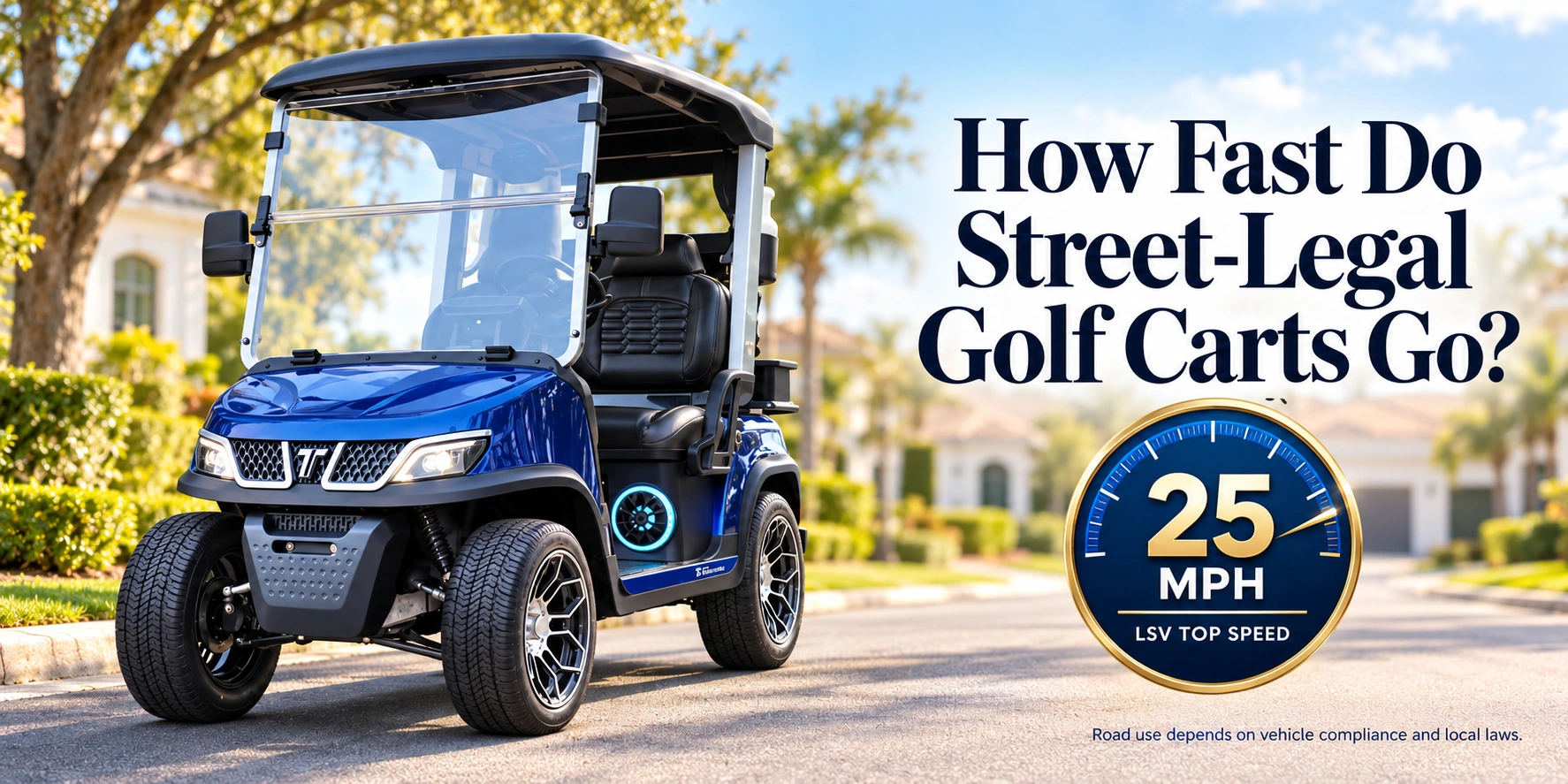
Quick Answer: In the United States, a federally defined low-speed vehicle must have an attainable speed above 20 mph and no higher than 25 mph under specified test conditions. That upper limit is approximately 40 km/h. Speed alone does not establish street legality.
Street-legal golf carts classified as LSVs typically reach 25 mph. Their legal use also depends on vehicle certification and state and local road rules.
What Is the Legal Speed of a Street-Legal Golf Cart?
“Street-legal golf cart” is a common shopping term, but the legal vehicle category matters. Many vehicles sold for neighborhood transportation are classified as Low-Speed Vehicles, or LSVs. Electric versions are also commonly called Neighborhood Electric Vehicles, or NEVs.
Under the federal definition, an LSV has four wheels, a gross vehicle weight rating below 3,000 pounds, and an attainable speed greater than 20 mph but no more than 25 mph within one mile on a paved, level surface.
Does an LSV Have to Travel at Least 20 mph?
The definition concerns the vehicle’s speed capability, not a minimum driving speed. Drivers should travel more slowly whenever conditions require it. A vehicle capable of only 20 mph does not satisfy the federal requirement that its attainable speed exceed 20 mph.
Can a Street-Legal Golf Cart Go Faster Than 25 mph?
A vehicle designed to exceed 25 mph falls outside the federal LSV category. A new road vehicle above that threshold must meet the standards applicable to its actual classification, such as a passenger car, multipurpose passenger vehicle, or truck. Increasing a cart’s speed does not automatically qualify it for another category.
Standard Golf Cart vs. Street-Legal LSV
Conventional golf carts prioritize controlled movement around courses, resorts, and private properties. Many operate around 12–19 mph, although specifications vary. Road-oriented LSVs combine higher speed capability with required equipment and compliance documentation.
| Vehicle Type | Typical Speed or Capability | Public-Road Considerations |
|---|---|---|
| Conventional golf cart | Often approximately 12–19 mph | Usually intended for courses or private property; some jurisdictions permit designated public-road use. |
| Federally defined LSV | More than 20 mph, up to 25 mph | Requires applicable compliance and must follow state and local operating rules. |
| Vehicle designed to exceed 25 mph | Above the federal LSV threshold | Cannot rely on LSV classification for road eligibility. |
How Fast Do Street-Legal Tara Golf Carts Go?
For buyers comparing Tara Golf Carts, published maximum speeds differ by model. Tara currently lists its Spirit fleet models at 13 mph and the personal models below at 25 mph. Confirm the configuration supplied in your market.
Spirit Air and Spirit Plus: 13 mph
The Spirit Air and Spirit Plus are two-seat fleet models with a published maximum speed of 13 mph. Their course-focused speed suits movement between tees, fairways, and clubhouse facilities.
These published 13 mph configurations do not meet the federal LSV speed definition. Buyers should not assume that adding lights or mirrors makes a standard fleet vehicle eligible for public-road registration.
Roadster and Explorer Models: Up to 25 mph
The Roadster 2, Roadster 2+2, and Explorer 2+2 each have a published maximum speed of 25 mph, approximately 40 km/h.
That speed matches the federal LSV ceiling. However, public-road eligibility depends on the specific vehicle’s certification, equipment, paperwork, and local requirements. Ask the dealer to verify these details for the exact unit before purchasing.
Where Can You Drive a Street-Legal Golf Cart?
Road access is governed by state and local law, rather than one nationwide 35 mph rule. Florida, for example, generally permits LSV operation on streets with posted limits of 35 mph or less, subject to applicable restrictions. Other jurisdictions may set different conditions.
A road’s posted limit and a vehicle’s maximum speed are separate figures. Permission to use a 35 mph road does not allow an LSV to exceed its 25 mph capability. Check the entire route, including intersections and restricted sections.
Buyer Tip: Before choosing a vehicle for neighborhood travel, confirm its certification label, VIN, registration eligibility, insurance requirements, and permitted routes. An “LSV package” description alone is not proof that every legal requirement has been satisfied.
Why Actual Golf Cart Speed May Be Lower
A published maximum describes capability under particular conditions. It is not a promise that the vehicle will maintain that speed throughout every trip.
- Passenger and cargo load: Additional weight can affect acceleration and hill performance.
- Terrain: Inclines and soft surfaces can reduce achievable speed.
- Battery condition: Charge level, temperature, and system protection settings can affect available power.
- Tires and configuration: Tire condition and approved controller settings influence operation.
Choose a vehicle around your route, seating needs, and operating conditions. A test drive with a representative load can be more useful than comparing maximum-speed figures alone.
Frequently Asked Questions
Can a Street-Legal Golf Cart Go 35 mph?
A federally defined LSV cannot have an attainable speed above 25 mph. A 35 mph road-access limit refers to the roadway, not permission for the vehicle to travel at 35 mph.
Does a 25 mph Golf Cart Automatically Qualify as Street-Legal?
No. Speed is only one requirement. Applicable federal safety compliance and state or local requirements must also be satisfied before public-road operation.
Are All Tara Golf Carts Rated for 25 mph?
No. Tara currently publishes 13 mph for Spirit Air and Spirit Plus, and 25 mph for Roadster 2, Roadster 2+2, and Explorer 2+2. Verify current specifications and road eligibility for your selected vehicle.
Choose the Right Speed for Your Application
For course use, a 13 mph fleet model may meet your needs. For permitted neighborhood routes, consider a properly certified and registered LSV with capability up to 25 mph. Match the vehicle to its intended use, documentation, and local rules before making your decision.
