
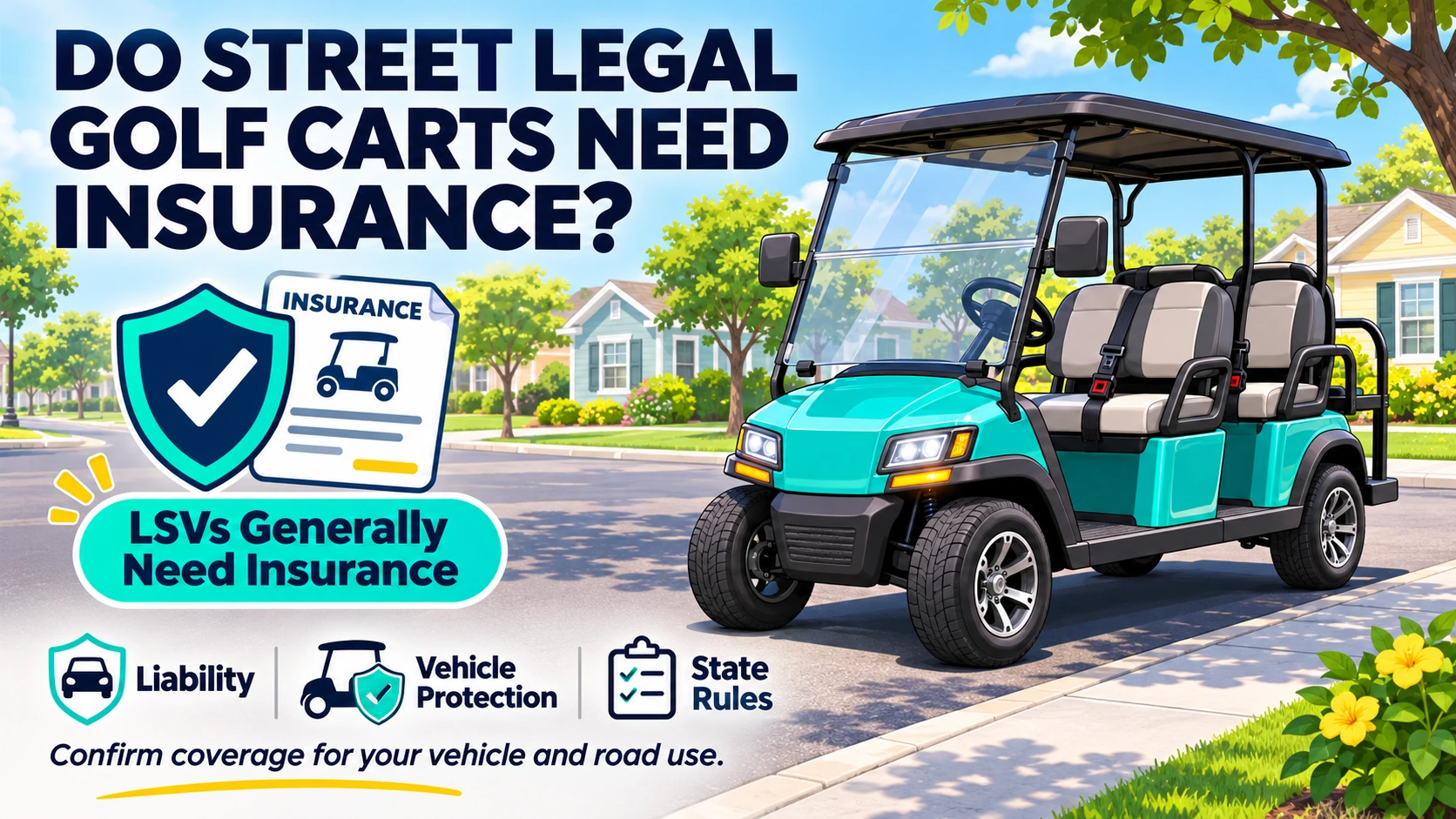
Quick Answer: Generally, yes. A golf cart titled and registered as a low-speed vehicle usually needs state-required motor vehicle insurance. The required coverage depends on your state, vehicle classification, and use. Check those details before driving on public roads.
Why Street Legal Golf Carts Usually Need Insurance
An LSV is a motor vehicle category, even when it resembles a traditional golf cart. Road use creates exposure to collisions, passenger injuries, and damage to other people’s property. State financial-responsibility requirements apply according to the vehicle’s legal classification.
Factory-built LSVs and legally converted carts may both require insurance. A conversion must follow the applicable certification, inspection, titling, and registration process. Adding headlights or increasing speed alone does not establish road legality.
Some communities separately permit ordinary golf carts on designated roads. Those arrangements can have different insurance rules, so the phrase “street legal golf cart” does not identify one universal legal category.
State Insurance Requirements: California and Florida
California Liability Insurance
California generally requires financial responsibility for vehicles operated or parked on public roads. For a standard liability policy, the published minimum limits are $30,000 for injury or death to one person, $60,000 for injury or death to multiple people in one accident, and $15,000 for property damage.
These limits are often written as 30/60/15. They cover qualifying losses suffered by others; they do not automatically pay to repair your cart. California also recognizes certain alternatives to a liability policy, but most individual owners arrange insurance.
Florida LSV Insurance
Florida distinguishes ordinary golf carts from LSVs. Its converted-cart registration guidance requires proof of at least $10,000 in personal injury protection and $10,000 in property damage liability. Ordinary golf carts follow different rules. Confirm the requirements for the vehicle you actually own.
Standard Golf Cart vs. Street Legal LSV Insurance
A traditional cart used only on private property may not face the same state insurance requirements as a registered LSV. Nevertheless, an HOA, golf course, lender, or property operator can require coverage. Private paths also deserve careful checking because community rules vary.
| Use or Classification | Insurance Consideration |
|---|---|
| Traditional cart on private property | State motor vehicle insurance may not be required; property rules and policy terms still matter. |
| Cart on designated community roads | Check local authorization, state classification, and HOA insurance conditions. |
| Registered LSV on public roads | Arrange the state-required coverage and confirm that the policy accepts LSV road use. |
| Financed vehicle | The lender may require collision and comprehensive coverage in addition to legal minimums. |
Will Auto or Homeowners Insurance Cover an LSV?
Do not assume your existing car policy automatically covers a separately owned golf cart. Homeowners coverage may also contain motor vehicle exclusions, location restrictions, and limited exceptions. It is too broad to say that every policy stops exactly at your property line; the actual wording controls.
Ask your insurer whether it offers a dedicated LSV policy, specialized golf cart coverage, or an appropriate endorsement. A recreational policy must explicitly accept your vehicle and public-road use. Describe the VIN, registration status, drivers, and routes accurately when requesting a quote.
What Coverage Should You Consider?
- Liability: Helps pay covered claims for injuries or property damage you cause to others.
- PIP or medical payments: Provides specified injury benefits, depending on state rules and policy terms.
- Collision: Helps pay for covered damage to your vehicle from a collision, subject to a deductible.
- Comprehensive: Can cover specified non-collision losses such as theft, fire, or weather damage.
- Uninsured motorist and accessories: Ask about available protection and limits for uninsured drivers and added equipment.
How Much Does It Cost to Insure a Golf Cart?
There is no single national price that fits both private-use carts and registered LSVs. Progressive advertises basic golf cart liability coverage starting at $75 annually, but that is an entry price with conditions, not a typical street-legal LSV quote.
For context, ValuePenguin cites an illustrative Progressive full-coverage golf cart cost around $538 annually, approximately $45 monthly. This is not a guaranteed price or an LSV-specific national average. Your premium depends on location, drivers, vehicle value, road use, coverage limits, and deductibles.
Compare quotes using identical coverage and disclose modifications. Ask whether discounts apply for bundling or secure storage, and choose a deductible you could afford after a loss.
Insurance Tip: Ask the agent to confirm that the exact VIN is insured for registered LSV use on permitted public roads. A policy labeled “golf cart insurance” does not, by its name alone, establish that protection.
How to Arrange Insurance Before Driving
- Verify classification. Check the certification label, VIN, and ownership documents.
- Confirm state requirements. Ask the DMV which coverage and registration documents apply.
- Request comparable quotes. Disclose all drivers, intended use, accessories, and vehicle value.
- Activate the policy. Obtain acceptable proof of coverage before registration or road use as required.
- Complete registration and route checks. Keep coverage current and drive only where authorized.
Which Tara EV Models Can Be Considered for LSV Use?
Tara EV lists the following personal transportation models with maximum speeds of 25 mph. Ask an authorized dealer to verify the actual vehicle’s LSV certification, equipment, and registration eligibility; model names and speed alone are insufficient.
| Model | Seating | Overview |
|---|---|---|
| Roadster 2 | 2 passengers | Compact lithium-powered model for neighborhood and short-trip applications. |
| Roadster 2+2 | 4 passengers | Roadster configuration suited to family and community transportation needs. |
| Explorer 2+2 | 4 passengers | Lifted personal transportation model with higher ground clearance. |
Conclusion
Street legal golf carts registered as LSVs generally need insurance appropriate to their state and use. Verify the vehicle’s classification, meet required limits, and confirm road-use coverage before your first trip. Comparing suitable policies helps protect your vehicle, passengers, and finances.
