
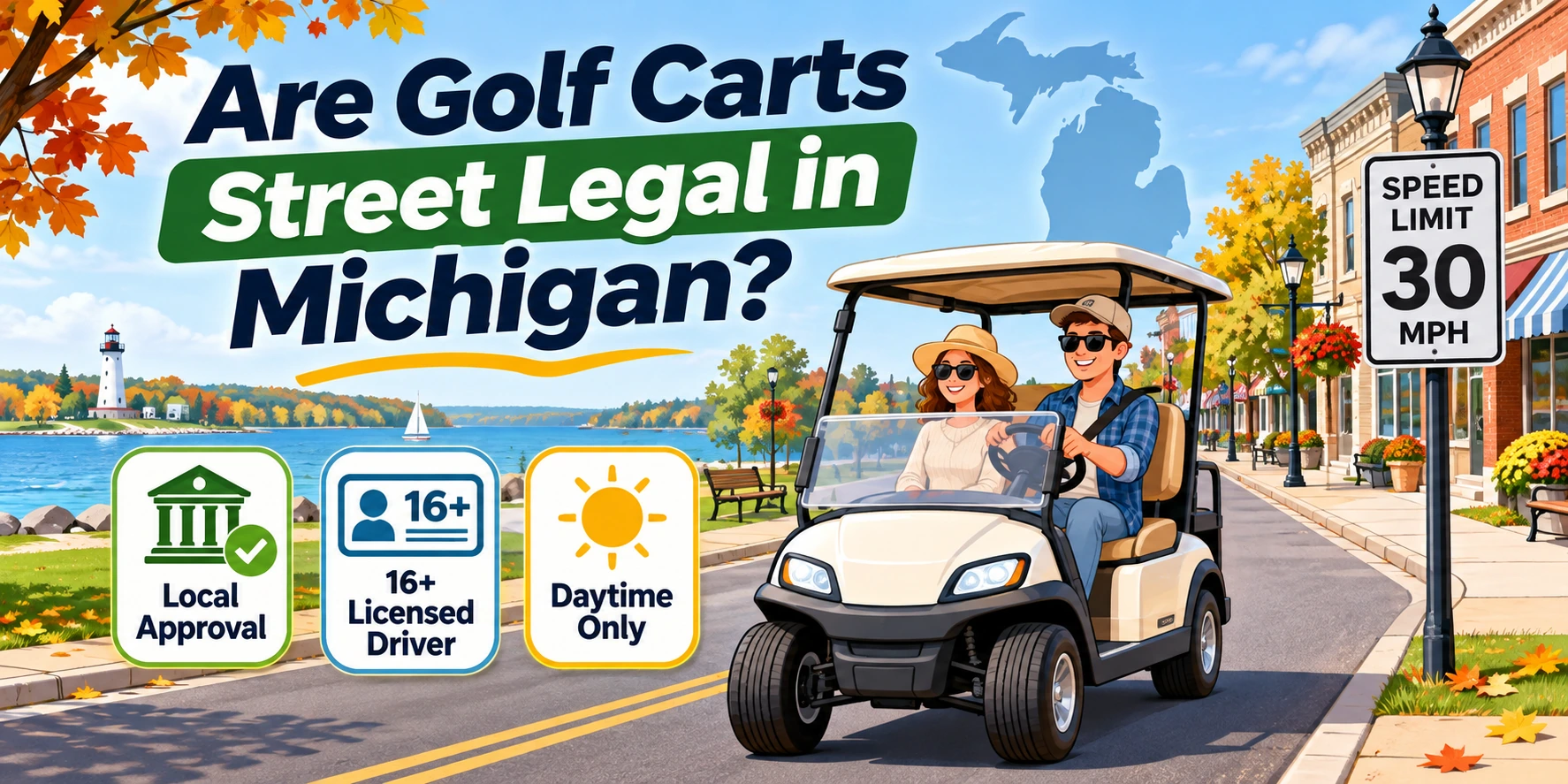
Michigan allows golf carts on some public streets, but only when state law and local authorization work together. A golf cart is not automatically legal simply because the road is quiet, residential, or located near a golf community.
Under Michigan law, qualifying local governments can adopt a resolution allowing golf carts on their streets. If your city, village, or township has not adopted such a rule, operating a standard golf cart on local public roads is generally not permitted.
This is why owners of Tara Golf Carts and other brands should verify local rules before assuming they can legally drive on public streets.
Michigan MCL 257.657a currently allows a city or village with a population of fewer than 30,000, based on the statutory census standard, to pass a resolution permitting golf carts on local streets. Eligible townships may also do so, subject to county-level provisions.
This means golf-cart legality is highly local. Two neighboring Michigan communities can have completely different rules even when their streets look similar.
A standard golf cart operating under Michigan’s local golf-cart statute may generally only use roads posted at 30 mph or less.
The golf cart itself may not be operated faster than 15 mph. Even on a 30-mph road, the golf cart remains limited to 15 mph under this statute.
Golf carts are generally not allowed to operate freely on Michigan state trunk line highways. However, current law contains a limited process that may allow a local government to seek MDOT authorization for certain non-interstate trunk line segments when specific connector or access conditions are met.
Golf carts may also cross certain roads where legally permitted, provided the crossing is made in the most direct manner possible.
| Requirement | Michigan Rule |
|---|---|
| Minimum Driver Age | 16 years old |
| Driver’s License | Valid motor vehicle driver’s license required |
| Maximum Golf Cart Speed | 15 mph |
| Permitted Road Speed Limit | Generally 30 mph or less |
| Operating Time | Daytime operation only under the statutory time restrictions |
| Road Position | Operate as near the right side of the roadway as practicable |
| Sidewalks | Not permitted |
| Traffic Signals | Applicable signaling requirements must be followed |
Michigan’s golf-cart statute restricts operation during nighttime hours. The law prohibits golf-cart operation from one-half hour before sunset until one-half hour after sunrise.
In practical terms, standard golf carts operating under MCL 257.657a should be treated as daytime-use vehicles on local public streets.
Local governments may impose additional restrictions, so drivers should check municipal rules even when their cart has headlights, taillights, and turn signals.
No. Michigan law specifically prohibits golf carts from being driven on pedestrian sidewalks.
This is important in communities where residents may assume that a golf cart can move onto the sidewalk when traffic increases. In fact, doing so can create both legal and pedestrian-safety problems.
A basic golf cart operating under MCL 257.657a is treated differently from a normal road-registered motor vehicle.
Michigan’s statute does not require the same standard state registration and no-fault insurance process for a golf cart being operated under the local golf-cart authorization framework.
Local municipalities may require golf carts or their operators to be recorded on a local list, but the statute does not allow the municipality to charge a fee simply for that listing.
A Low-Speed Vehicle is different. If the vehicle is legally classified and titled as an LSV, then title, registration, license plate, and insurance requirements apply.
Yes. Operating a golf cart on public roads does not create an exemption from Michigan’s impaired-driving or general traffic-safety laws.
Drivers should treat a golf cart as a vehicle whenever it is being operated on public streets. Driving while intoxicated, carrying an open container where prohibited, or ignoring traffic controls can result in serious legal consequences.
A number of Michigan municipalities have adopted golf-cart ordinances or local programs. Examples commonly associated with golf-cart access include:
This should be treated as an example list rather than a guarantee of current legality. Local ordinances can change, and some communities restrict golf carts to designated streets, neighborhoods, seasons, or times.
One of the most important distinctions for Michigan road use is the difference between a traditional golf cart and a Low-Speed Vehicle, commonly called an LSV.
| Feature | Traditional Golf Cart | Low-Speed Vehicle |
|---|---|---|
| Typical Maximum Road Speed | 15 mph under MCL 257.657a | Up to 25 mph |
| Road Speed Limit | Generally 30 mph or less | Generally roads posted at 35 mph or less |
| Local Authorization | Required under golf-cart statute | Operates under LSV and motor vehicle rules |
| Title and Registration | Generally not required under local golf-cart operation | Required |
| Insurance | Not the same registration-based requirement as an LSV | Required for road use |
| Safety Equipment | May depend on local rules | Must meet applicable federal LSV standards |
A standard golf cart cannot simply be modified and automatically treated as a road-legal LSV. Michigan Secretary of State guidance states that golf carts cannot normally be registered as on-road vehicles.
However, if the manufacturer’s certificate of origin confirms that the vehicle meets applicable federal on-road standards, it may be titled and registered as a Low-Speed Vehicle.
This makes manufacturer certification especially important. Lights, mirrors, seat belts, turn signals, and a 25-mph speed capability alone do not prove that a vehicle has the required federal road certification.
Tara offers several personal transportation models with features associated with road-oriented electric vehicles. Current Tara specifications list the Roadster 2, Roadster 2+2, and Explorer 2+2 with maximum speeds of about 25 mph, making them relevant to buyers interested in LSV-style operation.
However, whether an individual Tara vehicle can legally be titled and registered as an LSV in Michigan depends on its actual manufacturing certification, MCO, VIN, and compliance with federal road-use standards.
The Roadster 2 is a two-passenger lithium-powered vehicle with a listed maximum speed of approximately 25 mph. Tara also provides road-oriented equipment and a dedicated owner’s manual for its Roadster series.
The Roadster 2+2 provides four-passenger seating, a 48V lithium system, LED lighting, turn signals, hydraulic braking, and a listed maximum speed of 25 mph.
The Explorer 2+2 combines four-passenger seating with a 48V lithium system, hydraulic brakes, LED lighting, and a listed maximum speed of 25 mph.
Golf carts can be street legal in Michigan, but only where eligible local governments authorize them and drivers follow state requirements. Standard golf carts are generally limited to licensed drivers age 16 or older, speeds of 15 mph or less, daytime operation, and roads posted at 30 mph or below. Low-Speed Vehicles follow a different legal framework and require proper federal certification, title, registration, and insurance. Tara models such as the Roadster 2, Roadster 2+2, and Explorer 2+2 offer road-oriented features and 25-mph performance, but owners should confirm the exact MCO and Michigan LSV eligibility before driving them on public roads.
