
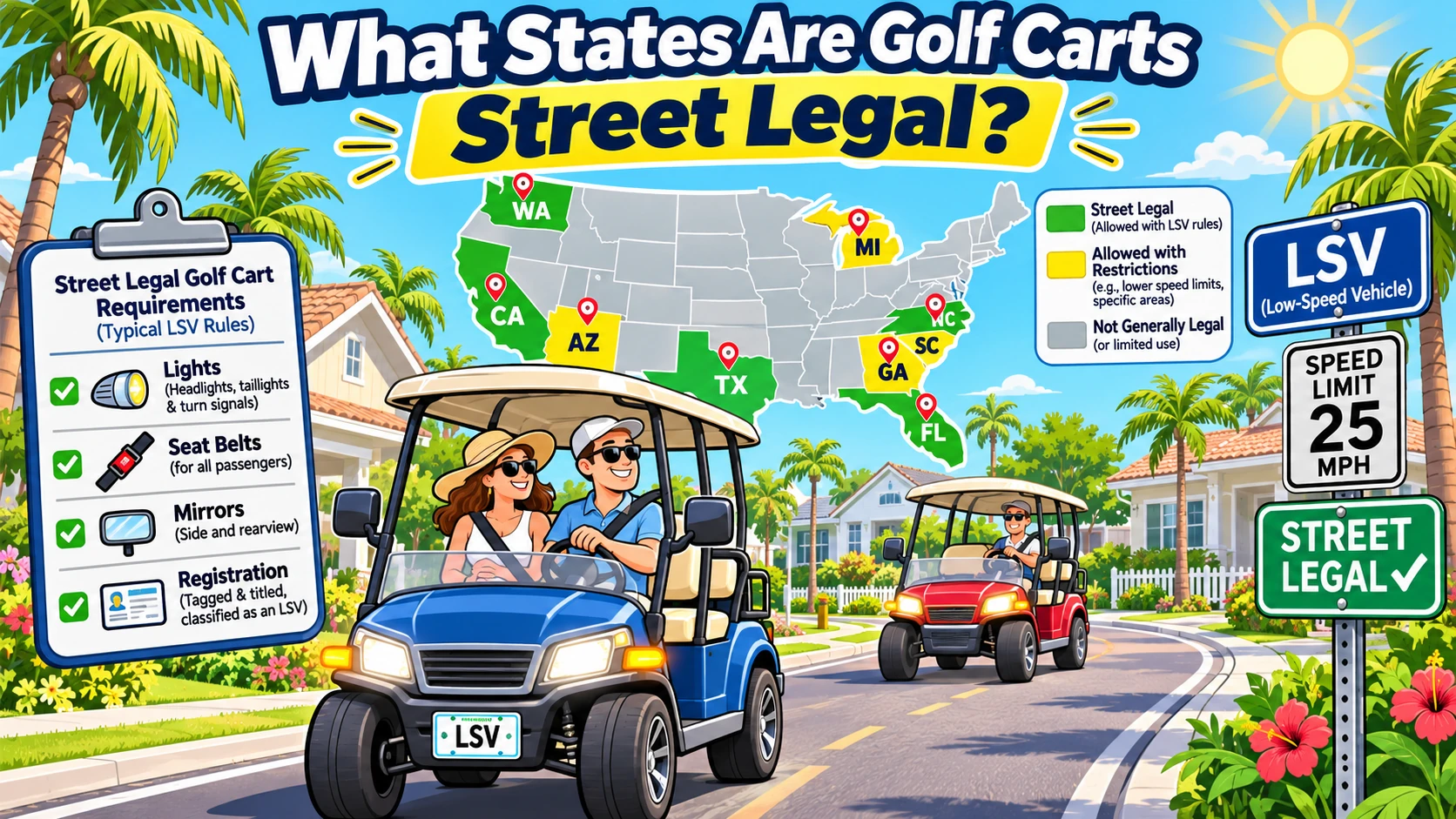
Golf-cart road legality in the United States is more complicated than a simple yes-or-no list of states.
Federal law establishes safety standards for Low-Speed Vehicles, but state governments decide how those vehicles may be registered and where they can operate. Cities, counties, towns, and villages may add additional restrictions.
As a result, a golf cart that is legal on a neighborhood street in Florida may not be legal on a similar road in another state.
Drivers should also distinguish between a conventional golf cart and an LSV.
| Feature | Standard Golf Cart | Low-Speed Vehicle (LSV) |
|---|---|---|
| Typical Maximum Speed | Usually below 20 mph | More than 20 mph but not more than 25 mph under federal definition |
| Federal Motor Vehicle Standard | Generally not manufactured to FMVSS 500 | Must meet FMVSS 500 |
| VIN | May not have a federal-compliant 17-digit VIN | Requires compliant VIN |
| Safety Equipment | Varies | Lights, turn signals, mirrors, windshield, seat belts, parking brake and other required equipment |
| Registration | Depends heavily on state/local law | Normally titled and registered under applicable state rules |
| Public-Road Access | Usually limited | Generally broader, but still limited by state and local laws |
Some states have relatively broad laws allowing golf carts on designated low-speed streets or allowing local governments to create golf-cart zones.
Florida is one of the most golf-cart-friendly states.
Standard golf carts may operate on roadways specifically designated for golf-cart use when the posted speed limit is generally 30 mph or less. Driver age and identification requirements also apply.
Registered LSVs are a separate category and must meet additional safety, registration and insurance requirements.
South Carolina allows golf-cart use under specific state requirements involving permits, insurance, distance limits and roadway conditions.
Local rules can also affect exactly where a cart may travel.
Texas allows golf carts in several specific situations, including certain master-planned communities, public or private beaches open to vehicle traffic, roads near golf courses and roads authorized by local governments.
A Texas Golf Cart license plate may be required depending on the situation.
Arizona and Georgia also have communities where golf carts and neighborhood electric vehicles are widely used on lower-speed roads.
However, drivers still need to check state classifications and individual municipal rules before assuming that every local street is open to golf carts.
| State / Group | General Approach | Main Consideration |
|---|---|---|
| Florida | Relatively permissive | Designated roads and local restrictions |
| South Carolina | Golf-cart road use permitted under specific conditions | Permit, insurance and operating restrictions may apply |
| Texas | Specific authorized locations and local roads | Golf Cart plate and equipment may be required |
| Arizona / Georgia | Many cart-friendly communities | Local authorization remains important |
| California | Golf carts and LSVs treated differently | Road speed and local authorization matter |
| Michigan | Local governments can authorize golf carts | Local resolution required for standard carts |
In many states, standard golf carts do not receive blanket statewide permission to use public streets.
Instead, state law gives local governments authority to decide whether golf carts may operate within their jurisdiction.
Michigan is a good example of this system.
Under current Michigan law, qualifying cities, villages and townships may adopt resolutions allowing golf-cart operation.
Where permitted, operators generally must be at least 16 and hold a valid driver’s license. Standard golf carts are limited to 15 mph and generally cannot operate on roads posted above 30 mph.
California also distinguishes sharply between standard golf carts and LSVs or NEVs.
California defines a conventional golf cart as a relatively lightweight vehicle designed for golf use with a maximum design speed of 15 mph. Such carts generally cannot use roads posted above 25 mph unless local authorization applies.
California LSVs and NEVs may travel up to 25 mph but are generally restricted from roads with speed limits above 35 mph.
Ohio, Illinois, North Carolina, Wisconsin and many other states also rely heavily on city, county or municipal ordinances to determine where standard golf carts may operate.
Some states provide much narrower road access for conventional golf carts.
In places such as Hawaii, Delaware, Maryland, Rhode Island and parts of Missouri, owners may encounter stricter limits on standard golf-cart use.
This does not necessarily mean every type of low-speed electric vehicle is prohibited. A properly manufactured and registered LSV may be treated differently from a golf cart.
For that reason, describing an entire state as simply “legal” or “illegal” can be misleading.
Federal FMVSS 500 requires LSVs to have specific safety equipment.
States may impose additional requirements involving registration, insurance, inspection and driver licensing.
A common misconception is that an LSV capable of 25 mph can automatically drive on any road posted at 35 mph.
Many states do permit LSV use on roads posted at 35 mph or below, but this is not a nationwide guarantee.
Local governments may impose tighter restrictions, and highways, freeways and interstates are generally off-limits to these vehicles.
Driver requirements depend on vehicle category and location.
Registered LSVs are treated much more like conventional motor vehicles and typically require a licensed driver.
Standard golf-cart rules vary more widely. For example, Florida applies special age and identification requirements, while Michigan requires operators using locally authorized public streets to be at least 16 and hold a valid driver’s license.
Federally compliant LSVs generally need title, registration and applicable insurance before road use.
Standard golf carts may follow different rules. Some states or municipalities require permits, registration stickers, plates or insurance, while others allow limited local operation without full motor-vehicle registration.
Owners should check their DMV or motor-vehicle department as well as local government regulations.
Tara Golf Carts offers golf-course vehicles as well as personal transportation models intended for neighborhood and road-oriented applications.
Tara currently identifies three models in its LSV-oriented lineup: Roadster 2, Roadster 2+2 and Explorer 2+2.
The Roadster 2 is a compact two-passenger personal transportation model powered by a 48V lithium battery.
Its smaller size makes it suitable for neighborhood transportation, resorts, communities and short local trips where the specific vehicle is certified, registered and legally permitted.
The Roadster 2+2 expands seating capacity to four passengers and is designed for broader personal transportation applications.
The rear seating configuration can be useful for families, residential communities and resort transportation.
The Explorer 2+2 also carries four passengers and combines personal transportation features with a lifted design.
Tara publishes road-oriented configurations in the approximately 25-mph LSV range, but buyers should confirm the exact vehicle’s federal certification label, VIN, state registration eligibility and dealer documentation before assuming it is street legal in a particular location.
Golf carts and LSVs can legally operate on public roads in many U.S. states, but there is no universal rule giving conventional golf carts unrestricted street access across all 50 states. Florida, Texas, South Carolina and several other states provide relatively broad golf-cart provisions, while states such as Michigan and California rely heavily on vehicle classification and local authorization. A properly certified LSV generally has broader road eligibility than a standard golf cart, and road-oriented models from Tara Golf Carts such as Roadster 2, Roadster 2+2 and Explorer 2+2 can be considered where local registration and road-use requirements are satisfied.
