
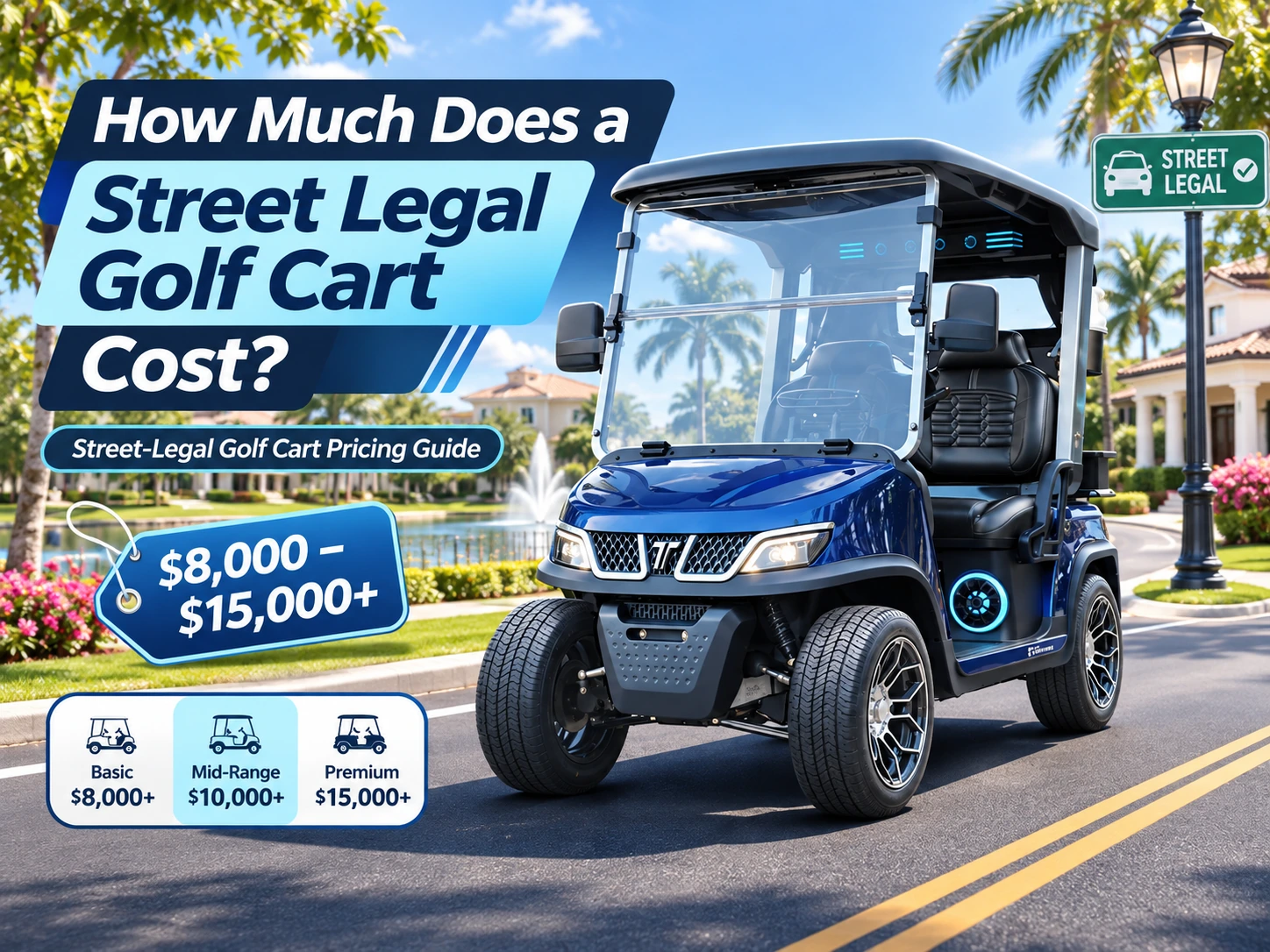
Street-legal golf carts usually cost more than standard course-only carts because they require additional safety equipment, road-oriented components, identification documentation, and federal or state compliance.
At the lower end of the market, some factory-built lithium LSVs are available for less than $10,000. Premium models from established brands can cost $15,000 to $20,000 or more, especially when larger lithium batteries, upgraded suspension, custom interiors, audio systems, larger wheels, or six-passenger configurations are included.
Used vehicles offer another option. A properly certified used LSV can often cost around $8,000 to $12,000, but battery health can dramatically affect the real value of the vehicle.
| Vehicle Type | Typical Price Range | What You Usually Get |
|---|---|---|
| Used / Pre-Owned LSV | $8,000–$12,000 | Older factory-built LSV or certified street-oriented vehicle; condition and battery age matter |
| Entry-Level New LSV | $9,000–$14,000 | Basic two- or four-passenger configuration with required road equipment |
| Mainstream New LSV | $14,000–$20,000+ | Lithium power, better seating, upgraded displays and comfort features |
| Premium / Custom LSV | $20,000–$30,000+ | Larger batteries, custom styling, lifted suspension, premium audio or six-passenger layouts |
A standard golf cart is primarily designed for golf courses, resorts, campuses, or private property. A true Low-Speed Vehicle is built for controlled public-road use and must meet additional federal safety requirements.
Under FMVSS No. 500, an LSV must include equipment such as headlamps, turn signals, taillamps, brake lights, reflectors, mirrors, a parking brake, compliant windshield, VIN, and seat belts.
These requirements increase production cost compared with a basic course cart.
Battery chemistry is one of the biggest pricing factors.
Lead-acid batteries generally have a lower purchase price, while lithium-ion batteries cost more initially. However, lithium batteries are lighter, require less routine maintenance, charge efficiently, and typically offer substantially longer cycle life.
For buyers who drive frequently, the higher lithium purchase price can make sense over several years of ownership.
A two-seat street-legal cart is usually less expensive than a four- or six-passenger model.
Additional seats often require a longer chassis, greater battery capacity, stronger suspension, and additional safety equipment. As a result, four-seat vehicles commonly cost more than equivalent two-seat configurations.
Features such as touchscreen displays, premium upholstery, lifted suspension, upgraded wheels, sound systems, GPS, storage accessories, weather enclosures, and custom paint can add thousands of dollars to the final price.
The phrase “street-legal golf cart” is commonly used in advertising, but the more important legal category is usually the Low-Speed Vehicle, or LSV.
Federal rules limit an LSV to a maximum speed of 25 mph and require specific safety equipment.
However, federal certification does not mean the vehicle can be driven on every public road. States and municipalities determine where LSVs may operate.
For most buyers who need reliable public-road eligibility, a factory-built and properly certified LSV is the safer choice.
Simply adding headlights, mirrors, turn signals, seat belts, and a faster controller to a conventional golf cart does not necessarily make it legally equivalent to a factory-certified LSV.
A genuine road-oriented vehicle should come with appropriate manufacturer documentation and a compliant VIN.
Used LSVs can provide excellent value, but battery condition is especially important.
A used lithium cart with a healthy battery may be a better purchase than a cheaper vehicle with a battery nearing the end of its service life.
Before buying a used street-legal golf cart, check:
Registration costs vary significantly by state and county. Taxes, title charges, license plates, inspection costs, and local administrative fees may also apply.
Insurance is another expense to include in the ownership budget. Because a registered LSV is a motor vehicle operating on public roads, applicable liability or other motor vehicle insurance requirements may apply.
Insurance premiums vary widely based on state, driver history, coverage limits, vehicle value, insurer, and local use, so buyers should request an actual quote rather than relying on one nationwide annual estimate.
For the right owner, yes.
A street-legal LSV can be practical for short trips in neighborhoods, gated communities, coastal towns, retirement communities, resorts, campuses, and other low-speed environments.
Owners can use them for local errands, community transportation, visiting neighbors, carrying passengers, or traveling between nearby amenities without using a full-size car for every short trip.
However, an LSV is not a replacement for a conventional car in every situation. It is best suited to predictable routes where road speeds are compatible with local LSV regulations.
Tara EV currently offers three road-oriented personal electric vehicle models that can appeal to buyers comparing factory-built low-speed transportation.
| Model | Seats | Battery | Maximum Speed | Listed MSRP |
|---|---|---|---|---|
| Roadster 2 | 2 | 48V 105Ah Lithium | 25 mph | $8,999 |
| Roadster 2+2 | 4 | 48V 160Ah Lithium | 25 mph | $9,695 |
| Explorer 2+2 | 4 | 48V 160Ah Lithium | 25 mph | $9,995 |
The Roadster 2 is the most affordable of the three listed Tara models, with an MSRP of $8,999.
It combines a compact two-passenger layout with a 48V 105Ah lithium battery and maximum speed of approximately 25 mph. This configuration is suitable for buyers who mainly need personal or two-person local transportation.
The Roadster 2+2 increases seating capacity to four passengers and uses a larger 48V 160Ah lithium battery.
Its listed MSRP is $9,695, making it an option for families, communities, resorts, and users who regularly carry rear passengers.
The Explorer 2+2 is another four-passenger model with a 48V 160Ah lithium battery and a listed MSRP of $9,995.
It provides a more rugged, adventure-oriented appearance while maintaining a road-oriented 25-mph configuration.
A street-legal golf cart typically costs about $9,000 to $20,000 or more in 2026, while used LSVs commonly fall around $8,000 to $12,000. Battery technology, seating capacity, safety certification, accessories, freight, registration, and dealer charges all affect the final price. For buyers comparing new lithium-powered options, Tara EV currently lists the Roadster 2 at $8,999 MSRP, Roadster 2+2 at $9,695, and Explorer 2+2 at $9,995, giving buyers several relatively affordable road-oriented configurations to consider.
