
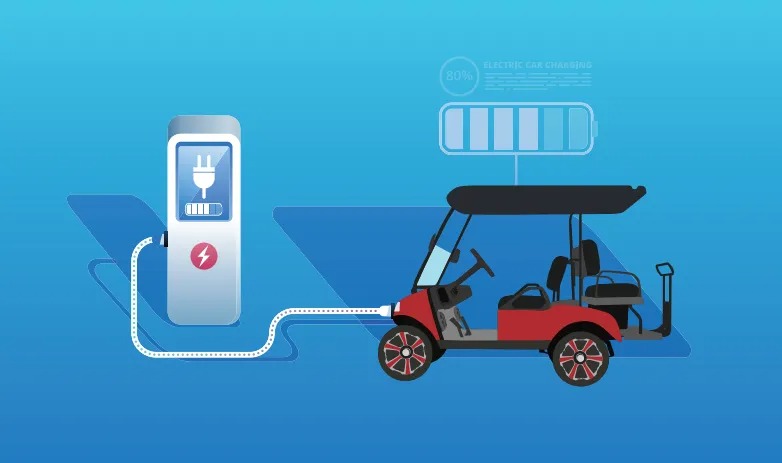
Charging a golf cart battery with a car charger is a practical temporary solution when the batteries are too deeply discharged for the regular golf cart charger to recognize them. This method can bring dead or very low batteries back to life so the proper charger can take over. While not a long-term fix, it is a useful technique for many owners facing unexpected power loss.
Golf cart batteries can become deeply discharged after extended storage, heavy use, or a forgotten charger connection. In these situations, the cart’s built-in charger may not detect the batteries or start the charging cycle. A standard car battery charger can provide the initial boost needed to raise the voltage enough for the golf cart charger to take over. This approach is especially helpful for lead-acid batteries that have sat unused for weeks or months. However, it should only be used as a short-term measure, and proper charging habits are essential afterward to protect battery health.
Before starting, park the cart on a flat, dry surface and turn it off completely. Wear safety glasses and gloves, as batteries contain acid and can release hydrogen gas. Work in a well-ventilated area away from open flames or sparks. Disconnect the negative battery cable first to prevent accidental shorts.
For safety and accuracy, disconnect the batteries from each other and from the cart’s wiring. This allows you to charge them individually or in smaller groups. Label the cables so you can reconnect them correctly later.
Use a 12-volt car charger set to a low amperage setting (2–10 amps). For 6-volt or 8-volt golf cart batteries, charge them in pairs or individually to match the charger’s voltage. Never attempt to charge a 48-volt pack as a single unit with a standard car charger.
Attach the positive (red) clamp to the positive terminal and the negative (black) clamp to the negative terminal of the battery or battery pair. Double-check polarity to avoid damage. Start the charger on a low setting and monitor the process closely.
Charge slowly until the voltage on each battery reaches at least 6.3V (for 6V) or 8.4V (for 8V). This may take several hours. Check the voltage periodically and stop if the battery becomes hot or starts to bubble excessively. Once the voltage is high enough, stop the car charger and reconnect the batteries in their original series configuration.
After the car charger has raised the voltage, reconnect the batteries and immediately plug the cart into its regular golf cart charger. Allow it to complete a full charging cycle. This ensures the batteries are properly balanced and conditioned for continued use.
Many owners make critical errors that can damage batteries or create safety hazards. Never charge multiple batteries in series with a car charger unless you are using a charger designed for that voltage. Avoid high-amperage settings that can overheat batteries. Do not leave the charger unattended, and always monitor temperature and voltage. Failing to disconnect the batteries before charging can lead to uneven charging or electrical issues. Finally, skipping the final proper golf cart charging cycle often leaves batteries unbalanced and reduces their overall lifespan.
Using a car charger to jump-start deeply discharged golf cart batteries is a useful temporary technique that can save time and frustration. By following the proper safety steps, disconnecting the batteries, charging carefully, and finishing with the correct golf cart charger, you can restore power safely and effectively. Consistent charging habits and timely maintenance will help your batteries last longer and perform better. For owners looking for modern, reliable carts with advanced battery systems, quality electric models from leading manufacturers offer excellent long-term value and convenience.
